Episode 73: What Made You An Agile Coach?

The Agile Revolution's avatarThe Agile Revolution Podcast

AgileCoachTony asks a philisophical question , whilst Renee harnesses her nineties pop star – Ice Ice Baby and Craig marvels at Tony’s  cool intro – probably the coolest intro he’s done since the eighties.

The Agile Revolution – 73 (54.21)

View original post

Episode 71: Essential Scrum with Kenny Rubin

The Agile Revolution's avatarThe Agile Revolution Podcast

KennyRubinAt Agile 2013 in Nashville, TN, Craig catches up with Kenny Rubin, author of “Essential Scrum” and Scrum trainer and coach at Innolution. While sitting in the corridor, they talk about:

TheAgileRevolution-71 (15 minutes)

View original post

Episode 70: Hello Is This Thing On?

The Agile Revolution's avatarThe Agile Revolution Podcast

IsThisThingOnCraig, Renee and Tony catch up again and discuss the wonderfully diverse world of Agile :

The Agile Revolution – 70  (65 minutes)

View original post

Episode 68: Together Again Like Peas & Carrots

The Agile Revolution's avatarThe Agile Revolution Podcast

peascarrotsCan you believe it ! Yes it’s a real Forest Gump moment, the revolutionists are finally back together again just like peas and carrots . They are back to their best discussing :

The Agile Revolution-68 (53 minutes)

View original post

Agile Encore 2013: Visual Management: Leading With What You Can See

AgileEncore2013My presentation from the Agile Encore 2013 conference called “Visual Management: Leading With What You Can See” is available on Slideshare.

Renee Troughton was unfortunately unable to join me to present this reprise of the talk we presented together at Agile Australia 2013.

Using task boards or story walls is a key Agile practice, but are you making the most of it? Visual Management is more than just putting cards on a wall, it is a growing style of management that focuses on managing work only by what you can see rather than reports or paper being shuffled around. Visual Management allows you to understand the constraints in the system, mitigate risks before they become issues, report on progress from the micro to the macro. Visual Management can also be used to demonstrate to customers and clients where the work they care about is at. This presentation is all about taking the management of your work to the next stage of transparency. Discover:

* How to identify when your story wall isn’t telling you everything and how to adjust it
* What the three different types of story walls are and which one is more suitable to certain circumstances
* Different ways to visualise your product backlogWhy queue columns and limiting work in progress is so important regardless of whether you are using Scrum or Kanban
* How symbols and tokens can be used to give more information
* What else can you use other than story walls to visualise information
* How to ingrain Visual Management into both the team and management structures of your organisation
* Visualising Your Quality, Testing and Team
* What is systemic flow mapping and why is it important

Unfortunately the talk was interrupted about three-quarters of the way through by a rogue video conference call into the auditorium. My attempt to try and answer questions why people were trying to fix the problem were interrupted by audio coming through the call. We soldiered on – but it interrupted the flow.

And here are some feedback from the feedback forms – much appreciated!

  • Lots of ideas
  • Very informative with real world examples
  • Delivered as per advertised. Was relevant and interesting to listen to. Some great take outs
  • More relevant to where we are as an organisation
  • Big wall
  • Most applicable as I am a newbie
  • Kept the audience engaged from start to finish
  • The task based techniques most relevant
  • Gave more understanding of how to do better Agile


Agile Australia 2013: Visual Management: Leading With What You Can See

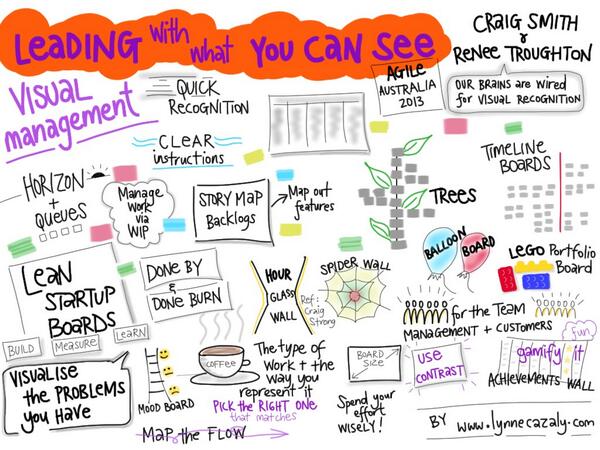
Agile Australia 2013 Speaker ButtonMy presentation with Renee Troughton from the Agile Australia 2013 conference called “Visual Management: Leading With What You Can See” is available on Slideshare.

Using task boards or story walls is a key Agile practice, but are you making the most of it? Visual Management is more than just putting cards on a wall, it is a growing style of management that focuses on managing work only by what you can see rather than reports or paper being shuffled around. Visual Management allows you to understand the constraints in the system, mitigate risks before they become issues, report on progress from the micro to the macro. Visual Management can also be used to demonstrate to customers and clients where the work they care about is at. This presentation is all about taking the management of your work to the next stage of transparency. Discover:

* How to identify when your story wall isn’t telling you everything and how to adjust it
* What the three different types of story walls are and which one is more suitable to certain circumstances
* Different ways to visualise your product backlogWhy queue columns and limiting work in progress is so important regardless of whether you are using Scrum or Kanban
* How symbols and tokens can be used to give more information
* What else can you use other than story walls to visualise information
* How to ingrain Visual Management into both the team and management structures of your organisation
* Visualising Your Quality, Testing and Team
* What is systemic flow mapping and why is it important

Lynne Cazaly did an awesome visualisation of the talk!

We had some great feedback from people after the talk as well as via Twitter.

Renee also has a (slightly earler) version of the slidedeck online via her Slideshare, with one slide change and one omission…

Brisbane Agile Meetup: Scrum Masters: The Full-Time Role Conundrum

MeetupMy presentation from the Brisbane Agile Meetup in May 2013 called “Scrum Masters: The Full Time Role Conundrum” is available on Slideshare.

A replay of the talk delivered by Craig Smith at the recent Scrum Australia gathering in Sydney

The Scrum Guide defines the Scrum Team as being made up of three primary roles: Product Owner, Development Team and Scrum Master. The role of the Scrum Master is often misunderstood, particularly by management, so often questions start to get asked such as “can I share the Scrum Master across teams”, “can the Scrum Master do Project Management” and “can the role be rotated”?

In this talk we will take a look at some of the misconceptions around the Scrum Master role, discuss how it fits into the organisational structure and tackle the age-old question of whether the Scrum Master is a full time role. We will also look at an improvement plan template to help Scrum Masters improve in their role.

Brisbane Agile

Here are some comments from Meetup:

  • Great presentation. Definitely good value (Gustavo)
  • Very good presentation. Good value. (Wilfred Brimblecombe)
  • Interesting subject, nice presso, Craig good value. Great presso, good job Craig. Also brill venue – good old Suncorp. (Derek Walsh)
  • Great presentation, thanks. (Chris Fortuin)
  • Impressive presentation, invaluable advice. (Carlos Augusto de Oliveira)
  • Craig did a great job putting together and presenting his scrum-master-view-of-the-world presso… (Juan)

Episode 56: Scrum Australia plus a Hint of Peas & Apples

The Agile Revolution's avatarThe Agile Revolution Podcast

Scrum Australia 2013Craig and Renee rendezvous in Sydney for Scrum Australia and clear the backlog for a way overdue podcast. Whilst Craig battled a cold and Renee a fit of giggles, they discussed:

View original post 37 more words

Scrum Australia 2013: Scrum Masters: The Full-Time Role Conundrum

Scrum Australia 2013My presentation from Scrum Australia 2013 called “Scrum Masters: The Full Time Role Conundrum” is available on Slideshare.

The Scrum Guide defines the Scrum Team as being made up of three primary roles: Product Owner, Development Team and Scrum Master. The role of the Scrum Master is often misunderstood, particularly by management, so often questions start to get asked such as “can I share the Scrum Master across teams”, “can the Scrum Master do Project Management” and “can the role be rotated”?

In this talk we will take a look at some of the misconceptions around the Scrum Master role, discuss how it fits into the organisational structure and tackle the age-old question of whether the Scrum Master is a full time role. We will also look at an improvement plan template to help Scrum Masters improve in their role.

Some of the comments from Twitter included:

Episode 47: $#*! Adam Weisbart Says