I attended the Brisbane Snowflake User Group meetup, hosted by Mantel on 26 August 2026 with some of my colleagues. The evening opened with a fireside chat (moderated by Snowflake’s Raj Sharma) on building a data literacy culture at Domino’s and rolling out Snowflake CoWork (Daria) to non-technical staff. Brad de Bruyns of Vivanti then demonstrated a code-first approach to Power BI development using Snowflake CoCo, showing how the shift to PBIP-format reports, Snowflake Semantic Views, and CoCo “Skills” enables version-controlled, AI-assisted report building governed by an OpenSpec change process and CI/CD pipeline. Snowflake’s Majid Miri and Yuqi Zheng closed out the evening with a broader rundown of Summit 2026’s announcements including the CoWork/CoCo rebrand, Horizon Context and Cortex Sense, AI Agent Identity, Apache Iceberg v3 reaching GA, and new ingestion tooling in OpenFlow and Datastream, framing them as the building blocks of a governed, agentic enterprise platform.
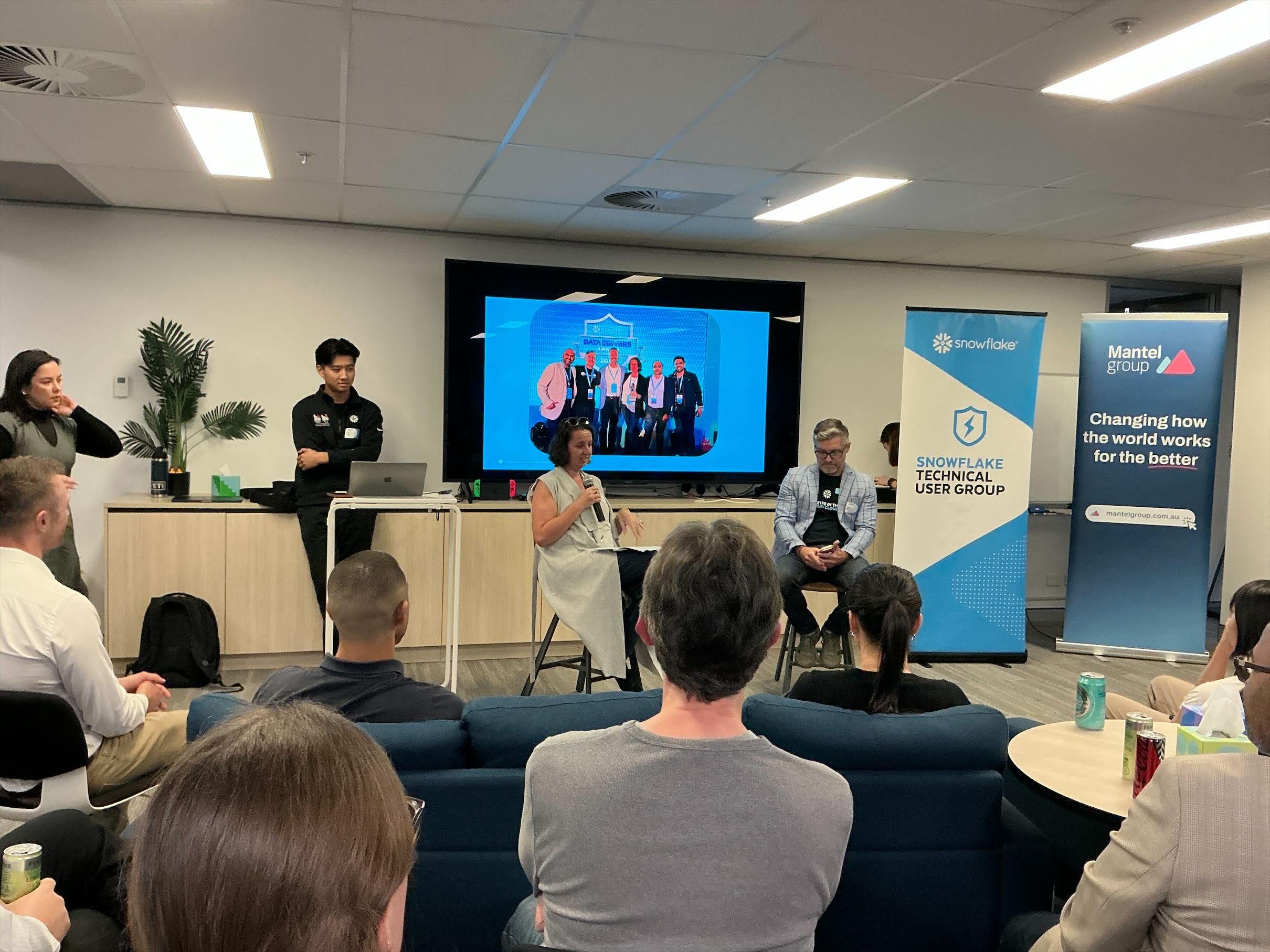
Innovations at Domino’s with Snowflake – Bianca Gilchrist – Domino’s
Bianca Gilchrist, Domino’s Data Literacy & Visualisation Lead and Snowflake Data Hero of the Year, spoke about building a data literacy culture at Domino’s and driving the rollout of Snowflake CoWork, branded internally as Daria, to non-technical staff.
“Every story, every report that we put out has to have a story behind it” – reports should read like an analyst’s narrative, not a grid of numbers
Run weekly “15-minute bites” sessions where staff watch live Q&A with Daria on calls – showing how easy it is to ask a question and get an answer, which then prompts a flow of similar questions from the team over following days
Wrote two data literacy books for children: “the A to Z of data“ and “The Australian Data Story“, and is developing a schools program with Snowflake to bring young kids into the data field
Three pillars of data literacy: accessibility (can people find the data), usability (what can they do with it), and storytelling
Marketing data internally – relentless, visible promotion (Viva posts, being put in front of every group) is essential to getting data trusted and used
One of the biggest recurring business questions the agent gets used for: when a limited-time offer or new product launches, is it cannibalising sales from other products – this previously took a Business Analyst half a day to a week to answer in Power BI, now answered by Daria in minutes
You need to show a working model quickly, since people can’t visualise an idea from a description alone
Had to explicitly instruct Daria to be more pessimistic — it was originally overly optimistic (e.g. overstating cost savings), so instructions were added to correct this and avoid dollar-figure recommendations, and to only make recommendations in the voucher area, not financial matters
Staff are given daily prompt limits partly to control cost, but also to keep people using the core “gold standard” Power BI reports for standard metrics, ensuring the numbers people see match what the CEO sees
Cost and usage limits are a live tension, staff loved unlimited prompts for two months and pushed back hard on new daily caps
Future focus is to get the AI agent to redirect simple, reportable questions back to the core Power BI reports, and expanding into specialised sub-agents
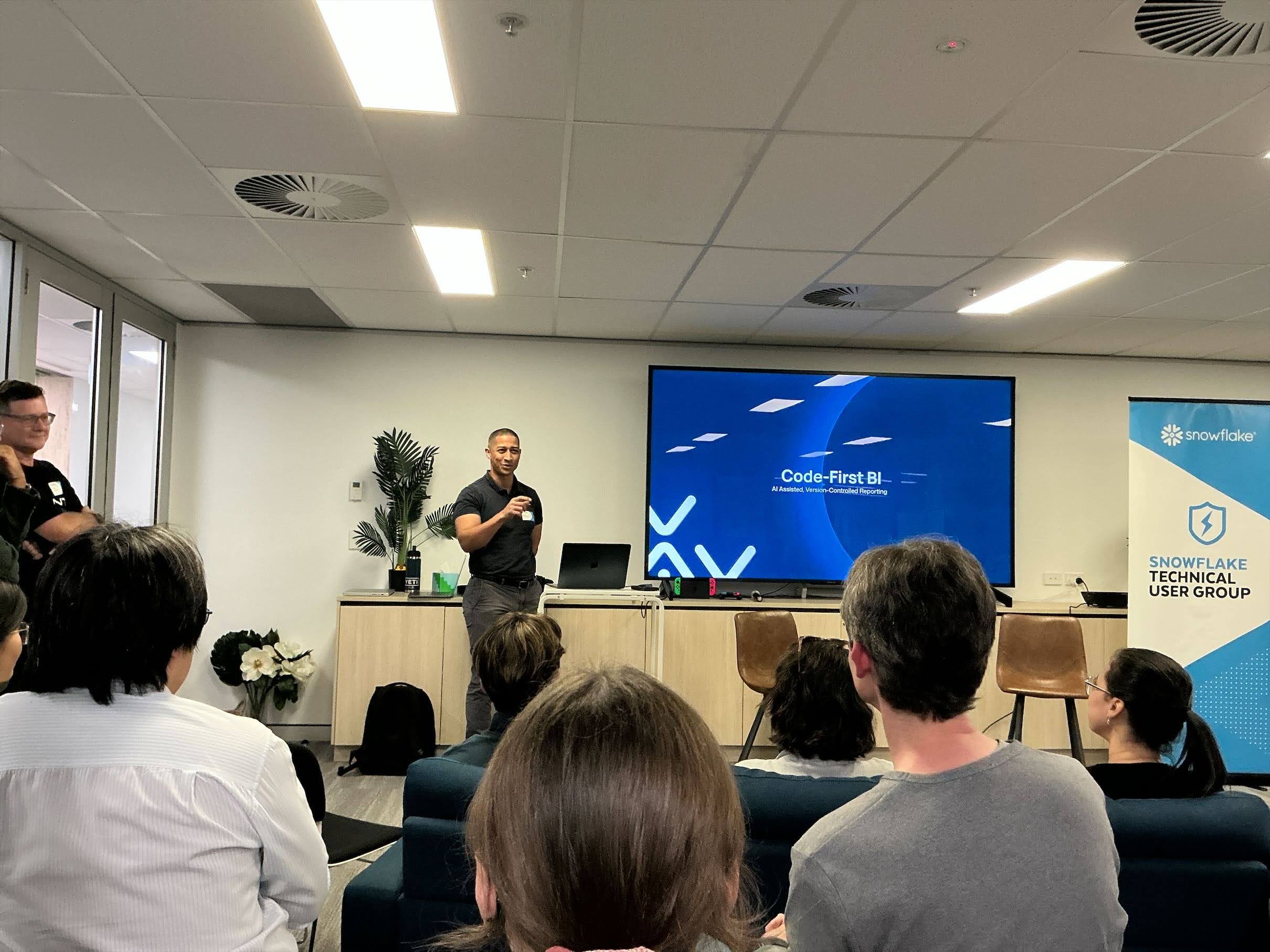
Power BI Report development with Snowflake CoCo – Brad de Bruyns – Vivanti
Brad de Bruyns, Senior Consultant at Vivanti (and a former Domino’s colleague of Bianca’s), demonstrated a code-first approach to Power BI development using Snowflake CoCo, showing how AI can turn report-building into a version-controlled, code-based workflow rather than manual clicking in binary files.
The traditional Power BI PBIX format is opaque and can’t be diffed, whereas the newer PBIP format exposes reports as text so it is version-controllable, diffable, and peer-reviewable in Git
Snowflake Semantic Views were used as the single source of truth for metrics, shared across both CoWork (formerly Snowflake Intelligence) and Power BI
Demonstrated CoCo “Skills” baked directly into the repository – encoding branding, DAX standards, layouts, and complex JSON so AI-generated reports and measures come out brand-compliant and consistent every time
Walked through a live OpenSpec demo: a plain-English request (“add a detailed credit consumption by type page”) was turned into a structured Propose > Explore > Apply process, generating a proposal, design doc, and task list before any changes were made
Deployment ran through a disciplined Azure DevOps CI/CD pipeline, validating and deploying automatically across Dev, Test and Production
Underlying agent is CoCo, essentially Claude-like – any Claude-style skills apply the same way
The Power BI semantic model and the Snowflake semantic view are currently separate but kept in sync via the same underlying spec with a further skill able to uplift a Power BI model into a semantic view
Manage multiple reports / workspaces in one repo (config-driven via subfolders and deployment targets)
Started from screenshots / Figma mockups instead of specs and outputs remain fully manually editable afterwards, since it’s still a standard Power BI file underneath
Less time memorising palettes and file structures, more time on the data modelling and insights that actually matter
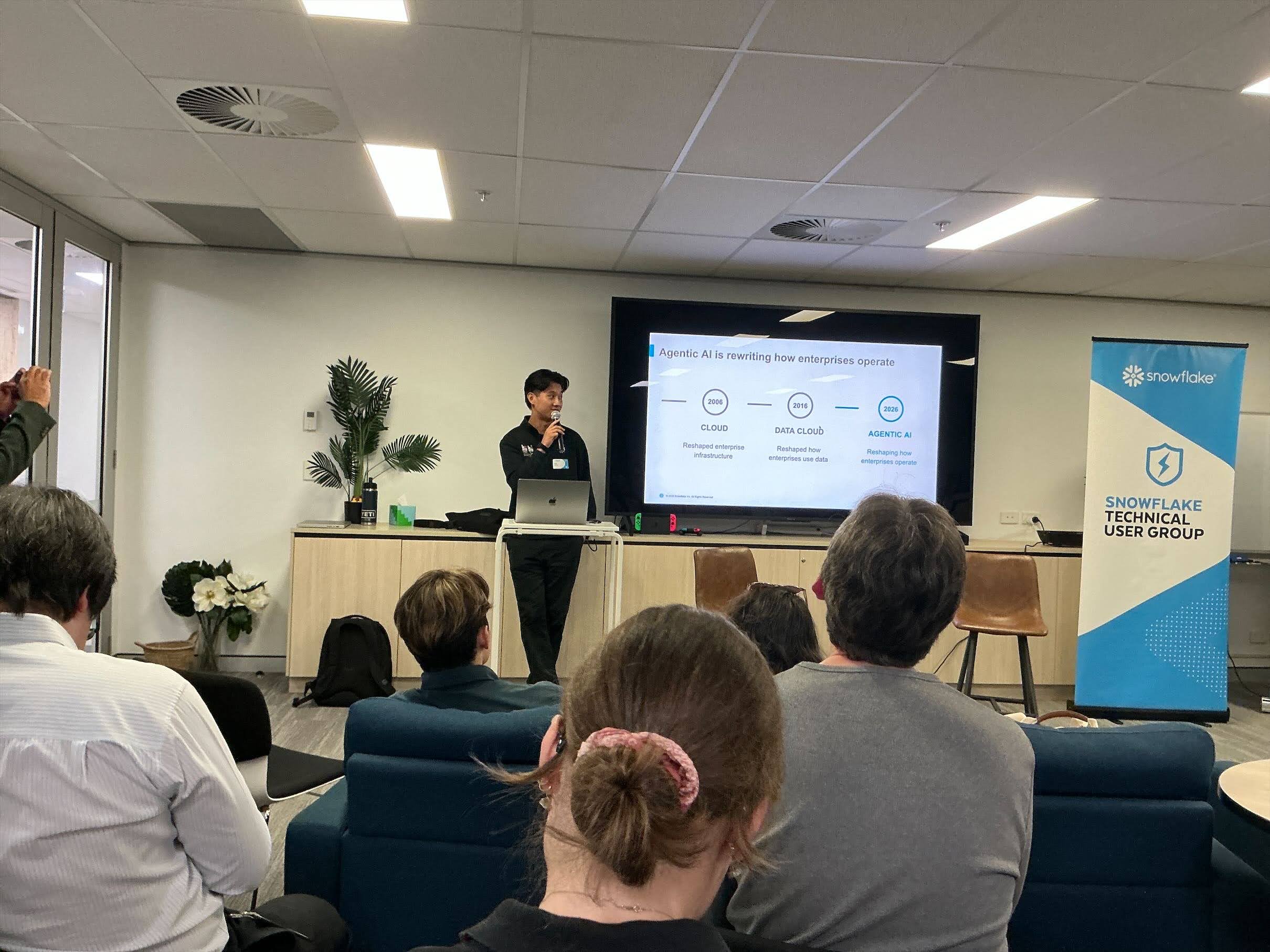
Majid Miri (Senior Solution Engineer) and Yuqi Zheng (Associate Solution Engineer) closed the evening with a rundown of Snowflake Summit 26 announcements, framed around the theme of the “agentic enterprise” and what’s needed to scale AI safely across an organisation.
CoWork and CoCo rebrands: Snowflake Intelligence is now CoWork, the agent for business users; Cortex Code is now CoCo, the builder’s agent — both reaching a wider surface (desktop, mobile, Slack) since launch
Horizon Context and Cortex Sense: supply governed business context and definitions to agents, aiming to eliminate the cold start problem of enterprise AI needing weeks of manual semantic modelling
AI Agent Identity: gives every agent a verifiable, cryptographic identity and a complete audit trail, distinguishing agent-driven queries from human ones for access control purposes
Apache Iceberg v3: reached general availability, with broad support for new data types, cross-system change tracking, and high performance on semi-structured data paired with Snowflake-managed Iceberg storage to cut operational overhead
OpenFlow and Datastream: managed data ingestion, OpenFlow for extract/load workflows with new connectors, Datastream as a new Kafka-compatible managed streaming service with separated storage/compute scaling
Control plane for a governed agentic enterprise – the connective layer of data, context, identity, and governance needed to run AI safely at scale
Gartner predicts that by 2028 the average Fortune 500 company will have over 150,000 agents, underscoring the need for centralised governance and observability
Deepened partnership with Anthropic, with Claude positioned as the default reasoning layer underneath both CoWork and CoCo
This report summarizes how the InfoQ Culture and Methods editorial team sees the ongoing and emergent trends in the culture and methods space in 2026.
AI adoption demands maturity frameworks that assess risk and context, and organisations must be honest about what they are actually trying to achieve with AI in their specific circumstances.
Collaboration patterns are changing fundamentally: Teams are shrinking, roles are blurring, and the question is no longer how to structure teams but how to make collaboration more effective in whatever form it takes.
The explosion of AI-generated code demands entirely new processes for quality, cognitive load management, and accountability.
Organizations that failed to embed agile fundamentals face catastrophic risk with AI adoption; fast feedback loops, reflective learning, observability, and shipping the right value to the right users remain as critical as ever.
Engineers are shifting from contributors to custodians: The defining future skill is not writing code but effectively directing, validating, and building guardrails around AI agents.
The industry must confront the environmental costs of AI usage, the erosion of diversity of thought from homogenized agent outputs, and the accountability gap when no individual fully owns AI-generated systems.
It’s the gap between the good and the not so good and the haves and the have-nots. Some organizations have embraced this and ran with it, but there are many organizations… they never really made the leap to agility practices in the twenty-five year span that we had in order to do that. And now they’re trying to adapt to these new practices and still building it on organizations that are still tending software’s being built in 1995.
This is the Engineering Culture Trends Report for 2026. Featuring a panel of QCon speakers and InfoQ contributors, they discussed AI adoption maturity and risk.







You must be logged in to post a comment.