Innovate Australia 2024

Innovate Australia is an event that brings together government in Canberra and showcases innovation that is happening between government and industry and this year it was held on May 29 alongside the Australian Cyber Security Showcase.

Innovate Australia is an event that brings together government in Canberra and showcases innovation that is happening between government and industry and this year it was held on May 29 alongside the Australian Cyber Security Showcase.

SoftEd / Skills Development Group had a presence as a partner and a stand in the partner area.

My colleague Andy Cooper run a thought experiment ahead of the conference: using AI to review the content of the conference.

Main themes from the Innovate Australia Conference:

  • Emerging technologies and innovation, including AI, cyber, and quantum technologies, and their progression within the APS. 
  • Digital transformation and simplicity, focusing on designing smart, simple, and connected services to meet citizen expectations. 
  • Workforce strategy and skills, addressing the skills gap, predicting demand, retaining talent, and developing an agile and collaborative workforce. 
  • Data strategy and analytics, including generating and executing progressive data strategies and uplifting capabilities across organizations. 
  • Customer experience (CX) and user-centricity, leveraging AI and automation to enhance personalization and streamline services. 
  • Privacy, trust, and regulation, addressing emerging gaps in existing laws and safeguards to protect the public.

The conference had a number of great sessions and insights into what is currently happening in Canberra and the public sector. Here are some notes and highlights from the sessions I attended.

Foreword:

  • The report celebrates innovation in public services, spotlighting over 50 individuals committed to citizen-centricity and transformative leadership.
  • It aims to foster collaboration by connecting innovative thinkers across the public sector through Public Sector Network’s platform and events.

Introduction:

  • Global trust in government is declining due to misinformation, economic and security concerns, and COVID-19 aftereffects.
  • The report emphasizes the importance of rebuilding public trust through effective, accessible, and inclusive services.

Key Innovators and Projects:

  • Fawad Abro (Australia): Led a large data transformation program at the Australian Taxation Office, emphasizing the importance of leadership culture and people’s capabilities.
  • Rod Apostol (Australia): Transformed the Victorian Ombudsman into a data-led organization to improve decision-making and service delivery.
  • Amrita Bhattacharyya (Australia): Played a pivotal role in the COVID-19 response in Victoria, focusing on data and analytics for testing and vaccination.
  • Kurt Brissett (Australia): Introduced contactless transport payment systems in NSW, significantly improving customer experience.
  • Eloise Burge (Australia): Led the South Australian government’s One Stop Shop initiative to simplify and improve access to government services.
  • Simon Cleverley (Australia): Advanced digital health capabilities to improve healthcare outcomes and service delivery across Australia.

Global Perspectives:

  • Trust: Innovators emphasize the critical role of trust in government, advocating for transparency, accountability, and citizen engagement to rebuild trust.
  • Culture: The importance of a positive organizational culture is highlighted, with leaders encouraging continuous improvement and recognizing employee contributions.

Conclusion:

The report aims to inspire public sector professionals to embrace innovation, prioritize citizen needs, and work collaboratively to overcome challenges and improve public trust.

These highlights capture the essence of the report, showcasing the dedication and impact of public sector innovators in enhancing government services and rebuilding trust with citizens.

  • Need for ethical AI leadership
    • 40% of Australians have used AI in last 12 months
    • 55% support government using AI extensively
    • 92% want struct government regulation on AI systems
  • Digital ID
    • 73% of Australians have a myGovID, 91% had a positive experience and 83% find it trustworthy
  • Citizens Insight Hub – Publicis Sapient – 2024 Report coming soon
    • ChatGPT Summary: The 2023 Digital Citizen Report highlights the evolving landscape of digital government services in Australia and the changing expectations of its citizens:

Increased Use of Digital Services:

  • More Australians are using digital government services, with MyGov, healthcare, and finance being the most popular.
  • Citizens want more digital services, particularly digital voting, mental health services, and digital driver’s licenses.

Digital Identities and Privacy:

  • Most Australians use digital IDs and wallets, but privacy risks hinder wider adoption.
  • There is significant concern over data privacy, with many citizens wary of providing personal information online.

Access and Inclusivity:

  • Minority groups and older Australians desire better access to digital government services.
  • There is a digital divide, particularly affecting rural and vulnerable populations.

Emerging Technologies:

  • Australians are enthusiastic about emerging technologies like AI, VR, XR, and Web 3.0 and want to be digitally equipped.
  • The government is leveraging these technologies to improve service delivery and economic prosperity.

Mental Health Services:

  • There is a growing uptake in digital mental health services, especially among younger generations and those in rural areas.
  • Mental health issues are on the rise, with a significant portion of the population seeking online support.

Economic and Social Impacts:

  • Digital literacy is seen as critical for employment, with many citizens recognizing the need for additional training and skills.
  • Technological advancements are both a perceived threat and an opportunity for job security.

Government Initiatives:

  • The Australian Government aims to be one of the top three digital governments by 2025, driven by an accelerated path of digital transformation.
  • Investments in digital infrastructure and inter-agency collaboration are key to expanding digital inclusion and trust.

Citizen Sentiment and Feedback:

  • Citizen feedback highlights the need for more personalized and user-friendly online experiences.
  • There is a strong demand for expanding digital services to support key life events, such as births, marriages, and new jobs.

Barriers to Digital Adoption:

  • Concerns over data privacy, digital literacy, and access to technology are significant barriers to wider digital adoption.
  • Addressing these barriers is crucial for improving citizen trust and engagement with digital government services.

The report underscores the importance of continuing to evolve and improve digital government services to meet the growing and changing expectations of Australian citizens.

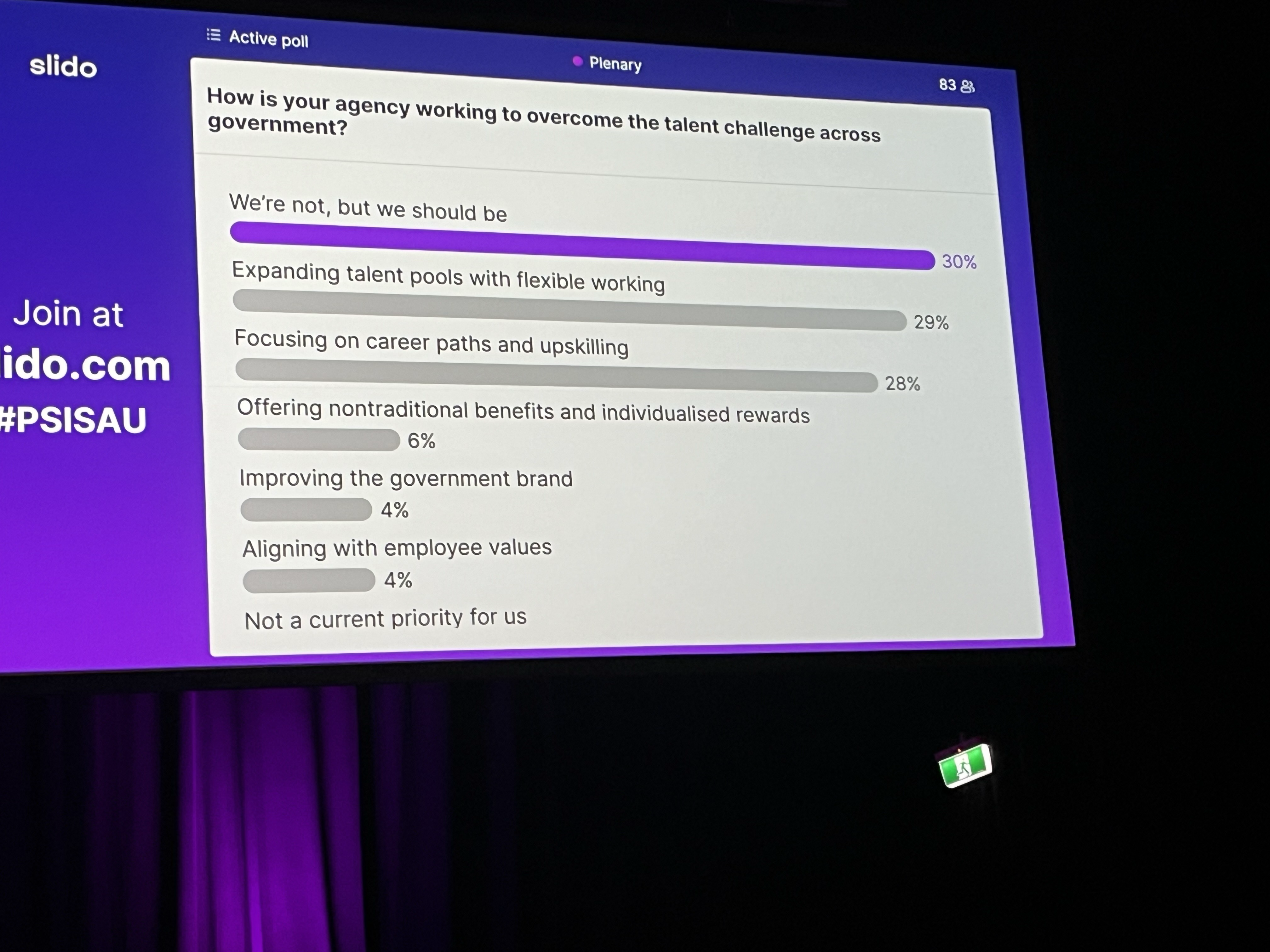
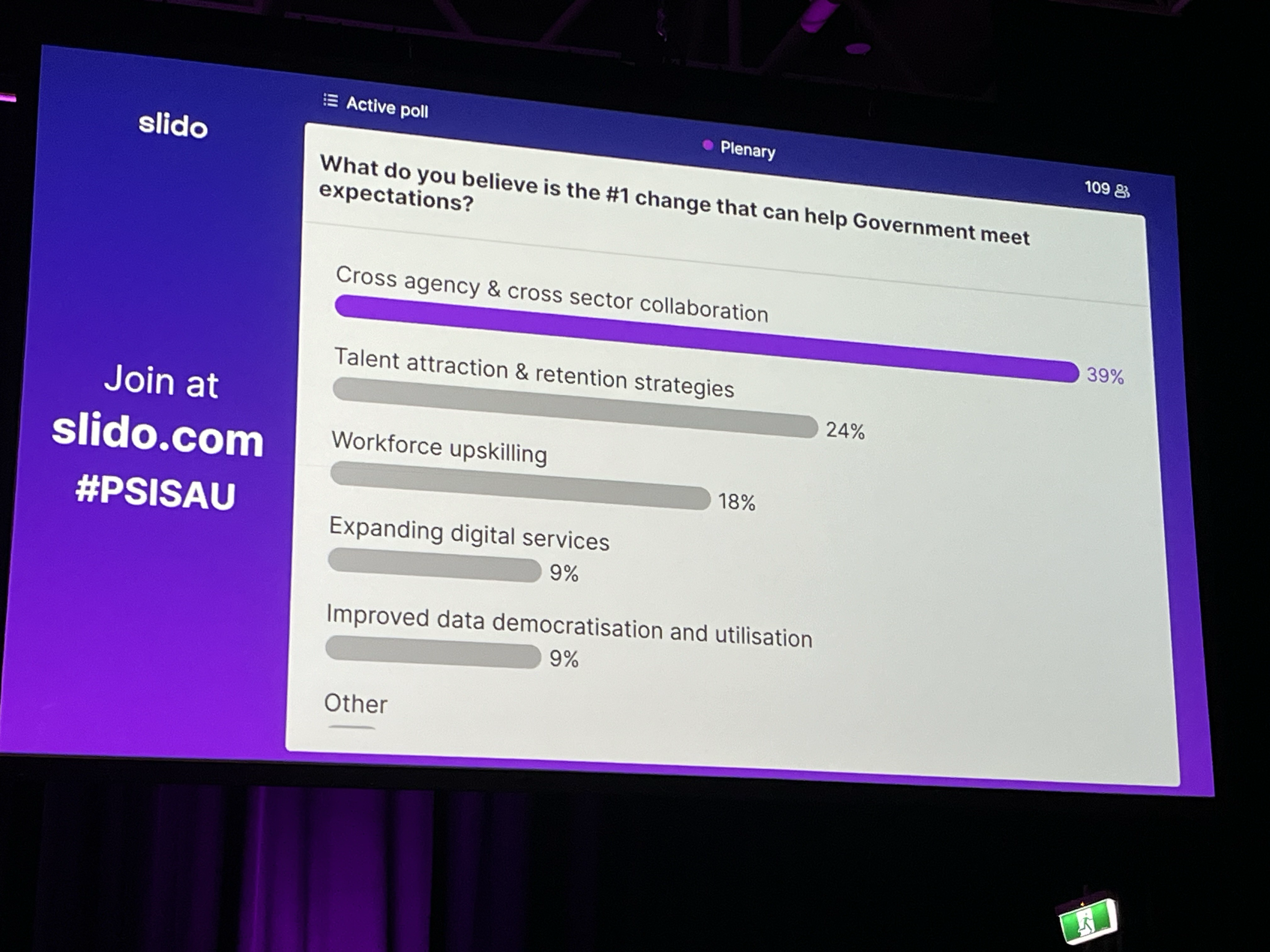
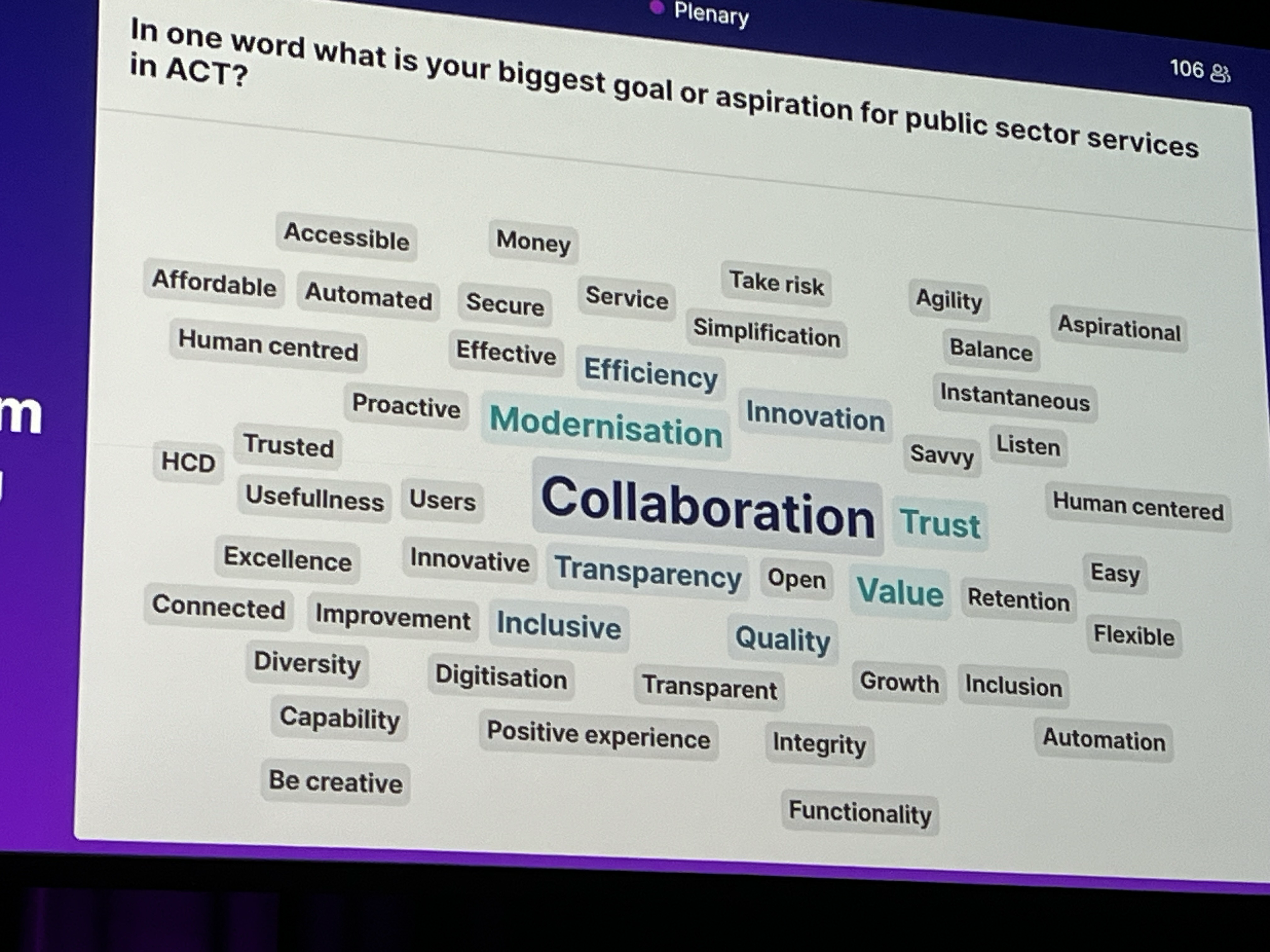
These were some polls of the audience at the start of the day:

Modern Service Delivery – David Hazelhurst – Services Australia

  • 10 million interactions a week, 90% digital
  • 15-20 million malicious attempts per week
  • Take down 360 fake myGov sites per week!
  • Observations after 5 months in the job
    • Extremely purpose driven organisation
    • Scale and leadership – some branch heads have 2,000 staff
    • Diverse and connected to their communities
    • Safety – up to 12 serious aggression reports per day
  • Modern Service Delivery
    • Simple, helpful and offering service, respectful and transparent
    • Need to help people get on with things
    • There is a digital divide so need choice
    • Being proactive – what else do people need
    • Efficient back of house – support and train staff, deliver a great experience
  • AI
    • Ambitious about technology and AI (despite Robodebt) as it allows us to spend times with more customers
    • Needs to be done in a way that builds trust – needs to be radically transparent
    • Establishing an ethics committee – understandable how the system works and a human in the system
    • Already experimenting with CoPilot in back of house
    • Using generative to AI to help with forms and how we explain what we do
    • Using AI to optimise the queues at National Operations Centre
  • Need an attitude of being humble and curious, bringing the outside in (those that have an interest, experience, consultation) and need to get out of Canberra and have a deep understanding of the business at the frontline

APS Priorities – Chris Fechner – DTA

  • New iteration of Digital Service Standard
  • Digital Identity
  • Responsible use of AI
    • Working across government about usable, safe and trustworthy, been working on this for over a year
    • Collaborating with all states on responsible use of AI
    • NSW AI Assurance Program
  • Improved Service Delivery
    • Service Agents using AI
    • Hyperpersonalisation so service delivery can be proactive – “creepy to cool” as things become more accepted
  • Industry + Government
    • ACS on skills, AIIA, Tech Council of Australia relationships around capability
    • Data, Cyber, Digital – need to build our sovereign capability
    • DTA has about 3,500 vendors, majority are SME
    • Need to grow indigenous businesses

Vision for Simple, Sophisticated and Trustworthy Public Service – APSC / Geoscience / DSS

  • Focus on the customer is a good basis to build trust
  • Emerging technologies – APSC undertakes long term insights briefings – legislation just passed
    • People who use services expect government to use AI, has to be used to improve service delivery
    • Has to be empathy when people need it (a human the loop)
    • Transparency is key on how and when you are using these technologies
  • Digital Atlas of Australia – Geoscience Australia – place based policy making, 175 trusted datasets curated across government, Google Maps on steroids, open and free to all citizens
  • Manage speed, privacy and trust
    • Start with people not the tech – how do we build that capability across the entire APS
    • Targeting Entrenched Disadvantaged Package – place based approach
    • How do we support APS to do genuine partnerships better eg. serving First Nations
    • Need to move from technocratic to relationship government
    • Cultural capability – engage and listen deeply across different cultures and ways of thinking
    • Shared responsibility – shared decision making, flexible pools of funding, shared risk
    • Capability to partner well with the community
    • Reuse of existing investments such as Digital Data Atlas
  • Front-end simple and back-end complex, government will never be simple it is highly complex
  • Misinformation and disinformation

Incremental Innovation – Ramah Sakul – SAP

  • Ongoing consistent enhancements to software eg. eTax software > prefilling > cloud based prefilling tax return
  • Incremental innovation across people, process, technology and data
    • Digitise process, automate the process, augment the process
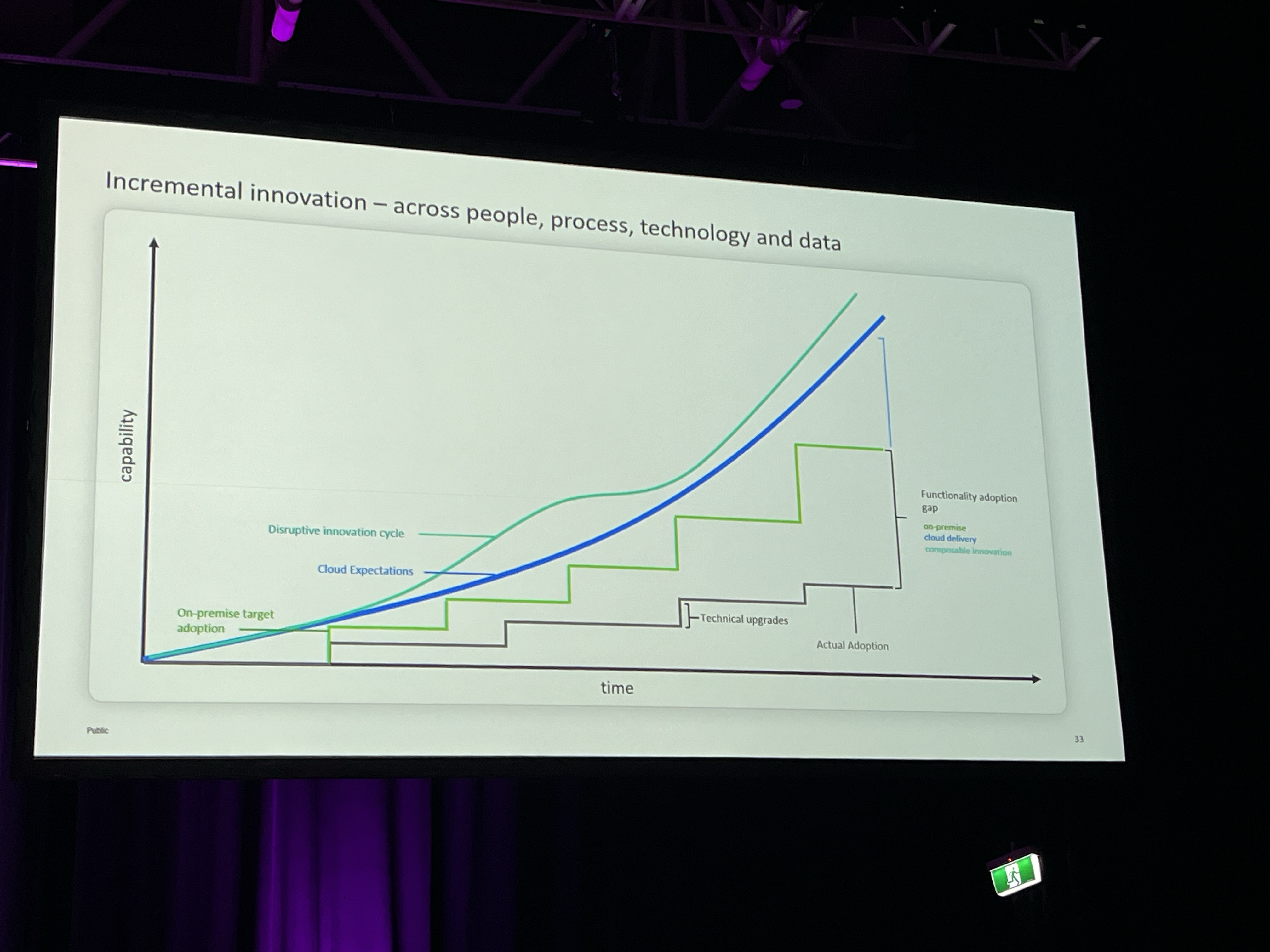
  • Technical debt is holding back government for incremental innovation

Understanding Technical Debt:

  • Technical debt (tech debt) is an implied cost of future refactoring due to using suboptimal solutions to meet immediate needs.
  • It is different from obsolescence or depreciation but can be highly disruptive and costly.

Survey Insights:

  • A survey of 750 executives revealed that nearly all acknowledge tech debt as a risk.
  • 46% of IT executives report that tech debt significantly hinders digital transformation and growth.

Types of Organizational Debt:

  • Tech debt includes infrastructure, applications, UX, data, process, and knowledge debt.
  • Each type of debt contributes to the overall challenges in maintaining and modernizing IT systems.

Impact of Technical Debt:

  • Tech debt limits an organization’s ability to adapt, innovate, and pursue digital transformation.
  • Examples include system failures and inefficiencies in crisis situations, such as outdated airline scheduling apps and federal aviation systems.

Reframing Technical Debt:

  • The report advocates for viewing tech debt as part of the modernization process.
  • Modernization efforts should be continuous and involve the entire organization, not just IT.

Modernization Strategies:

  • Organizations should focus on understanding and addressing tech debt through modernization.
  • Key strategies include adopting Agile practices, enhancing flexibility, and improving governance and performance management.

Four-Step Plan to Address Tech Debt:

  • Reframe Tech Debt: Recognize it as a modernization issue and involve executive leadership.
  • Define Opportunities: Conduct an honest inventory of the tech estate and set clear objectives.
  • Clear Barriers: Focus on knowledge capture, adaptability, and stakeholder management.
  • Organize for Execution: Foster collaboration across departments and prioritize modernization efforts.

Industry-Specific Insights:

  • The report provides insights into how different industries, such as financial services, healthcare, and public sector, are addressing tech debt.
  • Common challenges include legal, regulatory, financial, and cultural barriers.

Desired Outcomes of Modernization:

  • Improved operating margins, increased revenue, and enhanced employee satisfaction are top priorities.
  • Modernization also aims to improve security, flexibility, and overall business agility.

Case Studies and Examples:

  • The report includes case studies from various industries to illustrate the impact of tech debt and the benefits of effective modernization.
  • Examples include the modernization of e-commerce systems for a retailer and cloud migration for a health insurer.

Overall, the report emphasizes the importance of recognizing and addressing tech debt through a comprehensive and collaborative approach to modernization, involving all levels of the organization and focusing on both short-term fixes and long-term strategic improvements.

  • SAP believes SaaS sits at core of addressing technical debt while enabling incremental innovation – means maintenance is built in, as well as new capabilities
  • Question on moving to SaaS is when and how, not if

Next Phase of AI, Digital and Emerging Technologies – ANU / DITSR / Finance

  • Need to strike the right balance to get innovation, putting legislation in place for digital ID over last 12 months (but been in consultation for 8 years!)
  • Digital ID – voluntary but makes life easier
  • KPMG Trust in AI report
    • Australia had the biggest divide on trust vs non-trust
    • ChatGPT summary: The “Trust in Artificial Intelligence: A Global Study” report includes specific insights about Australia regarding public trust and acceptance of AI. Here are the key points focused on Australia:

General Trust and Acceptance:

  • Australians have relatively low trust in AI, with only 34% willing to trust AI systems.
  • Acceptance of AI is similarly low, with just 20% of Australians reporting high acceptance of AI systems.

Emotional Responses:

  • Australians exhibit mixed emotions towards AI. While some feel optimistic and excited, a significant portion also feels worried and fearful.
  • Fear and worry about AI are dominant emotions in Australia, with many citizens expressing concern over the potential risks associated with AI technologies.

Perceived Benefits and Risks:

  • Australians recognize the potential benefits of AI, particularly in terms of improved efficiency, innovation, and effectiveness. However, they are less convinced that these benefits outweigh the risks.
  • The primary concerns for Australians include cybersecurity risks, privacy issues, job loss due to automation, system failure, and the potential for AI to be used manipulatively or harmfully.

Trustworthiness and Governance:

  • Australians expect high standards of data privacy, security, and ethical governance for AI systems. They emphasize the importance of transparency, accountability, and human oversight in AI deployment.
  • Trust in government and commercial organizations to responsibly develop, use, and govern AI is low. Australians are more confident in universities and research institutions.

Regulatory Expectations:

  • A strong majority of Australians (71%) believe AI should be regulated, with support for independent oversight to ensure ethical and responsible use of AI.
  • There is a perception that current regulations and safeguards are inadequate, leading to calls for stronger governance frameworks to protect against AI-related risks.

Generational and Educational Differences:

  • Younger Australians and those with a university education are generally more trusting and accepting of AI compared to older generations and those without a university degree.
  • Managers and professionals in Australia are also more likely to trust and accept AI, seeing it as a beneficial tool for enhancing efficiency and decision-making.

These insights highlight the cautious yet optimistic stance of Australians towards AI, with a clear demand for robust regulatory measures and ethical governance to build trust and ensure the safe and beneficial use of AI technologies.

  • CSIRO National AI Centre – AI adoption for industry and individuals, new TAFe courses in this area, designed to be accessible and meet people where they are at
  • Encouraging leaders at Finance to get their hands dirty with AI and digital – they need to understand it and starts overcoming barriers
  • ACS research coming out soon on how to support teachers to deliver the digital curriculum and setup students to be reading for changing workforce
  • Policies within government to keep us safe, but ask about technologies you want to play with and exercise your own agency to come up to speed

Privacy & Information Requirements – Carly Kind – Australian Information Commissioner
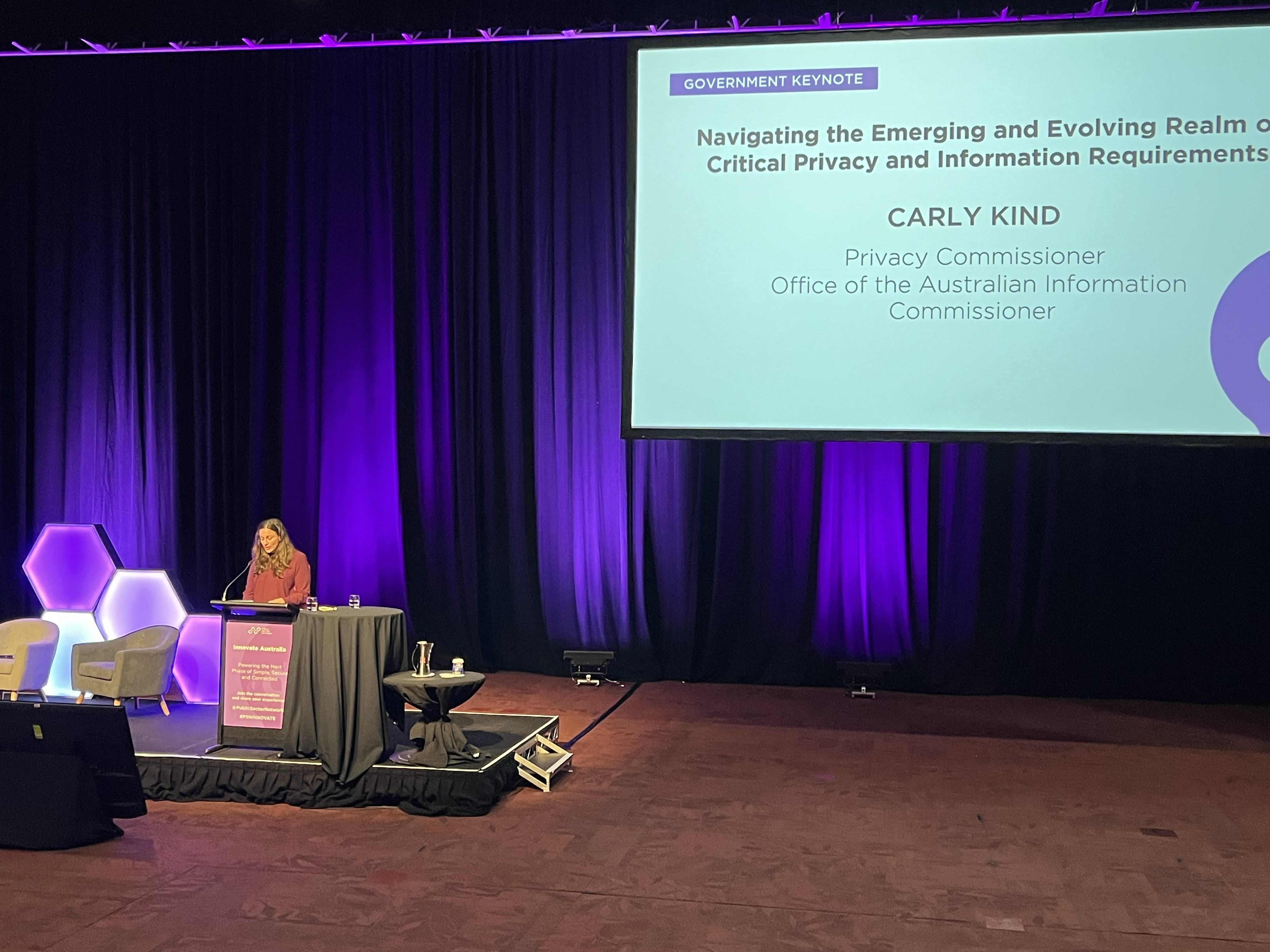
  • Innovation is just about new and novel, but for public good it needs to be about creating value and addressing public need

Employer of Choice – Catherine McLachlan – Home Affairs

  • Need to be less focussed on moulding new talent but asking what they can bring that is different
  • Workforce change needs to be iterative as 2-3 years new starters will have moved on to another role
  • Fear that if workforce strategy innovation does not work we will not be able to bring it back
  • Governance structures have been static for too long

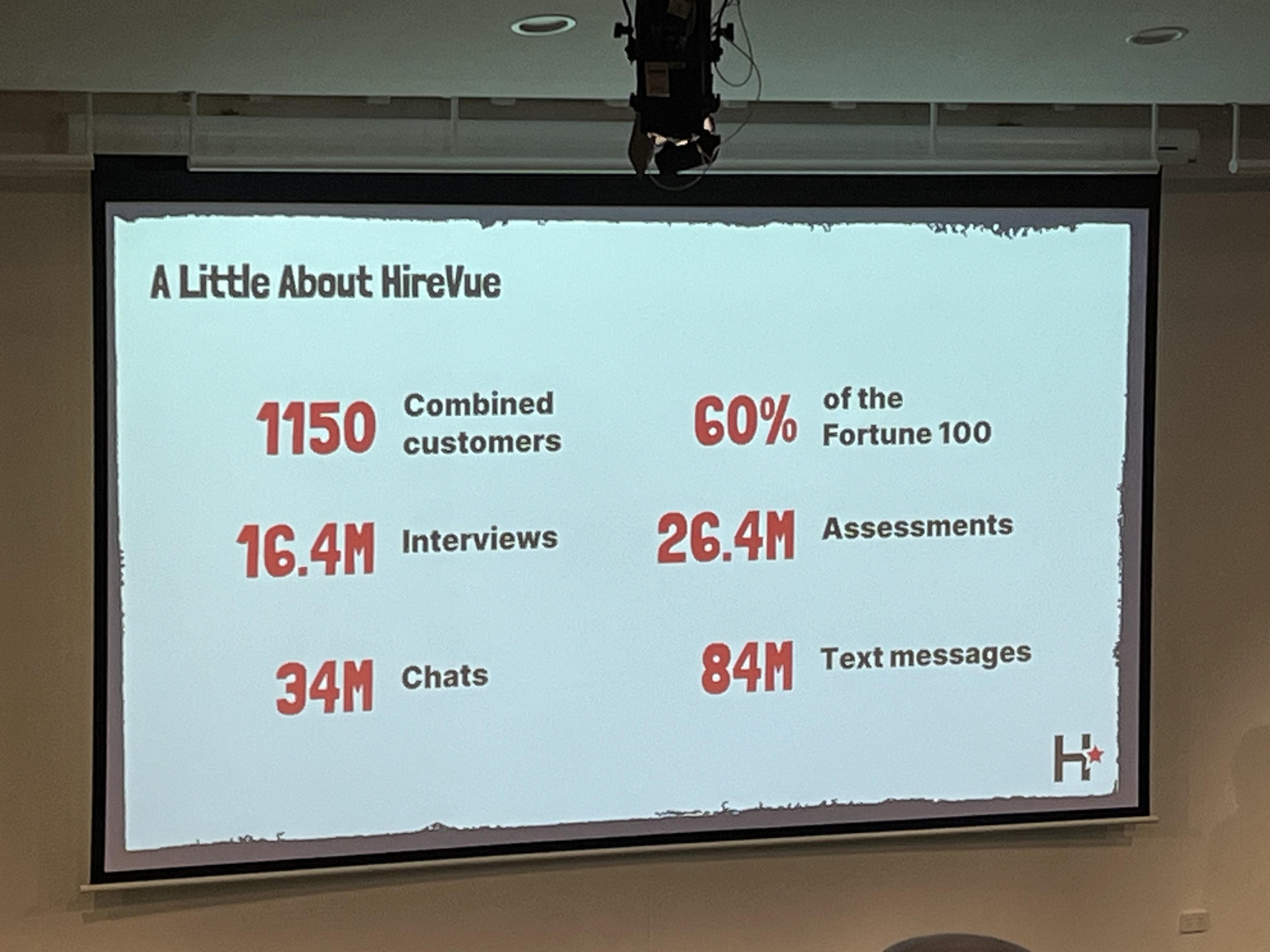
Public Sector Recruitment – Grant Meyer – HireVue

  • Work is changing and hiring is broken
  • Experienced employees are aging out of the workforce, pace of innovation means companies are falling behind

Leveraging Platforms to Support Business Demands – Australian Institute of Aboriginal and Torres Strait Islander Studies / Geoscience / AFSA / SAP

  • Want to find the friction points in organisations, simplify the process and use technology to scale
  • Dedicated Service Design team at AFSA – focussed on customer rather than technology, did not sit in technology or business
  • Co-design
    • Understanding needs of users and getting better data
    • Talk to other organisations, leverage other organisations RFI and tenders, collaboration and buy once, solve many
    • Need to get better at collaborating – how many service management products does federal government need?
    • There are cross CEO and AG forums but they are usually setup because of engaged people and mostly left to chance, need to get better at this

Navigating the Transformation Terrain – Australian Red Cross / AEC / National Transport / Fujitsu

  • AEC – 800 people organisation that scales to 120,000 at election time
  • If you are looking for an easy role, transformation is not the answer
  • Cultural change needs to come to the top and need to be focussed on one thing – Seek example – do senior leaders walk the talk
  • Red Cross under a massive transformation program – need to continue to go back to purpose and people will find other ways to give, people want to keep doing all the things and often we need to help them to stop
  • Need to invest in change readiness and change management throughout – focus on the people and don’t burn them out throughout
  • Need to look for capabilities not qualifications
  • Need to pace yourself and marathon not sprint – once you transform, you need to implement, then improve
  • The big bang is failing – need greater transparency of our projects

Takeaways

  • Agile is still alive and well, they are just not using the name because it has become the preferred approach
  • Lots of transformations occurring across government and industry (eg. Red Cross)
  • Lots of interest in AI, Cybersecurity and ITIL,
  • Ethics and transparency are also key issues for government

ICAgile Experts Meetup Group – Public Sector Agility Accelerator

ICAGILEMy talk with Julian Smith (no relation) from ICAgile Experts Meetup Group called “Public Sector Agility Accelerator” is available on Slideshare.

Today ‘agile’ is no longer just a buzzword. From building spacecraft to manufacturing, some of the most complex and largest organisations in the world are using agile ways of working to deliver better outcomes, respond to change, improve quality, foster more productive and happier teams, and reduce risk.

This hands-on and interactive session is aimed at showing how public sector organisations can support agile ways of working, from policy development through to service design and delivery.

Presenters, Craig Smith an Enterprise Agile Coach and Consultant from SoftEd, and Julian Smith, Head of Agile Practice for Australia’s Digital Transformation Agency, will provide an interesting and informative view of how agility can be applied in the public sector and will introduce the Government Agility Model, a framework that you can use to assess where to apply agility in your agency.

Speaker: Craig Smith
Craig is based in Australia and works extensively with the Australian Public sector and as a member of the Agile Alliance Board of Directors, brings a global perspective.

Speaker: Julian Smith
Julian is a digital leader and entrepreneur who specialises in public sector agility. He is experienced in lean-agile policy development, digital transformation, user-centred design and digital technology.

Many thanks to Shane Hastie and Kerri Sutey for inviting myself and Julian to present this session.

Business Agility Wellington (WellyBAM) – Public Sector Agility Accelerator

WellyBAMMy talk with Julian Smith (no relation) from WellyBAM called “Public Sector Agility Accelerator” is available on Slideshare.

Today ‘agile’ is no longer just a buzzword. From building spacecraft to manufacturing, some of the most complex and largest organisations in the world are using agile ways of working to deliver better outcomes, respond to change, improve quality, foster more productive and happier teams, and reduce risk.

This hands-on and interactive session is aimed at showing how public sector organisations can support agile ways of working, from policy development through to service design and delivery.

Presenters, Craig Smith an Enterprise Agile Coach and Consultant from SoftEd, and Julian Smith, Head of Agile Practice for Australia’s Digital Transformation Agency, will provide an interesting and informative view of how agility can be applied in the public sector and will introduce the Government Agility Model, a framework that you can use to assess where to apply agility in your agency.

Craig is based in Australia and works extensively with the Australian Public sector and as a member of the Agile Alliance Board of Directors, brings a global perspective.

Julian is a digital leader and entrepreneur who specialises in public sector agility. He is experienced in lean-agile policy development, digital transformation, user-centred design and digital technology.

This will be an interactive session, so please be prepared to share your own experiences as well as introducing and encouraging anyone that wants to bring agility to their department or agency to attend the session.

Many thanks to Andy Cooper for inviting myself and Julian to present this session.

Agility Today 2021 – Public Sector Agility Accelerator

My workshop with Julian Smith (no relation) from Agility Today 2021 called “Public Sector Agility Accelerator” is available on Slideshare.

Today ‘agile’ is no longer just a buzzword. From building spacecraft to manufacturing, some of the most complex and largest organisations in the world are using agile ways of working to deliver better outcomes, respond to change, improve quality, foster more productive and happier teams, and reduce risk.

This hands-on and interactive session is aimed at helping public sector organisations build capability to support agile ways of working, from policy development through to service design and delivery.

Deepti Jain and the team did an excellent job putting together this month long festival and it was also a pleasure to be part of the Advisory Board.


Digital Summit 2020 – Agility Accelerator Workshop

Digital Summit 2020

My workshop with Julian Smith (no relation) from the DTA Digital Summit 2020 called “Agility Accelerator” is available on Slideshare.

Today ‘agile’ is no longer just a buzzword. From building spacecraft to manufacturing, some of the most complex and largest organisations in the world are using agile ways of working to deliver better outcomes, respond to change, improve quality, foster more productive and happier teams, and reduce risk.

This hands-on and interactive session is aimed at helping public sector organisations build capability to support agile ways of working, from policy development through to service design and delivery.

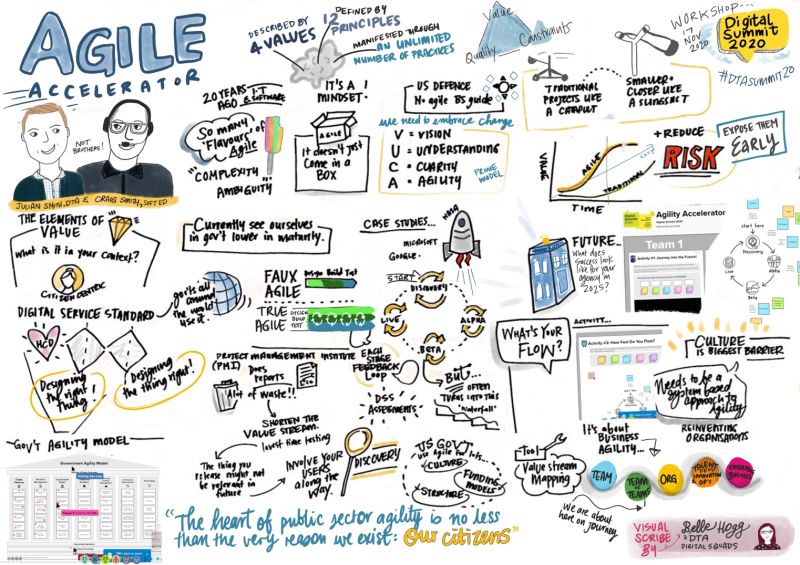
Belle Hogg from the DTA did an amazing job of capturing a visual scribe of the workshop and managed to capture my headset, glasses and lack of hair a little too well!

Episode 157: Transforming the UK Government Digital Service with James Stewart

The Agile Revolution's avatarThe Agile Revolution Podcast

Craig is at YOW! West in Perth and has a conversation with James Stewart, formerly Deputy CTO for the UK Government and co-founder of the Government Digital Service. In varying locations they talk about:

  • YOW! West keynote “Lessons Learned as a Government CTO
  • UK government had some large IT failures  in the last like the NHS National Program for IT (12 billion pound failure), but now lots of successes like Spine 2
  • Agile techniques have been successful in the UK government not just because other approaches have failed so badly but the cost of an IT project is only a fraction of the overall cost of a system
  • The Government Design Principles – start with user needs – successful projects start with clearly articulated principles, did not realise how much they would resonate
  • Worked around a number of government process early on, support from the…

View original post 202 more words

Episode 152: Communities of Practice, Onions, Bus Stops and Shopfronts with Emily Webber

The Agile Revolution's avatarThe Agile Revolution Podcast

Craig is at YOW! Conference and spends some time with Emily Webber, Agile Coach and author of “Building Successful Communities of Practice” and “The Agile Team Onion” and they chat about:

View original post 114 more words

Breaking the Cylinders of Excellence (in the Australian Government)

YOW-Nights_Logo_stackedAt the recent YOW! Night in Brisbane (as well and Sydney and Melbourne), Lindsay Holmwood (the Head of Technology at the DTA) presented “Breaking the Cylinders of Excellence”. It was a rare experience to hear the story of how the DTA is using cutting edge development practices to help the government catch up with, and even exceed, the public sector. 


  • DTA – aid transformation in government, small agency
  • Delivery hubs in Sydney and Canberra – help identify and plug capability gaps in teams
  • Prototype of how government services could work  gov.au/alpha
  • Digital Service Standard – 13 characteristics on what good looks like in government, useful in organisations as well
  • Cloud.gov.au  – government cloud service, usage growing, continuous delivery pipeline (which is a major change for government who are used to 2 changes per year)
  • The unit of delivery is the team – not about individuals, but the team – borrowed from GDS
  • Government is slow, but government is designed to be stable, they cannot fail, they have characteristics that are resistant to change
  • Myth that organisations must choose between speed and reliability, high performing organisations deploy more frequently, have shorter lead times, fewer failures and recover faster, but they also have a greater profit
  • Want to deliver like a startup but be stable like a government
  • Not a lot of cross pollination between departments currently
  • Read the policy! – quite often the process is not mandated
  • Document what works and doesn’t so it becomes a repeatable pattern – ie. running a meetup inhouse, don’t tell me I can’t do it, tell me how I can run it without being thrown in jail!
  • Stick with technologies the government is comfortable with if you are changing the delivery engine
  • Security matters – prevention is a battle you will always lose, detection is your best defence – aggregate and log in one place, identify threat signatures, etc
  • Embed security people on big services so it is part of the architecture
  • Proactive testing between different governments around the world on similar platforms
  • Simplest security breaches make the most mess – infected excel macros, leaving free USB keys in the foyer that are malware infected
  • Need to put user needs first – alpha mockup using tools like Jeckyll, then beta then live
  • Lots of people strictly interpret the design and delivery guides – they are guides not rules!
  • Create a longer runway by pulling tech forward – turn down the volume of design, turn up the volume of tech
  • If it hurts, do it more often!
  • Fixed cost delivery with agile is a thing, agile is a way to de-risk in the government
  • Don’t put manual testing on the critical deployment path – have special skills on hand for accessibility, performance and security

Agile 2012 Day 3 and 4 Review

Agile 2012Day 3 and 4 at Agile 2012 meant a large number of interviews for InfoQ, as well as some podcast interviews and numerous hallway discussions. As a result I have combined both days into one post. Here are my notes from the sessions that I attended.

That Settles It! Techniques for Transparent & Trusted Decision-Making on Your Agile Team

Ellen Gottesdiener led this workshop, her slides are available here.

From Agile 2012

Agile team values, starter list:

  • product – quality, value, just enough, validated learning
  • people – transparency, accountability, courage, mutual learning
  • process – fast feedback, all in collaborate, small steps, retrospect continually
From Agile 2012

They are a set of values that impact how we will make decisions.

Traps, risks and blunders:

  • group dynamics – fallacy of the flawed leader, no diversity in the group, inability to consider alternatives, lack of diversity in the group, group-think (striving for consensus  that drives down alternatives)
  • process – not understanding the key terms

Decision making styles:

From Agile 2012
  • delegative – group decision, decision leader may delegate decisions to a sub group
  • democratic – discuss and take a vote
  • consensus – leader and group together agree based on unanimous decision
  • consultative – where the group collaborates and consults to a person to make a decision
  • consensus – all legitimate concerns should be addressed that impact the group, stakeholders all need to be there, it is not a compromise, there is no bargaining, this is and/both thinking

4S – stake, stakeholders, speed and sustainability of a decision

We then created a 2D gradient to map out decison styles – delegate -> democratic -> consultative -> consensus

From Agile 2012

Ellen then introduced some decision making research, success was a decision that was used for greater than 2 years

From Agile 2012
  • edict – do it, not very sustainable, used 35% of time, worked 38% of the time
  • persuasion – used 49% of the time, worked 44% of the time
  • participation – used  less than 16% of the time, worked 80% of the time, delegated to a group or sub group
  • intervention – delegated but group had guidelines and benchmarks to make a decision, used less than 16% of the time,  worked 90% of the time

We then talked about values:

  • trust – contractual (shared goals and boundaries), communication (transparent, honest and frequent communication, walking the talk), competency (respectful of others ability of what they do on the team and learning how we can do better as a team, honour our agreements) – is a key part of making decisions
  • values for group effectiveness – people need valid information in a timely way to make a free and informed choice, decision rules that enhance internal commitment

Group versus individual decision making:

  • accuracy – better at group level – more alternatives, diversity, more points of view
  • acceptance – group
  • creativity – group
  • efficiency – individual
  • speed – individual

We then had some final thoughts and questions:

  • collaboration pattern – decide how to decide – need to make a decision but know you have made it
  • common decision rules – delegate, decide without discussion, negotiation, majority vote, spontaneous agreement, arbitrary, consensus  leader decides after decision
  • gradient of agreement – endorse, agree with reservations, disagree cannot support (but won’t block), block
  • 12 Angry Men – good example of the model

  • to reach closure – with decision leader decide on how to decide, with the whole group clarify the decision process, close discussion, clarify proposal, poll group using gradient and decision leader decides or chooses further discussion
  • RAPID – effective organisations have clarity in roles  around decision making – recommend, agree, perform, input, decide (like a RAPSI)

Evolve Your Agile Coaching Dashboard

David Parker led this workshop, his slides are available here.

From Agile 2012

We started the workshop bu being given 5 minutes to draw a fact about the group we were sitting in, and could not use any numbers.

From Agile 2012
  • use scrum to coach scrum teams – to get organized and be different from other coaches
  • scrum on a team of one – more forgiving because you know what is going on, you are all roles in one
  • create a project dashboard – 10 qualities of hyper productive teams, matrix on the wall, denoted yes/no using red/green stickies

We then created our own dashboard based around a scenario that were given.

From Agile 2012
From Agile 2012
From Agile 2012
From Agile 2012
From Agile 2012
From Agile 2012

Fixing Broke(n) Governments Through Serious Games

In keeping with the theme of Agile in non-software, I was very interested in hearing about this initiative from Luke Hohmann from Innovation Games. A copy of his slides from SXSW appear to be similar to those he presented here.

From Agile 2012
  • San Jose, 10th largest city in the USA, in deficit by $115 million, Luke ran into the mayor on a plane…
  • games – have a goal, arbitrary constraints, interaction rules, voluntary participation (Jane McGonical) – most people think fun and entertainment when they think game, now we use the term serious games
  • serious games – advergames (get you to buy stuff eg. Burger King), edutainment (CBS have news footage for school students), news games, simulations, exergames (Nike have a game to escape zombies to entice running), innovation games
  • executives love games because they involve strategy
  • San Jose have a yearly planning commission meeting – worse meeting ever, after a powerpoint, all the citizens were given a roll of nickels to vote on the areas that needed attention (the smarter citizens kept the roll of nickels!), got an accountancy firm to count the results, what happens if nobody voted on health care?
  • convinced them to try an innovation game because you can blame the consultant!
  • first, what is the problem – had already cut the budget to the bone, so the problem was prioritisation
  • buy a feature game– give people 40% of the total, give them a ranked list, the reasons for the ranking and the conditions of the acceptance, they can buy what they want but they need to collaborate often
    • adapted this game to imagine these are the things cut from the budget but we have no money to fund them (green list) and here are the things you can cut from the budget to try and fund them (red list) – the goal of the game was not for everybody to prioritize everything because there are essential services regardless
    • people respond better with physical money rather than things like poker chips
    • for a serious game to be serious it must affect the player – they were suggesting things like cutting 5 firemen per truck to 4 to fund anti-gang warfare and park rangers (for example)
    • each table had 7 citizens, 1 facilitator and 1 observer – used soloid sticks strapped to pant stirrers that were held up to signal questions – blue for police, red for fire, etc… and the head of that department would answer the question, citizens were seated from different districts at a table so they could not gang up on other districts
    • red items needed 100 percent unanimous agreement at the table
    • because people are citizens and dealing with real issues they tend to leave their political beliefs out of the discussion
    • San Jose citizens chose pavement maintenance over libraries – if the mayor went on record to cut libraries then the friends of libraries group would have come out in disagreement but there is no friends of pavements group
    • planning the first game took three months
    • when governments say they will cut the budget by 10% they are never specific, made them specify that cut with a smart goal (eg. no new helicopter)
    • the agile community donated quarter a million dollars of services and materials pro bono
    • the government took action (reductions in fire, police, delays in libraries and elimination of services) and citizens loved the process
  • pushed the boundaries in 2012 – tested new taxes, buy one or none and adding new proposals
  • budget games are better than budget puzzles – about making cuts not about education and they are collaborative
  • prune the product tree – usually for road mapping, used this to identify community service projects, which got shaped into initiatives which were added into buy a feature that the city would seed funding for but the citizens would need to donate time to implement them
  • games work for business but needed changes to work for governments – hard to have anonymity in a way the preserves free speech, coordinating large number of players, minimizing bias
  • gamification – need to ask can the average citizen play this game, need to level citizens up and play more sophisticated games
  • Innovation Games have a network of facilitators and have built trust, but they don’t have all the people and answers – created Every Voice Engaged
  • buy a feature works – a shared commitment using a scarce resource, citizens now sign up to community service initiatives using the same ideas
  • called it a priority budgeting exercise instead of using the word game
  • all the numbers come from the budget and are reviewed by an independent neighbourhood committee
  • neighborgoods – reducing consumer goods, sharing materials in the community
  • draw roadmaps as trees so you can talk about the -illities, show the critical infrastructure at the root
  • our aspirations as a community should be more than decreasing the length of sprints from 20 minutes to 15 minutes – we can do better!

The final story Luke told was how one disadvantaged woman was almost not going to turn up the session because they had always been a waste of time. At the end of the game she stood up and said that she felt empowered because she ” had the same amount of money as everybody else at the table” and was able to make real decisions. Enough said.

Demanding Technical Excellence and Professionalism

Robert “Uncle Bob” Martin presented this session. I had seen most of this content before and did not hear anything much new (I also had to sneak out 10 minutes early to meet up for an InfoQ interview). What was much more interesting was a discussion I had Andrew Prentice from Atlassian at the Conference dinner about the validity of many of the claims that were made in the session (I think we should strive for them but Andrew seemed to think it depends on time and place and the developer).

From Agile 2012

[vimeo 9981123]

  • bad code, 32000 lines of code in two classes (Order and OrderImpl) – what created that sheer irresponsibility? The fault lies with programmers – they chose to write it that way – that choice is always the wrong choice
  • our craft is defined – we have been writing the same sort of code for 40 years – assignment statements, if statements and loops
  • wear the green band – acceptance and willingness to follow my craft and unwillingness to comprimise the craft

These are my expectations from craftsmen:

  • short iterations – close the feedback loop, down to a week or shorter, deliver working code that passes all the tests and is ready to deploy, programmers should be working in short cycles 20 seconds or less (red-green-refactor loop)
  • never be blocked – never wait for anyone, if there is a blockage then go and fix the problem, don’t be stymied!
  • screaming architectures – does your code execute the use case without all the external architectures – should scream I am an accounting system not a Java web system, delay for as long as you can decisions about the database or web server , isolate the business rules so you can switch out the database at a moments notice, use decoupled architecture to focus on business rules, these architectures slow down tests
  • incremental improvement over grand redesign – grand redesigns tend to expensive and open to failure
  • clean code – output should always be clean and kept clean, boys scout rule – do a random act of kindness to the code (leave the camp ground cleaner than you found it)
  • go fast, go well – need to flip the professional bit in your head, the only way to go fast is to do good work
  • TDD – proportion is growing over the years, can’t write any production code until you have written a unit test, don’t write more of a unit test that is sufficient to fail, don’t write more production code that is sufficient to pass the  failing unit test, developers initially find these rules stupid, everything worked a minute ago, always a minute away from working code, don’t want to spend time debugging but want to spend time writing working code, development teams with a long list of defects over a page is not being responsible, confidence to change the code and ship it
  • 100% code coverage – what lower number makes sense, there is no other number that makes sense, personal ethics that the tests have good coverage
  • QA should find nothing – the QA organisation should wonder why they exist
  • statistical estimates – use velocity and it is not a failure if you deliver less, predictable team should have a flat velocity

After Dark

Wednesday night was the Rodeo Circuit which was an opportunity to collect stamps while visiting all the exhibits. I was lucky enough to win a netbook from the Agile Alliance.

From Agile 2012

Thursday night was the conference dinner that kicked off with a comedian and followed up with a really good band called Emerald City.

From Agile 2012
From Agile 2012

Podcast

Finally, I recorded a short audio podcast for The Agile Revolution wrapping up days 3 and 4 of the conference.

Barcamp Brisbane III: The Search For Flock Wrapup

Barcamp BrisbaneHere is my better late than never wrapup of Barcamp Brisbane III (held last weekend at the East Brisbane Bowls Club), a worthwhile meetup of locals willing to share their skills with others.

Discussion at Barcamp Brisbane III

Discussion at Barcamp Brisbane III

From the lightning talks that I attended:

Speed Intro

A new concept was the speed introductions, one minute to introduce yourself to someone you don’t know. Worked quite well, met a bunch of new people and got a good vibe of the different passions of the attendees.

Favourite Cloud Applications

Session presented by Michael Rees.

None of the applications were particularly new to me, but these were my takeaways for more of a look:

  • Gliffy – online diagram and flowchart editor
  • Slideshare – for uploading of presentations
  • Prezi – requires Flash, but is a big space to show text and is a new and interesting way to show presentations
  • Delicious – not new, but Michael uses it as a home page
  • Archive.org – from the guys that brought us the wayback machine, they have a service that allows you to upload audio and video maintaining the original resolution (although the upload is quite slow apparently)
  • Evernote – I have used OneNote for convenience of late, but a place to store and search for notes on multiple platforms and phones, this is a service that Michael pays for as well
  • Online Storage – LiveMesh is a favourite, gives you 5GB that syncs anywhere. He also mentioned Live Sync P2P, SkyDrive and Amazon S3

Introduction to Git

Attended two sessions on Git, a discussion and then an online overview.

  • A local repository, distributed
  • Competitors are Mercurial and Bazaar
  • Git is not as good on Windows environments right now
  • Github uses for public hosting
  • Gitgui is a an interface to Git, amongst many others

This is certainly the next generation of version control, but I have concerns on how to get this working in the enterprise especially since I have enough trouble convincing people to commit let alone to commit often. Can see its potential for open source and independent or small developers however.

Groovy, Griffon & Grails

Paul King and Bob Brown gave a good introduction to the G3 technologies. I was especially interested in Griffon, since I hadn’t spent any time looking at it previously.

Government 2.0

Was interested to listen into the discussion about PublicSphere / Government 2.0 by Des Walsh, and the opportunities it may present. Des has posted a more in-depth post here: http://deswalsh.com/2009/07/19/government-2-0-at-barcamp-brisbane/

Drupal Hosting

Discussion about Drupal Hosting:

  • Open Atrium – intranet website incorporating wiki, forum, internal-twitter – theme around existing modules
  • Aegir – Drupal Hosting System
  • Suspect that much like Linux, we will see many distributions in future
  • Acquia are the Red Hat of the Drupal world
  • Drupal 7 has gone full TDD with 80% coverage

Fish Shell

An online demonstration of the Fish Shell, which can be best described as a shell that adds a bunch of added functionality to bash, such as better history and visualisations.

Conclusion

A good way to get a launch into some new and interesting technologies and meet some new people. There is apparently another planned before the end of the year.