The Agile Political Landscape Series: PRINCE2 Agile and One Nation

Please note: This is article 2 in a series that explores mapping agile certifications to what we have coined the Agile Political Spectrum. The first blog in the series is What if Agile certifications were a political party?

A note on our political comparisons: These political comparisons are playful metaphors designed to illustrate philosophical positions on the agile spectrum. No certification body was harmed in the making of this analysis.

Every political spectrum needs a far-right party and in the agile certification world, that’s PRINCE2 Agile. The agile extension to a project management methodology called PRojects IN Controlled Environments, version 2 (PRINCE2) wears its conservative credentials openly.

In 1989, a UK government department created PRINCE seeking to protect itself from project failure through rigid process, strong governance and uncompromising control. Updated to PRINCE2 in 1996, these rigorous controls, defined decision points and detailed documentation requirements were designed to provide transparency and auditability considered critical in public-sector environments, but they also made the framework process-heavy and bureaucratic. The approach worked: PRINCE2 became one of the world’s most widely adopted project management frameworks.

Fast forward to 2015. The agile movement had transformed software development and was making inroads into broader business practices. PRINCE2 Agile emerged as an attempt to give organisations a way to adopt agile methods within the PRINCE2 framework. The goal was to preserve the strategic direction, business justification, and stage-gate controls of PRINCE2 while enabling teams to work in a more collaborative, incremental manner. In practice, that meant layering agile practices onto PRINCE2 governance rather than rethinking the underlying assumptions of the framework.

PRINCE2 Agile was launched with scepticism. The agile community rejected it for not being agile enough. The PRINCE2 community worried it was letting go of too much control. Caught between two worlds, PRINCE2 Agile largely satisfied neither.

This is the challenge of compromise and to PeopleCert’s credit, they’ve acknowledged it. In a recent conversation, Markus Bause (VP Product at PeopleCert, the owners of PRINCE2) reflected candidly on this balance. The organisation responded by releasing Version 2, which places greater emphasis on mindset, people and leadership, while significantly improving the learning experience. This is a topic Sean Blunt explored further in his article Agile Leadership: Enabling Government Transformation.

Version 2 offers a broad introduction to agile. It defines the mindset, values and principles and covers several techniques and approaches considered part of an agile toolkit. There are some interesting terminology and structure choices along the way, but overall, it provides a reasonable introduction to the fundamentals of agile project management.

However, as its name suggests, the certification on offer is PRINCE2 + Agile. At the intersection of fundamentally different philosophies, compromise is inevitable. But compromises reveal priorities. PRINCE2 by design prioritises slow, structured, risk-averse progression over speed, experimentation and rapid value delivery. The entire model assumes that careful planning, authorised stages, and methodical oversight are inherently safer than moving quickly, adapting frequently or learning through iteration. PRINCE2 Agile is a compromise that restricts agile to its most conservative form.

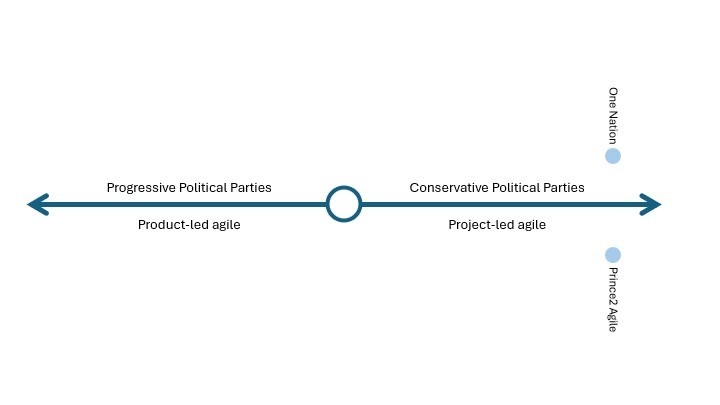
So on our spectrum of agile certifications, who is PRINCE2 Agile’s political counterpart? As our far-right conservative, PRINCE2 Agile is equivalent to One Nation.
We now hear the chorus “please explain”.

One Nation is a nationalist, socially conservative party sceptical of change and strong on government control. The parallels to PRINCE2 Agile are striking. Both were born from a desire to protect; One Nation from perceived threats to national identity, PRINCE2 from project failure. Both prioritise control over adaptation. Both are suspicious of external influences that might challenge their worldview and both struggle when reality demands flexibility.

Just as One Nation wants strong government control and has protectionist tendencies, PRINCE2 was born from a government department wanting to protect itself through rigid process and governance. PRINCE2 Agile attempts to liberalise this ideology, to let in some outside influence, but only on its own terms. Agile practices are permitted, but they are constrained to operate within PRINCE2’s governance framework. The conservative DNA remains intact.

This explains why PRINCE2 Agile has such a specific, narrow worldview. It defines how agile can be applied in “projects” and “business-as-usual” but disregards any notion of an operating model where products have continuous lifecycles independent of project boundaries. Like its political counterpart, PRINCE2 Agile knows how the world should work and anything outside that framework somewhat doesn’t exist.

PRINCE2 Agile has a legitimate place in the market, specifically for organisations already operating within the PRINCE2 framework who need to introduce agile project management practices. If you’re in a heavily regulated environment with genuine compliance requirements or working in government contexts where PRINCE2 governance is mandated, PRINCE2 Agile may be exactly what you need to increase speed.

The challenge arises when PRINCE2 Agile becomes someone’s only exposure to agile thinking. You’ll learn about “being agile” over “doing agile”, some agile practices and some lightweight methods but all within a structured project management governance model. You’ll understand iteration but not continuous delivery. You’ll practice ceremonies but not self-organisation. You’ll know agile vocabulary but not agile as a business operating model. It’s a starting point, not the full spectrum.

For practitioners building agile capabilities or organisations genuinely seeking business agility, understand what you’re getting: agile project management within PRINCE2, not agile transformation. There’s nothing wrong with that – as long as it’s intentional.

In the end, PRINCE2 Agile is doing exactly what One Nation does: serving a specific constituency with clear, unwavering views about how things should work. Both have their supporters, both have their critics, and both will insist they’re more flexible than they actually are. If your organisation lives in PRINCE2 territory and needs to introduce some agile practices without causing a governance revolt, PRINCE2 Agile is your candidate. Just don’t expect it to lead a revolution – that’s not what conservatives do. And whatever you do, don’t ask it to “please explain” why everything must fit within project boundaries. You’ll be there for several stage-gates.

This article was originally published on LinkedIn by Daniel Luschwitz. The next article in the Agile Political Landscape series is: LeSS and The Greens
What if Agile Certifications were a Political Party?

Over the last couple of decades, we have been pushing towards agility as a catalyst for a different way of working entirely. It’s interesting to reflect on where agility has ended up today.At the same time, traditional project management approaches talk about agile purely through a project management lens rather than a broader business and product context and as a result we aren’t always speaking the same language. To close that gap, you can use two different phrases:

“Agile within a project management operating model”
“Agility within a product management operating model”

Meeting organisations where they are matters more than ever. The agile industry took four values and twelve principles and somehow created hundreds of methods, wars between approaches, an alphabet soup of certifications, and a handful of enterprise frameworks each claiming to be the silver bullet. We’ve ended up with organisations at vastly different points on their journey and lots (and lots) of confusion in between.

Same word – agile – but very different contexts. Then it occurred to my long-time colleague Daniel Luschwitz, agile is just like politics. Both operate on a continuum left and right of centre. The further away from the centre to the right is a more conservative ideology, whereas to the left is a more progressive ideology.

In agile terms, the centre is the tipping point between:

Project-led agile (right-conservative)
Product-led agile (left-progressive)


Agile even has a constitution – the AgileManifesto. A set of 4 values and 12 principles that mostly any agile approach references and considers itself as following.

We also have a lot of ‘healthy’ debate in both politics and agile. Much like we hear in the halls of parliament “that is unconstitutional”; the agile community has been known to throw a few “that is not agile” phrases around too.

So, all this raises the question: if the various agile certifications were Australian political parties, what party would they be? Who would be our Australian Labor Party, Liberal Party of Australia and The Australian Greens parties? Do we have a contender for Pauline Hanson’s One Nation Party, the Trumpet of Patriots or the Shooters Fishers and Farmers Party?

Where does the various incarnations of Scrum fit in the political landscape? Is SAFe progressive or conservative? Do any agile certifications have their ‘bee in a bonnet’ about paper bags?

To complete this exposé of the agile political world, Daniel Luschwitz brought me in to help write this series, ads, in his words, I am an authority on the agile landscape, “40 agile methods in 40 minutes” creator, and having served on the Agile Alliance Board I am technically a retired agile politician… and we all know what happens when retired politicians talk!

What’s next?

Over the coming posts, Daniel and I plan to map well-known certifications and frameworks across the Agile Political Spectrum.

Why?

It should be a bit of fun. Plus, Daniel has told too many people he plans to write this to back out now.

However, there is a serious side to this. The market is saturated with agile certifications and in many cases participants, managers of teams and recruiters haven’t fully understood what context the certification they have received serves. Our aim is to create awareness.

In the meantime, we welcome you to join in the debate! Who is your far-right conservative agile party?

The first article in the series is: PRINCE2 Agile and One Nation

Note: This article was amended slightly form the original published by Daniel Luchwitz to be written from my perspective.

InfoQ Culture & Methods Trends in 2025 Podcast

This is the 2025 Engineering Culture Trends Report. The InfoQ editorial team and special guest Charity Majors discuss how AI is transforming software development and team performance.

Source: InfoQ Culture & Methods Trends in 2025

InfoQ Culture and Methods Trends Report – 2025

This report summarizes how the InfoQ Culture and Methods editorial team sees the ongoing and emergent trends in the culture and methods space.

  • AI tools dramatically increase development speed but come with quality concerns, creating a need for new testing and quality approaches.
  • Team collaboration remains essential despite AI advancement; there’s a risk of engineers turning to AI rather than colleagues for solutions, potentially undermining the collaborative culture that drives high performance.
  • Junior engineers remain vital to the industry, with today’s juniors adapting quickly by using AI as a learning accelerator before approaching senior colleagues with more refined questions.
  • Psychological safety continues to be fundamental for high-performing teams, though it’s being challenged by post-pandemic organizational cultures and economic pressures.
  • Observability costs are constantly growing, organizations need to view observability as a strategic investment rather than just a cost center.
  • Agile and DevOps practices have become so integrated into industry standards that they’re now “the air that we breathe,” with platform engineering emerging as the next evolution, bringing product and design mindsets to developer tooling.

In the annual Culture & Methods Trends Report podcast, InfoQ’s Culture & Methods editorial team, with special guest Charity Majors, explored the shifting landscape of software development culture, tools, and practices. The wide-ranging discussion revealed several key trends shaping how software teams are working in 2025, from the profound impact of AI tools on development practices to evolving perspectives on team performance and observability.

Source: InfoQ Culture and Methods Trends Report – 2025

InfoQ Culture and Methods Trends Report – April 2024

The Culture & Methods Trends in 2024 cover the value of staff plus engineers, DevEx metrics, ways to make remote teams effective, challenges with diversity and software development impact on climate.

  • Whilst remote working presents challenges to innovation and collaboration, there are effective techniques to address them
  • Staff-Plus engineers bring value through far more than their technical skills
  • Developer Experience can be measured and there are metrics that can be used to find small improvements that make a huge difference
  • It is possible and practical to include climate impact as a quality attribute of a software product
  • The use of AI tools, such as large language models, can enhance the work of good programmers but do not replace the need for human expertise and creativity

This report summarizes how the InfoQ Culture and Methods editorial team sees the ongoing and emergent trends in the culture and methods space.  We discuss evolving roles within teams, particularly the way staff plus roles can add value, the use, and misuse of DevEx metrics, how remote and asynchronous work continues to evolve, the fact that a lack of diversity is still a challenge in information technology, the slow pace of adoption of modern leadership approaches in many organizations and the need to move from climate change awareness to climate-conscious software engineering. Of course, we could not explore trends today without looking at the impact of AI and LLMs, but we looked at them from a risk and benefit perspective for the people involved in software engineering.

Source: InfoQ Culture & Methods Trends Report – April 2024

InfoQ Culture & Methods Trends in 2024 Podcast

In this podcast the Culture and Methods editorial team along with special guest Jutta Eckstein talk about the current state and trends we see in the technology industry in 2024.

Source: InfoQ Culture & Methods Trends in 2024

InfoQ Culture & Methods Trends in 2023 Podcast

In this podcast the whole Culture & Methods editorial team plus Rebecca Parsons, CTO of Thoughtworks, explore the trends they see happening in the technology industry in 2023.

Source: InfoQ Culture & Methods Trends in 2023

All the Remote Things – Agile as the Journey and not the Destination with Craig Smith

It was a privilege to be invited by my good mate Tony Ponton to speak on his other podcast All The Remote Things.

In this episode we are joined by Global Agility Lead, Craig Smith who, up until recently, was also the director of Agile Alliance. Craig chats to us about his time at Agile Alliance and what the future holds for the organisation. We also discuss the updates Craig has made to his ’40 agile methods in 40 minutes’ and how there isn’t necessarily a blueprint when choosing the right agile methods for your organisation. Get in touch – Podcast – https://theagilerevolution.com/ Agile Alliance – https://www.agilealliance.org/ Craig’s website – https://craigsmith.id.au/

Agile Summit: 40 Agile Methods in 40 Minutes – 2022 Edition

AVSMy talk with from Agile Virtual Summit called “40 Agile Methods in 40 Minutes: 2022 Edition” is available below:

2022 – Agile Virtual Summit – 40 Agile Methods in 40 Minutes

More to come.

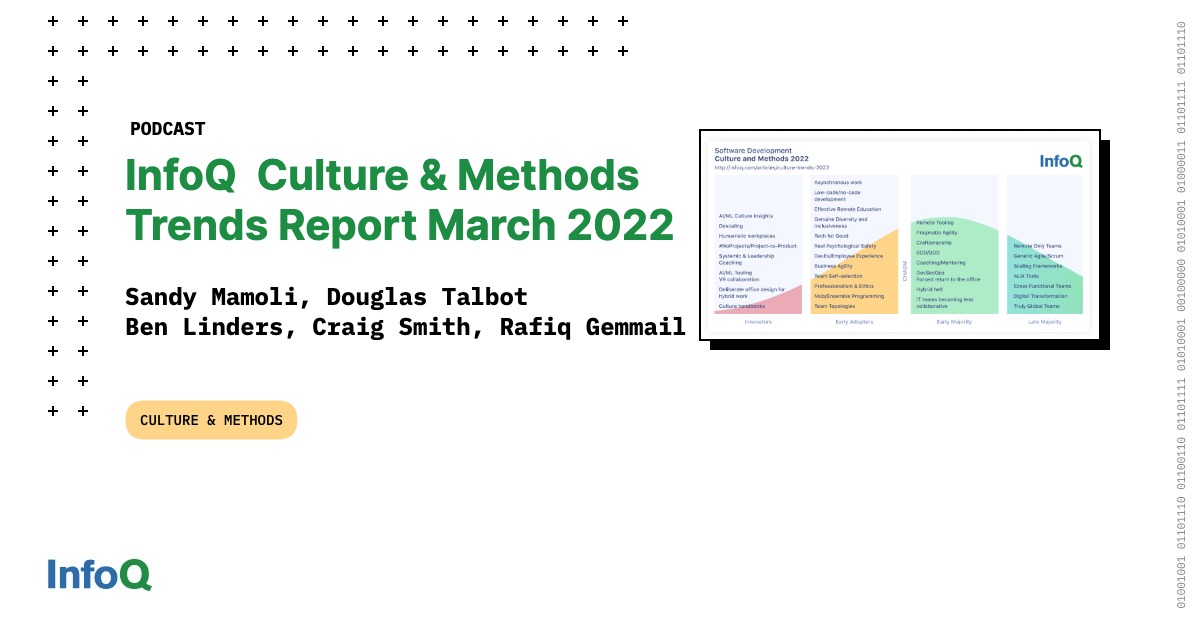
InfoQ Culture & Methods Trends Report March 2022 Podcast

In this podcast the InfoQ Culture & Methods editors, along with special guest Sandy Mamoli, discuss what they have seen over the last year and the trends they see going forward.

Source: InfoQ Culture & Methods Trends Report March 2022