Please note: This is article 2 in a series that explores mapping agile certifications to what we have coined the Agile Political Spectrum. The first blog in the series is What if Agile certifications were a political party?
A note on our political comparisons: These political comparisons are playful metaphors designed to illustrate philosophical positions on the agile spectrum. No certification body was harmed in the making of this analysis.
Every political spectrum needs a far-right party and in the agile certification world, that’s PRINCE2 Agile. The agile extension to a project management methodology called PRojects IN Controlled Environments, version 2 (PRINCE2) wears its conservative credentials openly.
In 1989, a UK government department created PRINCE seeking to protect itself from project failure through rigid process, strong governance and uncompromising control. Updated to PRINCE2 in 1996, these rigorous controls, defined decision points and detailed documentation requirements were designed to provide transparency and auditability considered critical in public-sector environments, but they also made the framework process-heavy and bureaucratic. The approach worked: PRINCE2 became one of the world’s most widely adopted project management frameworks.
Fast forward to 2015. The agile movement had transformed software development and was making inroads into broader business practices. PRINCE2 Agile emerged as an attempt to give organisations a way to adopt agile methods within the PRINCE2 framework. The goal was to preserve the strategic direction, business justification, and stage-gate controls of PRINCE2 while enabling teams to work in a more collaborative, incremental manner. In practice, that meant layering agile practices onto PRINCE2 governance rather than rethinking the underlying assumptions of the framework.
PRINCE2 Agile was launched with scepticism. The agile community rejected it for not being agile enough. The PRINCE2 community worried it was letting go of too much control. Caught between two worlds, PRINCE2 Agile largely satisfied neither.
This is the challenge of compromise and to PeopleCert’s credit, they’ve acknowledged it. In a recent conversation, Markus Bause (VP Product at PeopleCert, the owners of PRINCE2) reflected candidly on this balance. The organisation responded by releasing Version 2, which places greater emphasis on mindset, people and leadership, while significantly improving the learning experience. This is a topic Sean Blunt explored further in his article Agile Leadership: Enabling Government Transformation.
Version 2 offers a broad introduction to agile. It defines the mindset, values and principles and covers several techniques and approaches considered part of an agile toolkit. There are some interesting terminology and structure choices along the way, but overall, it provides a reasonable introduction to the fundamentals of agile project management.
However, as its name suggests, the certification on offer is PRINCE2 + Agile. At the intersection of fundamentally different philosophies, compromise is inevitable. But compromises reveal priorities. PRINCE2 by design prioritises slow, structured, risk-averse progression over speed, experimentation and rapid value delivery. The entire model assumes that careful planning, authorised stages, and methodical oversight are inherently safer than moving quickly, adapting frequently or learning through iteration. PRINCE2 Agile is a compromise that restricts agile to its most conservative form.
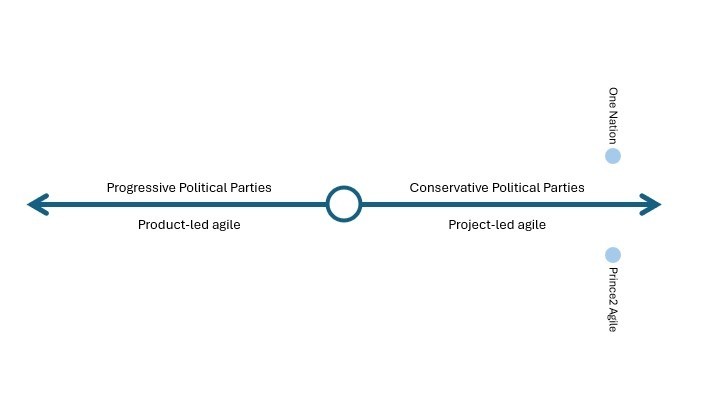
So on our spectrum of agile certifications, who is PRINCE2 Agile’s political counterpart? As our far-right conservative, PRINCE2 Agile is equivalent to One Nation.
We now hear the chorus “please explain”.
One Nation is a nationalist, socially conservative party sceptical of change and strong on government control. The parallels to PRINCE2 Agile are striking. Both were born from a desire to protect; One Nation from perceived threats to national identity, PRINCE2 from project failure. Both prioritise control over adaptation. Both are suspicious of external influences that might challenge their worldview and both struggle when reality demands flexibility.
Just as One Nation wants strong government control and has protectionist tendencies, PRINCE2 was born from a government department wanting to protect itself through rigid process and governance. PRINCE2 Agile attempts to liberalise this ideology, to let in some outside influence, but only on its own terms. Agile practices are permitted, but they are constrained to operate within PRINCE2’s governance framework. The conservative DNA remains intact.
This explains why PRINCE2 Agile has such a specific, narrow worldview. It defines how agile can be applied in “projects” and “business-as-usual” but disregards any notion of an operating model where products have continuous lifecycles independent of project boundaries. Like its political counterpart, PRINCE2 Agile knows how the world should work and anything outside that framework somewhat doesn’t exist.
PRINCE2 Agile has a legitimate place in the market, specifically for organisations already operating within the PRINCE2 framework who need to introduce agile project management practices. If you’re in a heavily regulated environment with genuine compliance requirements or working in government contexts where PRINCE2 governance is mandated, PRINCE2 Agile may be exactly what you need to increase speed.
The challenge arises when PRINCE2 Agile becomes someone’s only exposure to agile thinking. You’ll learn about “being agile” over “doing agile”, some agile practices and some lightweight methods but all within a structured project management governance model. You’ll understand iteration but not continuous delivery. You’ll practice ceremonies but not self-organisation. You’ll know agile vocabulary but not agile as a business operating model. It’s a starting point, not the full spectrum.
For practitioners building agile capabilities or organisations genuinely seeking business agility, understand what you’re getting: agile project management within PRINCE2, not agile transformation. There’s nothing wrong with that – as long as it’s intentional.
In the end, PRINCE2 Agile is doing exactly what One Nation does: serving a specific constituency with clear, unwavering views about how things should work. Both have their supporters, both have their critics, and both will insist they’re more flexible than they actually are. If your organisation lives in PRINCE2 territory and needs to introduce some agile practices without causing a governance revolt, PRINCE2 Agile is your candidate. Just don’t expect it to lead a revolution – that’s not what conservatives do. And whatever you do, don’t ask it to “please explain” why everything must fit within project boundaries. You’ll be there for several stage-gates.
This article was originally published on LinkedIn by Daniel Luschwitz. The next article in the Agile Political Landscape series is: LeSS and The Greens


Pingback: What if Agile Certifications were a Political Party? | Craig Smith
Pingback: The Agile Political Landscape Series: LeSS and The Greens | Craig Smith
Pingback: The Agile Political Landscape Series: DSDM and Katter’s Australian Party | Craig Smith
Pingback: The Agile Political Landscape Series: DevOps and Teal Independents | Craig Smith
Pingback: The Agile Political Landscape Series: Kanban and the Australian Democrats | Craig Smith
Pingback: The Agile Political Landscape Series: ICAgile and the Left-Leaning Independents | Craig Smith
Pingback: The Agile Political Landscape Series: PMI, IIBA, ISTQB and the Right-Leaning Independents | Craig Smith