This is the Engineering Culture Trends Report for 2026. Featuring a panel of QCon speakers and InfoQ contributors, they discussed AI adoption maturity and risk.
Source: Culture & Methods Trends 2026: The Human Side of AI Engineering
This is the Engineering Culture Trends Report for 2026. Featuring a panel of QCon speakers and InfoQ contributors, they discussed AI adoption maturity and risk.
Source: Culture & Methods Trends 2026: The Human Side of AI Engineering
This report summarizes how the InfoQ Culture and Methods editorial team sees the ongoing and emergent trends in the culture and methods space in 2026.

In the annual Culture & Methods Trends Report podcast, a panel of QCon speakers and InfoQ contributors discussed AI adoption maturity and risk, the transformation of engineering team structures and roles, and the human dimensions of software development that must not be lost in 2026. The discussion was hosted by Shane Hastie (Lead Editor, Culture & Methods) and included Ben Linders, Rafiq Gemmail, Craig Smith, Vanessa Formicola, Shawna Martell, Phillip Mortimer, and Yinka Omole.
Source: InfoQ Culture and Methods Trends Report – 2026

I was quoted in the article:
It’s the gap between the good and the not so good and the haves and the have-nots. Some organizations have embraced this and ran with it, but there are many organizations… they never really made the leap to agility practices in the twenty-five year span that we had in order to do that. And now they’re trying to adapt to these new practices and still building it on organizations that are still tending software’s being built in 1995.

Please note: This is article 10 in a series that explores mapping agile certifications to what Daniel Luschwitz and I have coined the Agile Political Spectrum. The previous blogs in the series are available here:
A note on our political comparisons: These political comparisons are playful metaphors designed to illustrate philosophical positions on the agile spectrum. No certification body was harmed in the making of this analysis.
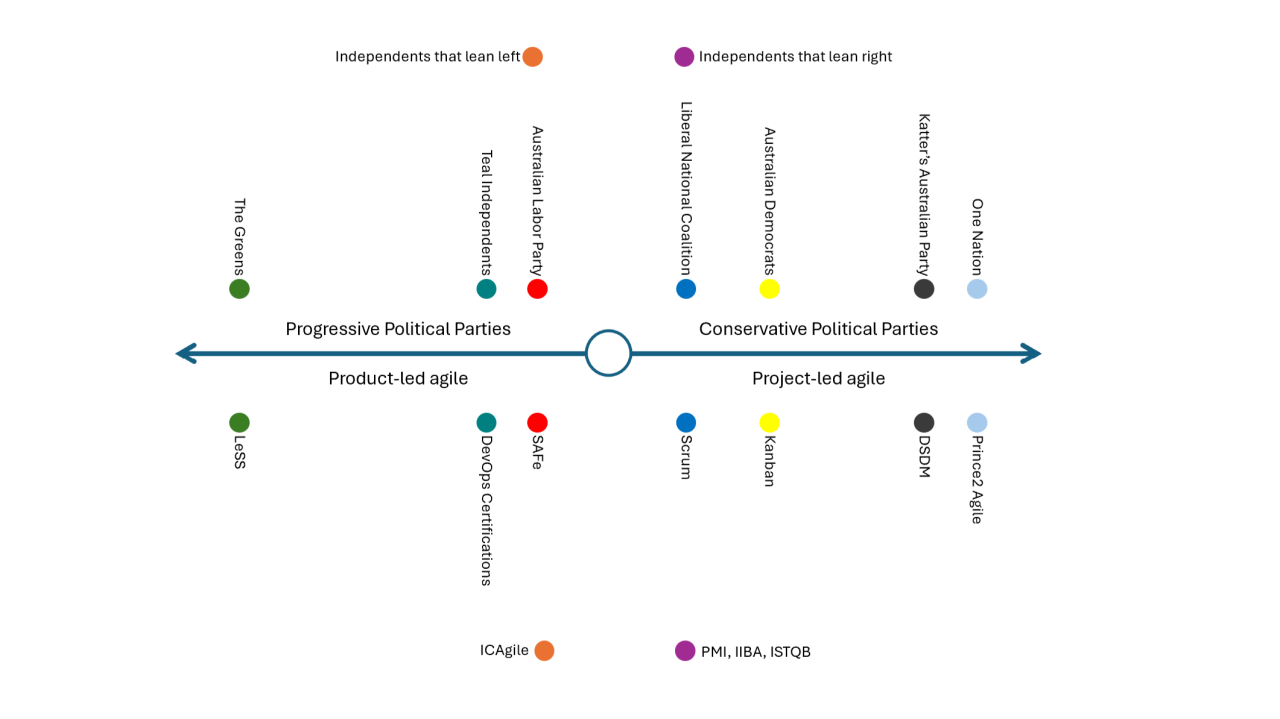
Every political spectrum has its conservative populist. The party that speaks to the mainstream, builds a broad coalition, and makes its platform feel like stability rather than ideology. The one that packaged its ideas so effectively, replicated the model so reliably, and planted its branding so deeply into the landscape that the name became synonymous with the thing itself. In the agile certification world, that party is Scrum.
Scrum’s roots run earlier than its formal founding. Jeff Sutherland began applying the practices that would become Scrum at Easel Corporation in 1993, drawing on a 1986 Harvard Business Review article by Hirotaka Takeuchi and Ikujiro Nonaka “The New New Product Development Game” which described how Japanese manufacturers like Honda and Canon were using small, cross-functional teams that worked in overlapping phases rather than sequential handoffs. Takeuchi and Nonaka borrowed the rugby term scrum to describe it. Iterative and incremental thinking had existed in software development for decades before that, practised by teams long before it had a name anyone agreed on. What Ken Schwaber and Jeff Sutherland did, when they jointly presented Scrum at OOPSLA in 1995, was package it. They took a fragmented landscape of approaches and independent practitioners, wrote a unifying document in the Scrum Guide, and built the organisational machinery that made it replicable at scale.
The certification story followed. Schwaber co-founded the Scrum Alliance in 2002, creating the Certified ScrumMaster credential that quickly became the most in-demand agile certification on the planet. Recruiters required it. Organisations mandated it. Sutherland founded Scrum Inc. in 2006, a significant force in its own right, offering training and consulting grounded in the framework’s origins. Then in 2009, Schwaber departed the Scrum Alliance after a disagreement with the board over assessment standards and founded Scrum.org, insisting that certification should require demonstrated understanding rather than simply course attendance. Scrum.org introduced open, assessment-based credentials with a higher barrier to entry. Two competing certifying bodies, overlapping training empires, one framework and beneath the rivalry, a genuine philosophical agreement about a way of working.
What the scale of Scrum’s adoption produced was remarkable: it didn’t just grow within the agile movement, it consumed the conversation entirely. Sprint, backlog, retrospective and even standup (a term Scrum didn’t originate but now effectively owns) became the vocabulary of agile itself rather than the vocabulary of one method within it. Agile and Scrum became interchangeable in boardrooms, job advertisements, and transformation programs. This created a drama the agile community is still working through. The Agile Manifesto’s four values and twelve principles were written to describe a mindset applicable across any number of practices and contexts. What the market heard instead was: do Scrum. Other approaches spent energy distinguishing themselves from Scrum, or incorporating Scrum within them, rather than explaining their own value. The distinction this series has been drawing, between a project-led and a product-led operating model, became harder to make because Scrum occupied the centre so completely, pulling both sides of the debate toward its own gravity.
Here is the tension at the heart of Scrum’s position on our spectrum. In its pure form, Scrum is a product delivery method. It assumes a Product Owner with genuine authority, a team with real autonomy, and a backlog driven by continuous value discovery. Practised as intended, it belongs on the product-led side of our divide. But the way Scrum was adopted at scale often told a different story. The Scrum Master frequently became a project manager by another name. The Product Owner tended to become a backlog manager. The sprint often diminished into mini-waterfalls with a ceremony wrapper. Scrum practitioners themselves were among the most frustrated voices. The community that had built the method watched organisations perform the rituals while ignoring the intent, and found themselves arguing not just with the project management world but with their own certification holders about what Scrum actually required. It is this pattern of adoption, shaped by the conservative organisational gravity it landed in, that places Scrum on the right side of our spectrum regardless of its original intent.
Into this environment arrived ScrumStudy. Where Scrum Alliance and Scrum.org were, in their different ways, attempting to put rigour around what Scrum competence meant, ScrumStudy saw the volume of demand and built a credential machine to collect it. The established community’s reaction was clear: ScrumStudy had created the SBOK, a Scrum Body of Knowledge that turned a deliberately minimal framework into a prescriptive, PMI-style methodology of several hundred pages. The Scrum Guide’s brevity was not an oversight. It was the point. A framework that leaves room for teams to think cannot coexist with a body of knowledge that tells them exactly what to do. Ken Schwaber was vocal in his objection but none of it slowed the growth. ScrumStudy was collecting enough of the market to assist in Scrum forming government, while feeding precisely the disconnect from genuine Scrum understanding that the established bodies were working hard to address. The two dominant bodies could do little but watch it hoover up the votes they were trying to make worth something.
So who is Scrum’s political counterpart?
As our conservative populist agile certification, Scrum maps to the Liberal National Party (the Coalition). The parallel begins with the founding moment. What Schwaber and Sutherland did in 1995 was not so different from what Robert Menzies did in 1944: they didn’t invent the ideas, but they unified a fragmented landscape into something durable and dominant. Menzies took a splintered centre-right and forged it into the Liberal Party, a vehicle that would define Australian conservative politics for generations. Schwaber and Sutherland took a fragmented movement of iterative practitioners and forged it into something the market could adopt, mandate, and certify at scale. The Scrum Guide became the party platform. And just as Menzies operated within the larger conventions of Westminster democracy, Schwaber and Sutherland were among the seventeen signatories of the Agile Manifesto. But it was their specific vehicle that came to define the centre for everyone else.
The parallel runs deeper than the founding. The Coalition has shaped Australian political life so thoroughly that every other party defines itself in relation to it: to its left, to its right, or in explicit opposition to what it represents. Scrum has done exactly the same thing to the agile landscape. Every certification in this series has had to locate itself relative to Scrum, whether by offering more rigour, more progressiveness, more specialism, or more scale. Scrum set the centre. Everyone else responded to it.
Within the coalition, the internal dynamics map cleanly. Scrum Alliance is the Liberals: community-oriented, relationship-driven, invested in the ongoing health of the ecosystem. Scrum.org is the Nationals: no-nonsense, focused on demonstrated capability, unimpressed by credentials that don’t require you to prove anything. Scrum Inc. is a significant internal faction, carrying real authority by virtue of its founding lineage but operating within the broader coalition rather than seeking to lead it. And ScrumStudy is the populist minor party the coalition never wanted but couldn’t stop: collecting votes that diluted the brand while the legitimate members tried to lift its meaning.
Both the Coalition and Scrum have faced the challenge that comes when your brand becomes large enough to attract followers who weaken rather than strengthen it. When your name becomes the default, you lose some control over what it means in practice. The Coalition has navigated this through preselection, factional discipline, and the occasional public falling out. Scrum has navigated it through competing certification standards, ongoing revisions to the Scrum Guide, and the slow, frustrating work of trying to hold a definition together across a market that long ago decided it already knew what Scrum was.
Scrum certifications remain the most widely held agile credentials on the planet. That is not an accident and it is not without merit. The method, practised with genuine understanding, has demonstrated real value in product development contexts over three decades. The Coalition governs when enough Australians decide that stability and proven capability matter more than transformation. Scrum leads the certification market for exactly the same reason.
As Menzies himself observed, more good things in life are lost by indifference than ever were lost by active hostility. He wasn’t talking about Scrum, but he could have been. Before your next sprint, it’s worth asking one question: have you adapted Scrum to suit your operating model, or have you adapted your operating model to optimise Scrum? The answer will tell you more than any certification ever could.
This article was originally published on LinkedIn by Daniel Luschwitz.
Please note: This is article 9 in a series that explores mapping agile certifications to what Daniel Luschwitz and I have coined the Agile Political Spectrum. The previous blogs in the series are available here:
A note on our political comparisons: These political comparisons are playful metaphors designed to illustrate philosophical positions on the agile spectrum. No certification body was harmed in the making of this analysis.
Every political spectrum has its broad church. The party that was born from a genuinely progressive cause, that carries real reform in its DNA, but that has spent decades learning how to win the mainstream rather than just inspire the faithful. It speaks the language of workers and battlers, of fairness and inclusion, but it governs from the centre because that is where elections are won. It is not the party of the purist. It is the party of the possible, shaped as much by what the electorate will accept as by what its founders believed.
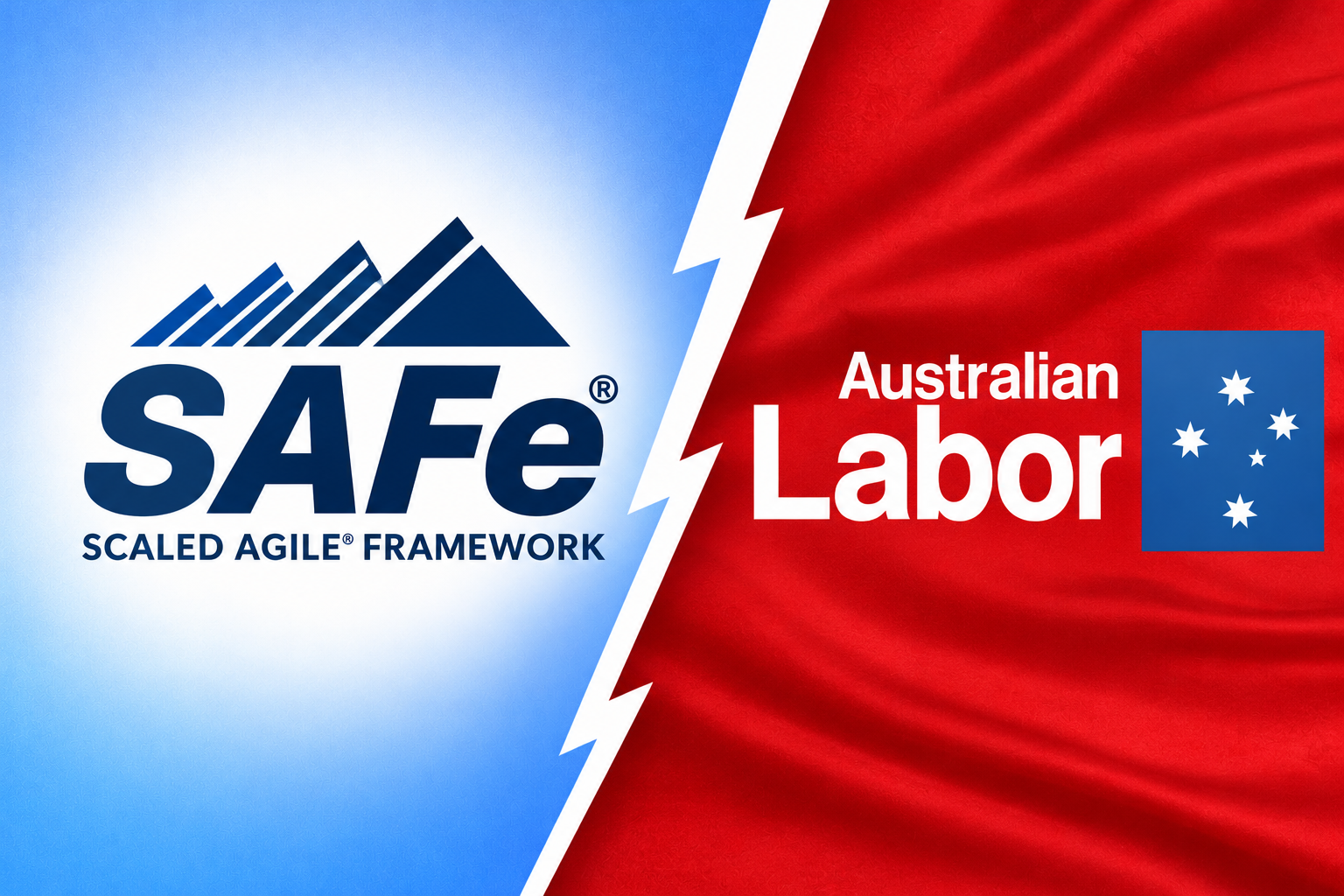
In the agile certification world, that party is SAFe, the Scaled Agile Framework.
SAFe emerged in 2011 from the work of Dean Leffingwell, who had spent years wrestling with a problem that the agile community was actively working to solve: how do you apply agile thinking across a large enterprise? The approaches on offer at the time were serious and principled, but they came with a significant ask. They required the enterprise to restructure, to dismantle hierarchy, to rethink governance from the ground up. Leffingwell took a different view. He met the enterprise where it was, building a framework that could live inside existing structures rather than demanding their removal as a precondition for entry. And in a move that would prove either inspired or irresistible depending on your perspective, he called it SAFe. Whatever you think of the framework, you have to admire the marketing. In an industry that had spent years arguing about whether agile was safe for the enterprise, naming your scaled framework the Scaled Agile Framework and shortening it to SAFe was a masterstroke. The enterprise heard the name and felt reassured before they’d read a single principle.
The result was a comprehensive, layered framework that acknowledged the realities of large organisations. Portfolio management, programme governance, release trains, PI planning ceremonies, architectural runway, business owners, RTE roles: SAFe gave the enterprise agile in a language the enterprise already spoke. The framework grew steadily, expanding with each version and by the time most practitioners encountered it, SAFe had become less a framework and more an ecosystem, complete with certifications, consulting partners, tooling integrations, and a global community of practice.
That breadth is both SAFe’s greatest strength and the source of its most persistent criticism. On one side, practitioners who have lived through failed agile transformations will tell you that SAFe gave them something to stand on, a common vocabulary, a planning cadence, a way to connect team-level delivery to portfolio-level priorities. On the other side, those with deeper roots in the progressive agile tradition will argue that SAFe reintroduces the very management layers and handoff points that agility was designed to remove, that it preserves the project-based operating model while calling it something new, and that its certifications prioritise fluency in the framework over genuine understanding of the underlying principles.
Both sides are, in important respects, correct. The published evidence base on SAFe outcomes is thin and contested, with most claims coming from parties with a commercial interest in the answer, which leaves practitioners to draw their own conclusions based on their experiences, rather than data.
So who is SAFe’s political counterpart?
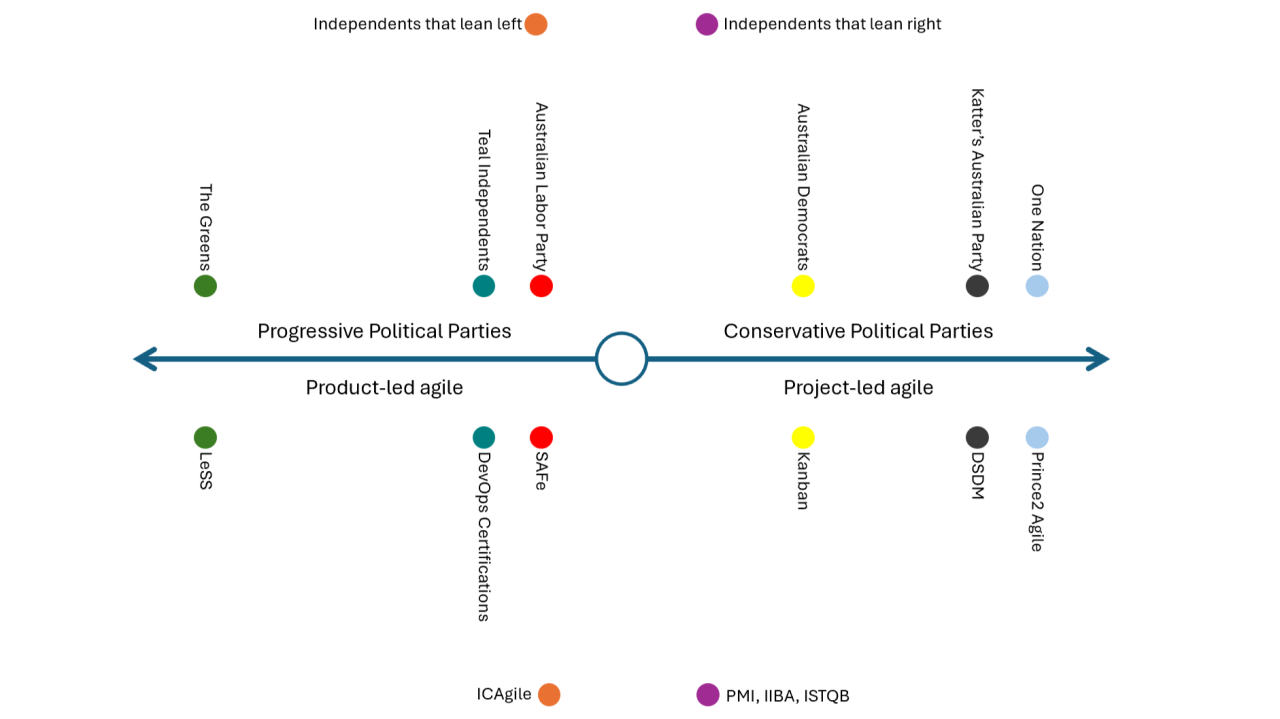
As our large-scale, institutionally progressive, pragmatic agile framework, SAFe maps to the Australian Labor Party.
The parallels run deeper than they might initially appear. The ALP was founded on the conviction that working people deserved better conditions, fairer systems, and a genuine voice in how institutions operated. It is, at its heart, a progressive movement. But Labor has always understood something that the parties further to its left tend to underestimate – you don’t win government by being right. You win it by being electable. And that means translating progressive values into policies that can carry constituencies well beyond the converted.
SAFe operates with exactly this logic. The agile movement had the right values: collaboration, flow, customer focus, empirical thinking. But enterprise adoption required more than values. It required structure that PMOs could recognise, reporting lines that executives could work within, and a rollout model that HR and finance could plan around. SAFe provided all of it. It didn’t so much compromise agile as it packaged agile for an audience that would never have signed up to the original proposition without that packaging.
Labor has always understood that reach requires infrastructure, not just principle. The ALP built its base through affiliated institutions and organised constituencies, individual unions folding their cause into the broader movement, each one extending the party’s reach into communities it couldn’t have accessed alone. SAFe’s partner model works the same way. The network of certified consultants and implementation partners created an ecosystem with a remarkably low barrier to entry. Complete a four-day course, pass the exam, and you were a SAFe Practice Consultant (SPC), empowered with the courseware and authorised to deliver training. The credential created the constituency, and the constituency grew the framework. Critically, SAFe gave that constituency something the rest of the agile world hadn’t managed to offer at scale: a framework with enough structure and governance that leadership could see themselves in it. Executives had a model. Portfolio managers had a layer. Programme leads had a planning cadence. From a scaling perspective, the rest of the agile world was offering radical models that required a shift in mindset before they could take hold. SAFe was already in the building.
There is something recognisably Labor in the tension that sits at SAFe’s centre. Labor has always attracted people whose values sit well to the left of the party platform, people who made their peace with the compromise because the alternative was no seat at the table at all. SAFe drew exactly that kind of practitioner. Coaches and consultants who cared deeply about product thinking, genuine agility, and organisational transformation found that SAFe got them through the door of enterprises that would never have engaged them otherwise. For those practitioners, SAFe was training wheels, a pragmatic starting point from which the real work of shifting mindsets could begin. The problem is that the framework is large enough, and complex enough, that for most organisations it became the destination rather than the departure point. The training wheels never came off. And the practitioners who always intended to remove them found themselves maintaining a system they had hoped to transcend.
For practitioners, SAFe certifications provide genuine value for people working in large enterprise contexts who need to navigate the intersection of agile delivery and traditional governance. The PI planning approach, when implemented well, creates real alignment across teams that previously had no shared rhythm. The portfolio-level thinking addresses a genuine gap that team-level agile methods leave almost entirely unaddressed. And the common vocabulary SAFe establishes across a programme or portfolio is not a small thing. When practitioners from different disciplines can have a productive conversation about capacity, priorities, and dependencies without translating between frameworks, that shared language is valuable.
At the same time, be clear about the limitations. SAFe certifications, particularly at the foundational levels, often produce practitioners who are knowledgeable in SAFe rather than fluent in agile. The distinction matters. An organisation that has implemented SAFe has changed how it coordinates and plans. It has not necessarily changed how it thinks about value, customers, or the nature of the work. The transformation has often reached the programme layer and stopped there, leaving the underlying operating assumptions, particularly the assumption that work is best managed as a sequence of projects rather than as continuous product development, largely intact.
The Australian Labor Party rarely governs from its most progressive position. It wins by being electable, implements by being pragmatic, and makes its peace with the fact that the transformation it delivers will always be partial. SAFe carries the same character. Organisations that adopt it do move, structures loosen, delivery improves, conversations about value and flow begin to happen that simply weren’t happening before. But it has also, in many implementations, made a comfortable home for exactly the kind of governance and hierarchy that agile was supposed to challenge. Whether you view that as a reasonable compromise or a fundamental betrayal says a great deal about where you sit on the Agile Political Spectrum.
Just don’t be surprised when SAFe, like Labor, occasionally needs to negotiate with its own right faction to get anything across the line. Breadth has always come at a price.
This article was originally published on LinkedIn by Daniel Luschwitz.
Please note: This is article 8 in a series that explores mapping agile certifications to what Daniel Luschwitz and I have coined the Agile Political Spectrum. The previous blogs in the series are available here:
A note on our political comparisons: These political comparisons are playful metaphors designed to illustrate philosophical positions on the agile spectrum. No certification body was harmed in the making of this analysis.
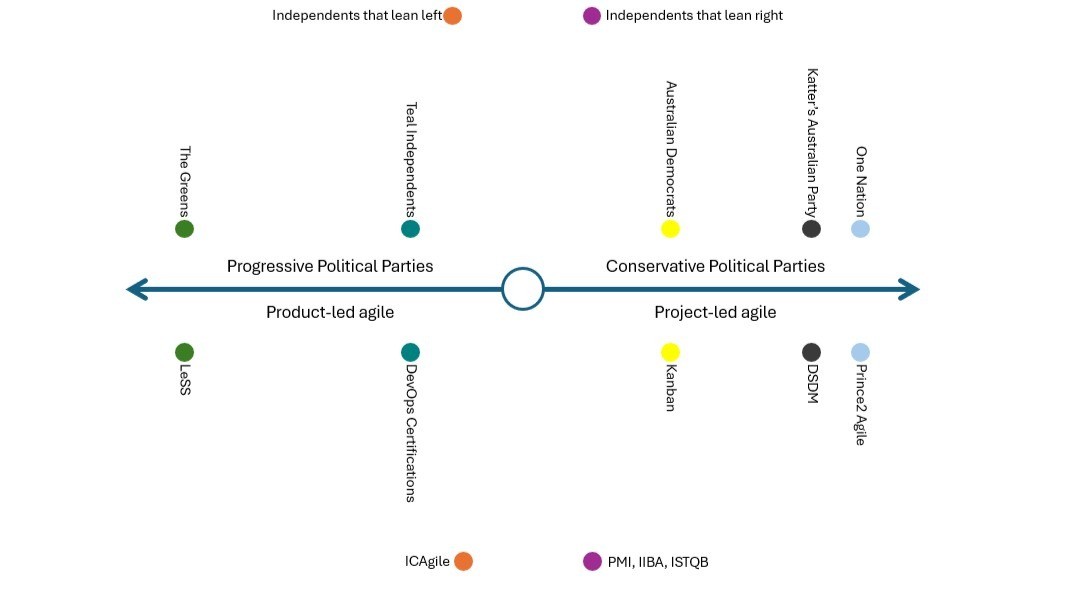
Every political spectrum has its right-leaning independents. Not party loyalists, not ideologues, but professionals who built their authority within an established discipline, created a constituency around it, and when the political winds shifted, didn’t abandon their ground. They absorbed the new language, translated it into terms their community already understood, and carried on.
In the agile certification world, that role belongs to PMI, IIBA and ISTQB.
The Project Management Institute (PMI), the International Institute of Business Analysis (IIBA), and the International Software Testing Qualifications Board (ISTQB) weren’t born from the agile movement. Each was built on the conviction that project management, business analysis, and software testing were distinct professional disciplines, each deserving its own body of knowledge, its own structured credential, and its own seat at the table. All three had developed substantial, globally recognised certification architectures on that premise long before agile became the dominant conversation in solutions delivery. And when that conversation became impossible to ignore, all three made the same move: they added agile to what they already offered, on their own terms.
PMI was the earliest and perhaps the most deliberate about it. The Project Management Institute had spent decades building the PMP into arguably the most recognised project management credential on the planet. When agile began reshaping how solutions were delivered, PMI had a problem: the profession it represented was being told, by increasingly loud voices, that its core assumptions were wrong. Rather than engage with that critique, PMI launched the PMI Agile Certified Practitioner, the PMI-ACP, in 2011. The message was clear: agile is a toolkit, and project managers can learn to use it. The PMI-ACP covers a broad range of agile and hybrid approaches, drawing on methodologies from across the spectrum to demonstrate that agile competency is an addition to the project manager’s repertoire, not a replacement for it. The role stayed intact. The credential adapted around it.
The absorption deepened from there. In 2019, PMI acquired Disciplined Agile from Scott Ambler and Mark Lines, and weeks later FLEX from Al Shalloway‘s Net Objectives; some of the more thoughtful independent voices in the agile community. Then came PMBOK 7 in 2021, the most complete move of all. The Guide abandoned the architecture that had defined the profession for decades – ten knowledge areas, forty-nine processes, the full procedural edifice – and restructured itself around twelve principles and eight performance domains, with a new vocabulary of value delivery, stewardship, and tailoring. Every principle could be reconciled with agile, lean, traditional, or hybrid ways of working. Presented as modernisation, it was also a reframing broad enough that almost no position within the delivery community sat outside it. The Guide no longer committed itself to a method; it committed itself to being the container within which methods live.
IIBA and ISTQB followed the same instinct. Because the question agile was really asking, whether specialist roles like the BA and the dedicated tester needed to exist in their traditional form within self-organising teams, was precisely the question neither body had any institutional interest in answering honestly. So they answered a different one. They asked how agile delivery changes the context these disciplines operate in, and built certifications around that. IIBA demonstrated this instinct directly: business analysis became “agile analysis”, the BABOK grew an agile extension, and a new certification emerged to recognise competency in delivering analysis within an agile context. ISTQB followed the same pattern. The vocabulary changed. The disciplines they described did not.
They weren’t alone in this approach. Across the professional credentialling landscape, a number of established bodies followed the same instinct, extending their frameworks to acknowledge agile without disturbing the structures those frameworks were built to protect. The pattern is consistent: take the new vocabulary, demonstrate how your discipline remains relevant within it, and issue a credential that bridges the two worlds. It’s not cynical. It’s what professional bodies do. They exist to conserve something, and they’re good at it.
So who are PMI, IIBA and ISTQB’s political counterparts?
As our discipline-first, reframe-rather-than-reform agile certifications, they map to the right-leaning independents: professionals who enter the political arena not to change the system but to make sure their constituency is protected within it. Independent of the major parties, pragmatic in their dealings, and deeply conservative in the one area that matters most: the continued relevance of the professional community they represent.
The parallels are direct. Right-leaning independents don’t arrive in parliament with a transformation agenda. They arrive with a specific brief: protect these jobs, represent this industry, make sure this community isn’t left behind by whatever the major parties decide to do next. PMI, IIBA and ISTQB carry exactly that brief. Their mandate isn’t to reimagine how solutions are built. It’s to ensure that project managers, business analysts, and testers retain a credentialled, respected place in whatever delivery model their organisations adopt. Agile is the context. It is not the cause.
This is also why the agile content within these certifications tends to feel like an additional module rather than a rewrite of the core. It is worth acknowledging that PMI made genuine strides here: the shift to a principles-based model in their later standards represented real philosophical movement, not just rebranding. But even with that evolution, the agile extensions across all three bodies still sit on top of established role structures, the knowledge domains, the professional boundaries, all remain structurally intact. Agile is introduced as a context the discipline now operates within, not a lens that reexamines whether the discipline, in its current form, is still the right tool. The project manager still manages. The BA still analyses. The tester still tests. The world changed around them, and the certification acknowledges that. The professional identity at the centre did not move.
Right-leaning independents are notably pragmatic about language. When the political winds shift, they update their messaging before they update their positions. All three bodies demonstrated this instinct. All three speak agile fluently, and they mean it, but the fluency is in service of protecting the ground they already hold. The translation is genuine. The priorities underneath it are unchanged.
For practitioners, that’s not necessarily a problem. A project manager holding the PMI-ACP brings something real to an agile context: breadth across multiple approaches, familiarity with hybrid environments, and a structured lens for managing complexity. An experienced business analyst who understands stakeholder facilitation, business value, and how to navigate complex organisational constraints brings real value to an agile team. A tester with genuine capability in risk, coverage, and quality thinking is an asset in any delivery environment. These certifications offer a structured bridge between deep existing expertise and the agile context it now operates within. That’s worth something, and it shouldn’t be dismissed.
For organisations, understand what you’re investing in: practitioners equipped to apply their discipline within agile delivery, not practitioners equipped to question whether that discipline, as currently structured, is what the team actually needs. In environments where project management, BA, and testing functions are well established and role clarity matters, these may be exactly the right credentials. In environments genuinely rethinking their operating model, the role boundaries these certifications reinforce may be part of what you’re trying to move beyond.
Right-leaning independents serve a real constituency and they serve it honestly. They’re not in parliament to lead a revolution. They’re there to make sure that when the revolution arrives, the people they represent still have a seat at the table. PMI, IIBA and ISTQB do exactly the same thing. They didn’t reshape agile. They made sure agile had room for the professionals who were already in the room. Whether that’s the credential you need depends entirely on whether your goal is to fit agile around your existing structure, or to let agile challenge it.
This article was originally published on LinkedIn by Daniel Luschwitz.
Please note: This is article 7 in a series that explores mapping agile certifications to what Daniel Luschwitz and I have coined the Agile Political Spectrum. The previous blogs in the series are available here:
A note on our political comparisons: These political comparisons are playful metaphors designed to illustrate philosophical positions on the agile spectrum. No certification body was harmed in the making of this analysis.
Every political spectrum has its left-leaning independents. Not career politicians shaped by party preselection and factional compromise, but people who arrive carrying genuine depth in a field, a clear set of values, and a conviction that none of the available options adequately represent what they believe. They don’t offer a party platform. They offer a proposition based on principles and evidence, choosing policies that best fit the community they serve.
In the agile world, the certification that best represents the left-leaning independent is ICAgile.
Now before we go too deeply, Daniel and I should acknowledge our relationship with respect to ICAgile. We both have a long association with the certification as founding partners and have dedicated much of our careers to what this certification set out to achieve. We have done our best to apply the same honesty here that we have brought to the rest of the series, but some bias might prevail.
The International Consortium for Agile was founded in 2010 by Ahmed Sidky, Ph.D and Alistair Cockburn, an original signatory of the Agile Manifesto. Their founding proposition was radical for its time: agile is not a process, a methodology, or a framework. It is a mindset, described by four values, defined by twelve principles, and manifested through an unlimited number of practices. ICAgile was the first certification body to build its entire certification architecture around this approach. It was designed explicitly to strip away any prescriptive approaches and invite participants to adopt agile in their context. ICAgile is the “choose your own adventure” story in the spectrum.
So who is ICAgile’s political counterpart?
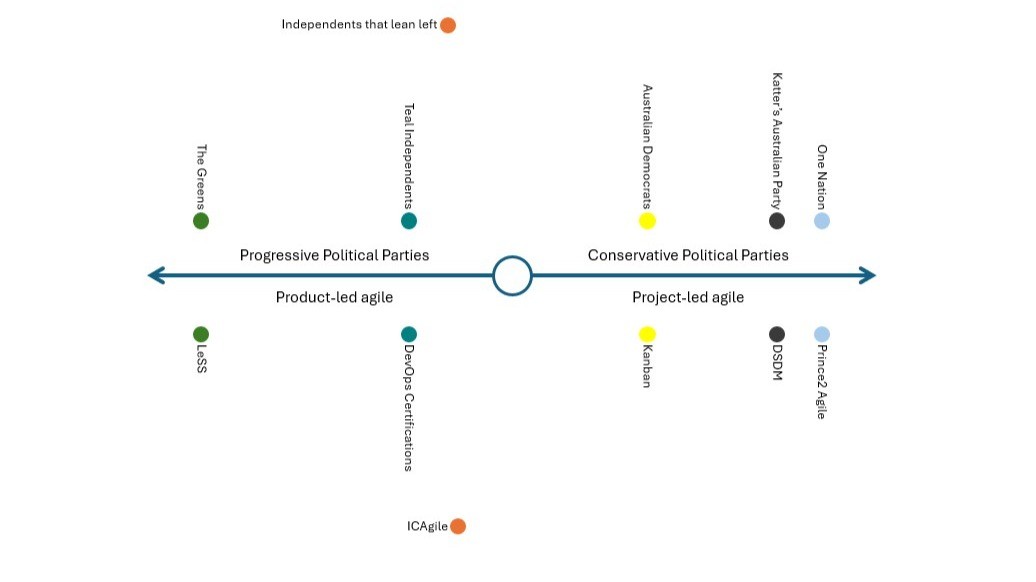
As our values-driven and deliberately non-prescriptive agile certification, ICAgile maps to left-leaning independents, the credible crossbenchers who sit outside the major party structures, have deep expertise in their chosen discipline, and win on the strength of their knowledge and principles.
The parallels are immediate. Left-leaning independents don’t run on a party platform because a platform implies a fixed position regardless of context. Instead, they review the options, apply their expertise, and make policy decisions based on what their community actually needs. ICAgile works the same way. It accredited learning experiences against outcomes developed by thought leaders, and trusted facilitators to review the available approaches, apply their own expertise, and choose the practices that best suited their learners. Neither is making a bet on a single system. Both are making a bet on the quality of the judgement in the room.
Left-leaning independents also attract people of genuine substance. What draws them is rarely ambition for power, it is frustration that the existing options are failing the people they care about. Their constituents are not just voters; they are the community they have spent their professional lives serving. ICAgile attracted the same calibre of contributor. The thought leaders who built its learning tracks, Craig among them, brought genuine field experience to what they created. These were not theorists writing curriculum. They were practitioners who had lived the problems the learning was designed to address, and that credibility showed in the quality of what the best facilitators delivered.
One of the most compelling qualities of the left-leaning independent is the breadth of community they can serve. Unconstrained by party ideology, they are free to work across the aisle, drawing on whatever evidence and expertise the situation demands. Their values are progressive, but their reach is not limited to the left. ICAgile operates the same way. Grounded in a progressive, mindset-first philosophy, its certification was never the exclusive territory of product-led organisations or transformation advocates. Practitioners working in heavily governed, project-based environments found ICAgile equally valuable, because values and principles are transferable regardless of context. A conservative organisation and a progressive one can both benefit from genuine agile understanding. The method they choose to apply it through is simply a different chapter of the same adventure.
There is a challenge that comes with being an independent that party politicians rarely face in the same way. Without a machine behind them, left-leaning independents can spread themselves across too many issues, developing a view on everything and a focused mandate on nothing. The community expects breadth, but the work demands focus. ICAgile faced an equivalent tension. The curriculum expanded steadily across the years, reaching into coaching, leadership, product ownership, DevOps, and business agility, each addition driven by genuine expertise and real demand. But breadth created a maintenance problem. Learning outcomes that had been developed by some of the finest practitioners in the field began to age, and the pace of updates did not match the pace at which the discipline was moving. What had once felt current started to feel like it was describing a conversation from several years earlier. There was also a structural constraint that compounded this: every certification had to fit within a deliverable of two or more days to qualify, which worked well for standalone learning but became a genuine hindrance when organisations needed bespoke, modular transformation programs that didn’t map neatly to that format. The architecture that had once been liberating had quietly become a limitation.
For practitioners, ICAgile’s foundational certification remains one of the most intellectually honest starting points in the market. It grounds people in the thinking behind agility rather than the mechanics of performing it. Because the learning is anchored in values and principles rather than prescribed practices, it has an inherent flexibility that method-specific certifications simply cannot offer. Practitioners are not taught one way to do something. They are equipped to think about why agility works, which means the application of that learning can evolve as the field evolves, as their organisation matures, and as their context demands. For organisations, understand what you are investing in: practitioners who can think, adapt, and choose the right approach for their context, rather than practitioners who can only perform a prescribed one.
Left-leaning independents rarely form government. Their value is not in the machinery of power but in the quality of thinking they bring to the room, and in their willingness to hold a position on principle when the major parties are playing politics. ICAgile’s most enduring contribution is exactly that: it said, early and clearly, that agile is a mindset and that the values and principles that define it can be applied in any context, through any practice, by any team willing to genuinely understand them. No method required. No platform necessary. Just the conviction that the right answer should follow the evidence and the context, not the other way around.
This article was originally published on LinkedIn by Daniel Luschwitz. The next article in the series is PMI, IIBA, ISTQB and the Right-Leaning Independents.

Please note: This is article 6 in a series that explores mapping agile certifications to what Daniel Luschwitz and I have coined the Agile Political Spectrum. The previous blogs in the series are available here:
A note on our political comparisons: These political comparisons are playful metaphors designed to illustrate philosophical positions on the agile spectrum. No certification body was harmed in the making of this analysis.
Every political spectrum has its quietly effective parties. Not the idealists demanding systemic overhaul. Not the establishment parties jostling for the centre. But the movements that do serious, disciplined work, build a loyal following, and somehow never quite break through to the mainstream because a louder, more charismatic neighbour took all the air out of the room.
In the agile certification world, that party is Kanban.
Ask most practitioners if they ‘use Kanban’ and a majority will say yes. Ask them whether they actively limit work in progress, track flow metrics, use service level expectations, or practice evolutionary change discipline and the numbers drop sharply.
David J. Anderson, who pioneered the Kanban Method for knowledge work, has himself declared “Kanban is ubiquitous, it’s time to declare victory.” And in one sense, he’s right. Kanban boards are everywhere however the Kanban Method is far less common than you might think. That gap, between widespread adoption of the surface and shallow understanding of the substance, is precisely what makes Kanban one of the most underappreciated certifications on our Agile Political Spectrum.
Kanban’s roots stretch back to post-war Japan and the Toyota Production System, not as ideology, but as operational discipline. The original Kanban was a signalling card used to trigger replenishment in a pull-based production line. No manifesto. No cultural revolution. A control mechanism designed to reduce inventory risk and improve flow.
When Anderson introduced the Kanban Method to knowledge work in the mid-2000s, he was deliberate about what it was and wasn’t. He made the positioning explicit from the outset: start with what you do now, respect current roles and responsibilities, and pursue incremental, evolutionary improvement.
Kanban does not require new roles, it does not demand reorganisation or assume that hierarchy must be dismantled. Instead, it asks organisations to visualise their work, limit work in progress, measure flow, manage risk, and improve gradually over time. This is not structural reform. It is structural preservation combined with operational discipline.
Over time, Kanban matured into a serious professional discipline. Kanban University formalised the certification pathway, building a rigorous body of knowledge around flow metrics, service-level expectations, probabilistic forecasting, and the Kanban Maturity Model. The emphasis was never on ceremonies or team rituals. It was on service delivery systems and organisational capability.
So who is Kanban’s political counterpart?
As our right-of-centre, disciplined, and chronically underrated agile certification, Kanban maps to the Australian Democrats.
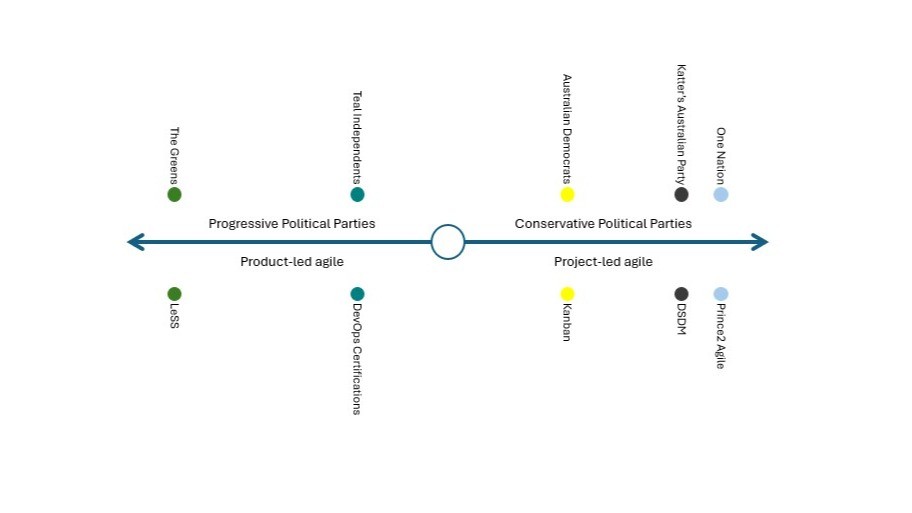
The Australian Democrats were a centrist party founded in 1977, best known for holding the balance of power in the Senate and their rallying cry: “keeping the bastards honest.” At their peak they wielded influence well beyond their vote share, doing serious legislative work while louder voices on both sides dominated the headlines.
The parallels with Kanban are immediate and striking.
Both built serious, rigorous bodies of knowledge and operated with genuine discipline. Both accumulated loyal, knowledgeable followings that punched above their weight in terms of real-world influence. And both were ultimately drowned out, not because their ideas were wrong, but because a louder movement captured the room.
Against the noise of certification ecosystems that scaled aggressively through the 2000s and 2010s, Kanban University’s comparatively modest global network barely registers. And yet, in organisations that genuinely implement it, the Kanban Method consistently delivers improved flow, reduced risk, greater predictability, and a cleaner picture of organisational capacity.
The Democrats were never trying to win government. They were trying to make the system work better. Kanban was never trying to replace whatever else was in the room. It was trying to improve how work flows through whatever system already exists. Both found meaningful influence in that role. Neither got the recognition their contribution deserved.
Kanban boards have become so ubiquitous that many practitioners genuinely believe they are “doing Kanban” simply by moving cards across columns in a tool or on a physical whiteboard. Far fewer implement WIP limits with discipline. Fewer still track cycle time, use probabilistic forecasting, or develop capability in flow analytics. The Kanban Maturity Model, one of the more thoughtful frameworks for understanding organisational development in the agile world, is largely unknown outside the Kanban community itself.
This creates a peculiar market dynamic. Kanban suffers not from bad press, but from misrepresentation by familiarity. Nobody declares Kanban adoption a failure. They just assume they’re already doing it. The certification therefore struggles to communicate its genuine depth to a market that thinks it already knows what Kanban is.
The agile world generated years of passionate debate, consultant wars, and certification inflation around louder frameworks, which paradoxically gave them more visibility. Kanban slipped in the back door, got implemented on whiteboards everywhere, and then got largely forgotten as a serious discipline.
Kanban sits on the right-conservative side of our Agile Political Spectrum, but in a particular way. It is not conservative because it adds bureaucracy or resists change. It is conservative because it genuinely respects existing structures and pursues improvement within them rather than demanding their replacement.
This makes Kanban valuable in a range of contexts that more progressive certifications struggle to serve. For teams operating in complex, highly regulated, or politically sensitive environments where structural redesign is simply not on the table, Kanban offers a credible, evidence-based path to improvement. For leaders who need to demonstrate results without triggering a governance revolt, Kanban’s language of flow, throughput, and risk is far more accessible than the vocabulary of transformation.
For organisations genuinely committed to a product operating model and cultural transformation, Kanban may feel insufficient on its own, though it often becomes essential as a delivery discipline within that broader journey. The ability to visualise and manage flow doesn’t become less important once you’ve reorganised around products. It becomes more important.
If you are an organisation wondering whether Kanban ‘counts’ as agile, or whether it’s just a board tool, the answer is that the board is the least interesting part. The discipline underneath it is where the value lives.
The Australian Democrats may no longer exist as a political party. Their legacy, however, is woven into the fabric of Australian legislative history in ways that rarely get acknowledged. Kanban risks a similar fate, its ideas absorbed into every tool and methodology without credit, its depth largely undiscovered.
Like a good Democrats senator, Kanban won’t promise you a revolution. But it will make the system you already have work considerably better. If you are attempting to reduce waste, bottlenecks and the invisible work quietly choking your organisation then Kanban might be just what you need in keeping the bastards honest.
This article was originally published on LinkedIn by Daniel Luschwitz. The next article in the series is ICAgile and the Left-Leaning Independents.
Please note: This is the fourth article in a series that explores mapping agile certifications to what Daniel Luschwitz and I have coined the Agile Political Spectrum. The previous blogs in the series are available here:
A note on our political comparisons: These political comparisons are playful metaphors designed to illustrate philosophical positions on the agile spectrum. No certification body was harmed in the making of this analysis.
Every political spectrum needs its bridge-builders. Movements that refuse to fit neatly into traditional categories, that challenge established divides, and that prioritise outcomes over ideological purity. In the agile certification world, that’s DevOps.
DevOps emerged in the late 2000s from frustration with the fundamental divide between software development and IT operations. Developers wanted speed and change; operations wanted stability and control. The result was organisational silos, blame cultures, and slow, unreliable software delivery. In 2009, Patrick Debois organised the first DevOpsDays conference in Belgium, crystallising a movement that had been brewing in organisations struggling with this dysfunction.
The core insight of DevOps was never primarily technical, it was cultural. Yes, automation, continuous integration, and infrastructure as code became associated practices, but the fundamental shift was breaking down the wall between Dev and Ops: shared responsibility, collaborative problem-solving, and optimising for the whole system rather than individual silos. You can’t buy DevOps in a box. You must become it.
There is no single definition of DevOps as it became a set of practices and principles defined by the community. A number of bodies and vendors emerged offering certifications, including those focussed on culture and principles (DevOps Institute, ICAgile, and SAFe), and those on technical implementation (AWS, Microsoft, Google, and others). Like the Teal Independents, these certifications are themselves independent. There is no single governing authority, no party platform, only a shared set of principles. This is part of what makes DevOps sometimes misunderstood. And like the Independents movement itself, the ecosystem continues to grow, with DevSecOps, GitOps, and MLOps extending the same philosophy into new domains.
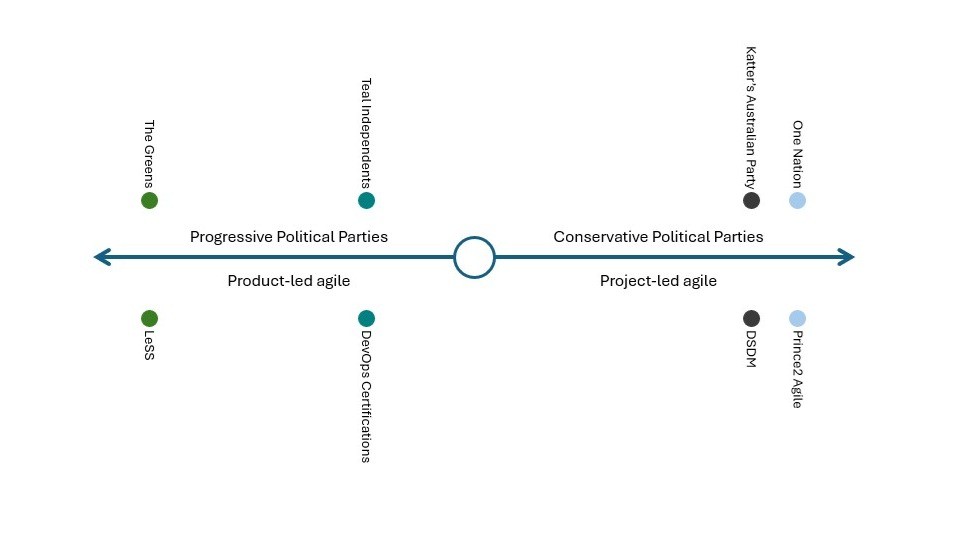
So who is DevOps’s political counterpart? As our left-progressive but pragmatic certification movement, DevOps maps to the Teal Independents.
The Teals emerged in 2022, winning traditionally Liberal seats by offering something that didn’t fit conventional party lines. They are progressive on social and environmental issues, yet centre-right on economic policy, focused on fiscal responsibility and business effectiveness. They rejected the false choice between environmental action and economic pragmatism.
DevOps certifications mirror this exactly. Progressive on culture by breaking down silos, challenging hierarchies, emphasising collaboration; but pragmatic on delivery through efficiency, automation, reliable systems, measurable outcomes. Just as the Teals blended blue economics with green values, DevOps blends cultural progressiveness with operational pragmatism. Both movements emerged from rejecting a false dichotomy that had paralysed their respective fields.
This positioning explains where DevOps sits on the agile political spectrum. It sits firmly on the left-progressive side because it enables something fundamental – continuous delivery. The technical foundation that makes product operating models possible.
Think of it this way. An organisation might reorganise around product teams, leadership might embrace product thinking, but if it still takes weeks to get a change into production with manual testing, change approval boards, scheduled release windows and the like, then the organisation chart has changed but the operating model hasn’t. DevOps is what closes that gap. Without it, the transition to product-led ways of working stalls at the delivery pipeline.
For practitioners, DevOps certifications provide essential frameworks for understanding software delivery as a sociotechnical system. It speaks to developers who need to care about operational concerns, and to operations professionals who need to embrace change and automation. For organisations, DevOps practices aren’t optional extras to bolt on after establishing product teams. The capability to deliver continuously must be built deliberately, and that requires both cultural change and significant technical investment.
Like a good independent MP, DevOps certifications won’t hand you a four-phase implementation plan. But they will help you understand what genuinely needs to change (culturally and technically) to make continuous delivery real.
This article was originally published on LinkedIn by Daniel Luschwitz. The next article in the series is Kanban and the Australian Democrats.
Please note: This is the third article in a series that explores mapping agile certifications to what Daniel Luschwitz and I have coined the Agile Political Spectrum. The previous blogs in the series are available here:
A note on our political comparisons: These political comparisons are playful metaphors designed to illustrate philosophical positions on the agile spectrum. No certification body was harmed in the making of this analysis.
DSDM emerged in 1994 from a consortium of UK organisations frustrated with failed IT projects. At the time, Rapid Application Development (RAD) was popular for its rapid prototyping and faster development, however, the movement was unstructured inviting some “cowboy” practices and issues around quality. DSDM was created by practitioners actually looking for more governance and stricter controls. They weren’t ideologists trying to revolutionise project delivery, they were pragmatists trying to find a balance between speed and quality. The result was one of the first true agile methods, with Arie van Bennekum representing the DSDM Consortium at the signing of the Agile Manifesto in 2001.
The DSDM philosophy centres on eight principles, including “focus on the business need”, “deliver on time”, and “build incrementally from firm foundations”. DSDM acknowledges that organisations need governance, stakeholders need confidence, and projects need structure, but it also wanted to allow teams to deliver value incrementally and adapt to change.
DSDM introduced some common agile practices still used today. Have you heard of MoSCoW prioritisation, timeboxing, iterative development, and continuous stakeholder involvement? These all came about in the creation of DSDM.
Yet DSDM remains unmistakably a project management approach. It defines roles like Business Sponsor, Project Manager, and Team Leader. It organises work into projects with defined phases: pre-project, feasibility, foundations, evolutionary development, deployment, and post-project. It emphasises business cases, feasibility studies, and formal review points.
In 2010, the DSDM Consortium partnered with APMG International offering three main certifications for Project Management, Business Analysis and Program Management –cementing DSDM’s positioning on the spectrum.
In 2016, the DSDM Consortium rebranded as the Agile Business Consortium and launched their Framework for Business Agility. On the surface, this looked like an evolution – moving beyond project delivery to address organisational agility. But here’s where the certification business model creates tension. The Agile Business Consortium now promotes business agility while their flagship offering remains AgilePM… Agile Project Management.
This is where DSDM faces the classic certification scale-up challenge: they built a successful business on project management certifications, saw the opportunity in business agility, but seemingly didn’t challenge their revenue stream far enough. They added to the market confusion that has inspired this series. How many of the 200,000+ AgilePM certification holders associate their credential with “business agility” because of the framework and branding? It’s a Kodak moment in reverse. Instead of a new technology disrupting the old business model, we saw the new concept (business agility) being absorbed into the old business model (agile project management).
DSDM has very specific appeal, typically chosen at an organisational level for its governance and control capabilities, often representing a logical evolutionary step from waterfall or RUP. While the framework itself is an organisational choice, it appeals strongly to project managers seeking an agile project management certification, offering them a structured approach that bridges traditional project governance with agile delivery.
So who is DSDM’s political counterpart? As our right-conservative, tactical agile certification, DSDM is equivalent to Katter’s Australian Party.
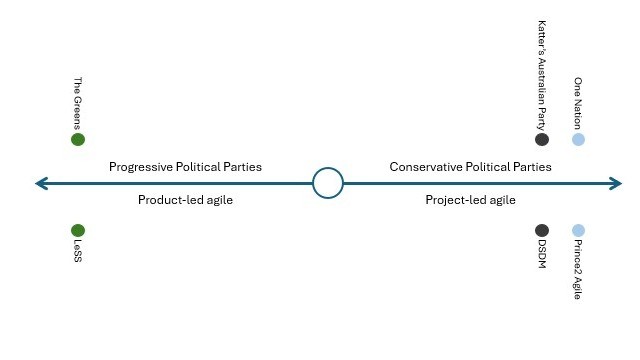
Katter’s Australian Party (KAP) is a right-conservative party, but not in the polished, establishment sense. It occupies a similar position in Australian politics that DSDM holds in the agile spectrum, both having carved out distinct identities outside the mainstream. KAP operates beyond the major party duopoly, while DSDM sits apart from dominant frameworks like Scrum and SAFe.
Both are conservative, but pragmatic rather than ideological. KAP blends traditional values with whatever works for regional communities; DSDM maintains project management foundations whilst adopting agile flexibility when needed. Neither appeals to purists or revolutionaries, instead they serve constituents who need practical solutions within existing constraints, valuing stability and proven approaches alongside necessary flexibility.
Both prioritise tangible results over theoretical purity. KAP focuses on concrete outcomes for rural and regional areas; DSDM emphasises delivering business value over perfect processes. And both have strong but geographically concentrated followings rather than global dominance, KAP in regional and rural Queensland, DSDM in the UK and European public sector organisations.
We are not sure about the parallels with crocodiles, or if cowboy hats are optional though.
DSDM has a valuable place in the market, particularly for project managers navigating the transition to agile. DSDM embraces the Project Manager, explicitly defining it as a key role responsible for traditional project management concerns while enabling teams to work iteratively.
If you’re a Project Manager looking for an “Agile Project Management” certification, AgilePM offers a straightforward and relatively affordable pathway. The Foundation and Practitioner structure provides clear progression without requiring continuous learning credits or subscription models – making it an accessible option for practitioners in conservative organisations with established PMOs and governance structures.
For organisations seeking business agility, continuous product delivery, or transformation of their operating model, understand what you’re getting: a tactical, right-conservative, project-based approach to agile delivery. The Agile Business Consortium branding might imply broader ambitions toward business agility, but the certification portfolio tells a different story. DSDM remains firmly project-focused.
Like its political counterpart, DSDM serves a specific constituency that values practical delivery within conservative structures. Just don’t mistake the “business agility” branding for a framework that challenges project-based thinking – because that would require challenging the very certification business that sustains it.
This article was originally published on LinkedIn by Daniel Luschwitz. The next article in the Agile Political Landscape Series is: DevOps and Teal Independents

Please note: This is the third article in a series that explores mapping agile certifications to what Daniel Luschwitz and I have coined the Agile Political Spectrum. The previous blogs in the series are available here:
What if Agile Certifications were a Political Party?
The Agile Political Landscape Series: PRINCE2 Agile and One Nation
A note on our political comparisons: These political comparisons are playful metaphors designed to illustrate philosophical positions on the agile spectrum. No certification body was harmed in the making of this analysis.
Every political spectrum needs its idealists – parties that refuse to compromise on their principles that would make the world a better place. In the agile certification world, that is Large-Scale Scrum which decided to “choose a vowel” and became known as LeSS.
LeSS emerged in 2005 from the work of Craig Larman and Bas Vodde, early adopters of Scrum who were attempting to scale the framework across multiple teams. In those early days, Larman and Vodde were among the few voices addressing Scrum at scale, pioneering territory with their books and experiments. Over a decade of work involving more than 500 experiments, they discovered something fundamental: the problem wasn’t that Scrum didn’t scale, the problem was that traditional organisational thinking prevented it from scaling.
This insight became the foundation of LeSS. Fewer roles, fewer artefacts, fewer processes. They stripped away the organisational debt accumulated over decades of hierarchical thinking and proposed doing more with less. The framework is deliberately minimal as its primary purpose is descaling through simplification. One product owner, one product backlog, multiple teams working together in coordinated sprints. No scaling roles, artefacts, or ceremonies beyond what teams need to coordinate. LeSS acknowledges it’s not for every business context as it focuses on two clear objectives: building adaptability and delivering customer value.
LeSS describes itself as “barely sufficient methodology”, providing minimal rules to establish empirical process control and whole-product focus, then expecting organisations to think, learn, and adapt. For organisations aligned with these objectives, LeSS offers ten guiding principles with certain mandatory practices that define the start of the journey. Beyond this, there are no detailed prescriptions or step-by-step playbooks. Instead, LeSS provides rules (the minimum framework), principles (the thinking foundation), guides (recommendations worth trying), and experiments (situational options). This isn’t a methodology you implement; it’s a framework that defines a minimum standard and invites you to apply systems thinking and lean thinking to continuously improve your organisation toward your objectives.
So on our spectrum of agile certifications, who is LeSS’ political counterpart? As our far-left progressive agile certification, LeSS is equivalent to The Greens.
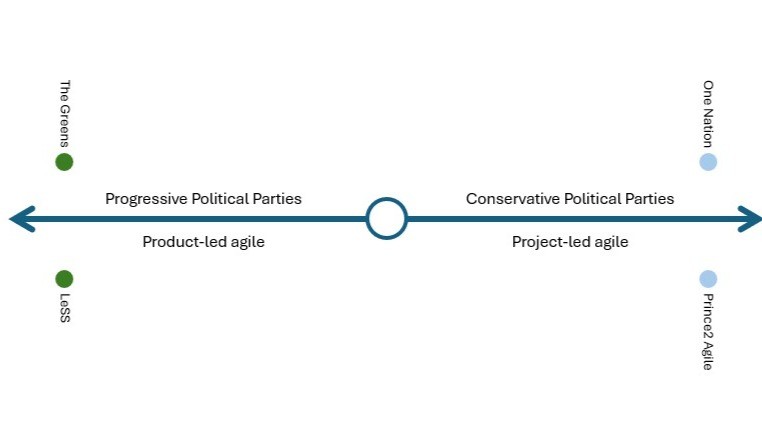
The parallels are immediate and striking.
Both emerged from direct experience with key problems being treated as negotiable. The Greens because environmental degradation was compromised away by major parties, LeSS because Larman and Vodde discovered that scaling Scrum required removing organisational impediments, not adding structure. Both demand systemic transformation: The Greens challenge capitalism’s growth imperative and advocate for radical power redistribution; LeSS eliminates command-and-control hierarchies and redistributes authority to self-organising teams.
Both champion grassroots empowerment and systems thinking. Both define a minimum acceptable state and argue that anything less undermines the outcomes they seek to achieve.
Both also share a common challenge: translating a principled vision into change within complex, existing systems. The Greens articulate a clear picture of sustainable societies while facing scrutiny over transition pathways within current economic structures. Similarly, LeSS articulates a clear minimum state for effective agility, while deliberately avoiding prescriptive transformation roadmaps. Both describe a minimum standard for an acceptable state and invites us to confront the gap between the current reality and meeting this standard. For some, this clarity is liberating; for others, it can feel confronting.
This explains why LeSS has such polarising appeal. For organisations genuinely committed to transformation, for leaders willing to challenge their own authority, for teams ready to take on real responsibility, LeSS provides a clear and uncompromising path – it’s honest about what’s required and doesn’t pretend you can have agility without changing power structures. The certifications reflect this philosophy: training will provide you with this acceptable standard, however, if you are operating in a project-led structure even this might seem like an insurmountable barrier.
LeSS appeals to an organisational profile that is looking to optimise towards adaptability and value delivery. If you’re working in a more traditional organisation with entrenched hierarchies, established governance structures, and risk-averse cultures, the radical simplification and structural changes LeSS requires will feel frustratingly disconnected from your reality. This doesn’t mean that LeSS is wrong, it likely means your organisation is optimising toward different objectives. In that case, LeSS becomes a reference point for what agile at scale could look like, rather than a framework that serves your current needs.
In many ways, LeSS resembles the Australian Greens party in politics – it articulates an ambitious, principle-driven vision of how things ought to work, appealing strongly to those who share its values. However, like the Greens operating within Australia’s established political system, LeSS can struggle to gain traction if your worldview is on the right-side of the spectrum.
There’s nothing wrong with unwavering principles and minimum standards. Progress requires people willing to articulate a vision, to refuse compromise, to insist that systemic problems require systemic solutions. The Greens serve this role in politics. LeSS serves this role in the agile political landscape.
For organisations ready to genuinely transform, LeSS might be exactly what you need. For organisations needing to navigating current realities such as command-and-control leadership and heavy bureaucracy, you may need to look elsewhere on the spectrum to address these constraints first. Like its political counterpart, LeSS isn’t trying to win over the pragmatists. It’s trying to inspire the revolutionaries.
Special thanks to Venkatesh Krishnamurthy, Australia’s first Certified LeSS Trainer for his contributions to this article.
Footnote: In this article we specifically focused on LeSS as it fits within our requirement of offering an agile certification, however, we would like to acknowledge its place alongside others in what we have deemed the “ideal state movement”. This entire movement is rich with various approaches addressing work differently. Examples include Holacracy‘s elimination of hierarchy, FAST‘s fluid teaming and network structures, XScale‘s descaling and elimination of command-and-control, and Teal organisations‘ evolutionary purpose made famous in Laloux’s cultural model.
This article was originally published on LinkedIn by Daniel Luschwitz. The next article in the Agile Political Landscape series is: DSDM and Katter’s Australian Party


You must be logged in to post a comment.