Agile Encore 2013: Visual Management: Leading With What You Can See

AgileEncore2013My presentation from the Agile Encore 2013 conference called “Visual Management: Leading With What You Can See” is available on Slideshare.

Renee Troughton was unfortunately unable to join me to present this reprise of the talk we presented together at Agile Australia 2013.

Using task boards or story walls is a key Agile practice, but are you making the most of it? Visual Management is more than just putting cards on a wall, it is a growing style of management that focuses on managing work only by what you can see rather than reports or paper being shuffled around. Visual Management allows you to understand the constraints in the system, mitigate risks before they become issues, report on progress from the micro to the macro. Visual Management can also be used to demonstrate to customers and clients where the work they care about is at. This presentation is all about taking the management of your work to the next stage of transparency. Discover:

* How to identify when your story wall isn’t telling you everything and how to adjust it
* What the three different types of story walls are and which one is more suitable to certain circumstances
* Different ways to visualise your product backlogWhy queue columns and limiting work in progress is so important regardless of whether you are using Scrum or Kanban
* How symbols and tokens can be used to give more information
* What else can you use other than story walls to visualise information
* How to ingrain Visual Management into both the team and management structures of your organisation
* Visualising Your Quality, Testing and Team
* What is systemic flow mapping and why is it important

Unfortunately the talk was interrupted about three-quarters of the way through by a rogue video conference call into the auditorium. My attempt to try and answer questions why people were trying to fix the problem were interrupted by audio coming through the call. We soldiered on – but it interrupted the flow.

And here are some feedback from the feedback forms – much appreciated!

  • Lots of ideas
  • Very informative with real world examples
  • Delivered as per advertised. Was relevant and interesting to listen to. Some great take outs
  • More relevant to where we are as an organisation
  • Big wall
  • Most applicable as I am a newbie
  • Kept the audience engaged from start to finish
  • The task based techniques most relevant
  • Gave more understanding of how to do better Agile


Agile 2013: 7 Deadly Sins of Agile Software Test Automation

Agile2013_Speaker_bannerMy presentation from the Agile 2013 conference called “ 7 Deadly Sins of Agile Software Test Automation” is available on Slideshare.

Adrian Smith was unfortunately unable to join me to present this extended version of the talk that he has presented previously at Agile Australia and Fusion.

Automated software testing is a key enabler for teams wanting to build high quality software that can be progressively enhanced and continuously released. To ensure development practices are sustainable, automated testing must be treated as a first-class citizen and not all approaches are created equal. Some approaches can accumulate technical debt, cause duplication of effort and even team dysfunctions.

The seven deadly sins of automated software testing are a set of common anti-patterns that have been found to erode the value of automated testing resulting in long term maintenance issues and ultimately affecting the ability of development teams to respond to change and continuously deliver.

Taking the classic seven sins (Gluttony, Sloth, Lust, Envy, Rage, Pride, Greed) as they might be applied to test automation we will discuss how to identify each automated sin and more importantly provide guidance on recommended solutions and how to avoid them in the first place.

A full house for the talk, some really positive feedback and heaps of questions following the talk, so thanks to everyone who attended!

And here are the comments from the feedback cards that were handed in and nothing negative!:

  • Great speaker, am so glad I came here
  • Excellent slides, pictures
  • Very humorous – kept me awake!
  • Super content, gave me some great ideas to take back to my workplace. THANKYOU!
  • Great analogy, good tips / info
  • By far, the absolute best QA session I have attended this week. I wish my entire company could have heard this presentation. It was engaging, meaningful and practical information that I can take directly back to my colleagues. Well done!
  • Very good session, got a lot out of it – got some good direction, fun presentation
  • Best session I have attended! Great speaker delivering the content in a very entertaining manner
  • Excellent session! Craig is a great speaker, content was SO good! Nice I can go get preso and link to templates and materials
  • Pragmatic testing!! 🙂
  • Enjoyed the session, this will make me look for other opportunities (tools) for automation testing
  • Great speaker! Although new to testing sessions, I gained good insight from this session to put into use back at the business! 🙂
  • This was the most insightful and best talk I’ve attended thus far
  • Excellent session

Agile Australia 2013: Visual Management: Leading With What You Can See

Agile Australia 2013 Speaker ButtonMy presentation with Renee Troughton from the Agile Australia 2013 conference called “Visual Management: Leading With What You Can See” is available on Slideshare.

Using task boards or story walls is a key Agile practice, but are you making the most of it? Visual Management is more than just putting cards on a wall, it is a growing style of management that focuses on managing work only by what you can see rather than reports or paper being shuffled around. Visual Management allows you to understand the constraints in the system, mitigate risks before they become issues, report on progress from the micro to the macro. Visual Management can also be used to demonstrate to customers and clients where the work they care about is at. This presentation is all about taking the management of your work to the next stage of transparency. Discover:

* How to identify when your story wall isn’t telling you everything and how to adjust it
* What the three different types of story walls are and which one is more suitable to certain circumstances
* Different ways to visualise your product backlogWhy queue columns and limiting work in progress is so important regardless of whether you are using Scrum or Kanban
* How symbols and tokens can be used to give more information
* What else can you use other than story walls to visualise information
* How to ingrain Visual Management into both the team and management structures of your organisation
* Visualising Your Quality, Testing and Team
* What is systemic flow mapping and why is it important

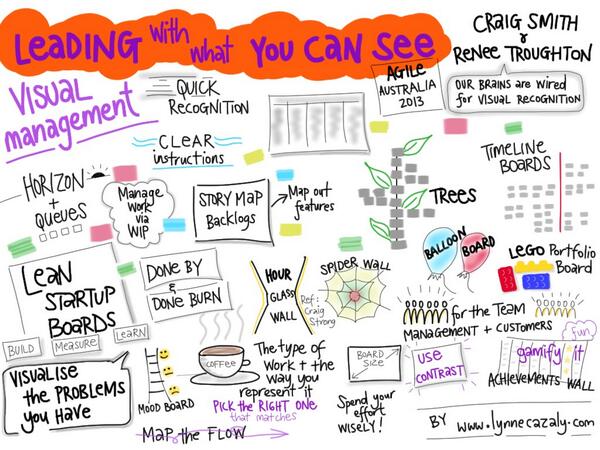
Lynne Cazaly did an awesome visualisation of the talk!

We had some great feedback from people after the talk as well as via Twitter.

Renee also has a (slightly earler) version of the slidedeck online via her Slideshare, with one slide change and one omission…

Brisbane Agile Meetup: Scrum Masters: The Full-Time Role Conundrum

MeetupMy presentation from the Brisbane Agile Meetup in May 2013 called “Scrum Masters: The Full Time Role Conundrum” is available on Slideshare.

A replay of the talk delivered by Craig Smith at the recent Scrum Australia gathering in Sydney

The Scrum Guide defines the Scrum Team as being made up of three primary roles: Product Owner, Development Team and Scrum Master. The role of the Scrum Master is often misunderstood, particularly by management, so often questions start to get asked such as “can I share the Scrum Master across teams”, “can the Scrum Master do Project Management” and “can the role be rotated”?

In this talk we will take a look at some of the misconceptions around the Scrum Master role, discuss how it fits into the organisational structure and tackle the age-old question of whether the Scrum Master is a full time role. We will also look at an improvement plan template to help Scrum Masters improve in their role.

Brisbane Agile

Here are some comments from Meetup:

  • Great presentation. Definitely good value (Gustavo)
  • Very good presentation. Good value. (Wilfred Brimblecombe)
  • Interesting subject, nice presso, Craig good value. Great presso, good job Craig. Also brill venue – good old Suncorp. (Derek Walsh)
  • Great presentation, thanks. (Chris Fortuin)
  • Impressive presentation, invaluable advice. (Carlos Augusto de Oliveira)
  • Craig did a great job putting together and presenting his scrum-master-view-of-the-world presso… (Juan)

Scrum Australia 2013: Scrum Masters: The Full-Time Role Conundrum

Scrum Australia 2013My presentation from Scrum Australia 2013 called “Scrum Masters: The Full Time Role Conundrum” is available on Slideshare.

The Scrum Guide defines the Scrum Team as being made up of three primary roles: Product Owner, Development Team and Scrum Master. The role of the Scrum Master is often misunderstood, particularly by management, so often questions start to get asked such as “can I share the Scrum Master across teams”, “can the Scrum Master do Project Management” and “can the role be rotated”?

In this talk we will take a look at some of the misconceptions around the Scrum Master role, discuss how it fits into the organisational structure and tackle the age-old question of whether the Scrum Master is a full time role. We will also look at an improvement plan template to help Scrum Masters improve in their role.

Some of the comments from Twitter included:

Victoria University of Wellington: Going All XP On Your Business

Victoria University of WellingtonMy lecture for students in SWEN302 Agile Methods at Victoria University of Wellington called “Going All XP On Your Business” is available on Slideshare.

Fusion 2012: Going All XP On Your Business

FusionMy presentation from Fusion 2012 called “Going All XP On Your Business” is available on Slideshare.

When XP and Scrum were devised over 10 years ago, they were created to improve the delivery of software development projects. As many enterprises have matured in the Agile adoption, many of the business users on IT projects are now attempting to use Agile approaches on their own non-IT projects.

In this session we will cover using Agile in a non-IT environment and demonstrate how the original XP practices map extremely well over to business processes. And how those in SD can help your business counterparts.

Throughout the talk I will be referencing back to specific examples and case studies that we have experienced
in our organisation as we have rolled out agile processes across the enterprise. We’ll look at:

  • Agile values for non-software development, including an updated look at the agile manifesto.
  • Agile principles and why they make good business sense.
  • Agile practices (such as TDD, standups, retrospectives, storycard elaboration and acceptance criteria
    and planning approaches) and how to adapt them effectively into a business process (using case
    studies as specific examples).
  • Mapping the XP, Scrum and Kanban practices to work in a business context.
  • Agile vs Kanban and how to decide when which is most appropriate.
  • What a business storycard looks like and why the elaboration and acceptance criteria are important.
  • Project delivery and how iterative delivery applies (and what delivery looks like in a non-software development project).

Agile Australia 2012: Agile: Looking Back, Looking Forward: Adapt, Innovate, Collaborate & Deliver

My plenary presentation from Agile Australia 2012 with Nigel Dalton, David Joyce and Simon Bristow called “Agile: Looking Back, Looking Forward: Adapt, Innovate, Collaborate & Deliver” is available on SlideShare.

Agile adoption in Australia and across the world is now becoming more mainstream and, as a community, we are struggling to address the issue of how to take experienced Agile practitioners to the next level, while still supporting those who are beginning their journey. With the “agile” word getting so overloaded, the challenge is to continually innovate without assigning labels or losing focus on our prime objective – to deliver!

Join Craig Smith with Nigel Dalton, Simon Bristow and David Joyce (on the couch) as they explore different viewpoints on all things Agile – then, now and future!

Some of the comments on Twitter included:

@jchyip: #adapt discussion is similar to our Agile cult discussion at this morning’s Lean Coffee. #agileaus

@carolineggordon: Issueing a challenge to the women in the audience at the panel, I want to see one of us up there next year #agileaus — #deliver

@stephlouisesays: Always look forward to hearing @smithcdau at #agileaus -didn’t disappoint! Valuable messages and images that make you think (and giggle!)

@lukasm: Great start to #agileaus Inspiring talk by Dr Fiona Wood followed by a thought provoking panel on where agile is, has been, and going.

@kiwihoria: Are we there yet? There’s no #Agile destination, just a journey.http://ow.ly/i/EYyW #AgileAus

@agilerenee: Hmm not sold that Perth was the highest per capita ad a community – Wellington rocks with 467 people for 200k city #agileaus @smithcdau

@andrewlitvak: Why paper documentation is the worst way to collaborate – no rich interaction, not effective communication #agileaus

@kiwihoria: Is your organisation retrenching to waterfall? Hold stand-ups in stairwells, hide kanban boards under the desk – #guerillaagile #agileaus

@Prash_Sagar: agile will not solve the problems, it will help you identify them @simonbristow #agileaus #adapt

@rowanb: Great to hear @dpjoyce call out “veneer agile”… “doing Agile vs *being* Agile”. Let’s stop saying “doing Agile” #agileaus

@SMRobson: #agileaus @smithcdau agile adoption is like playing Donkey Kong. Level 1 is hard & everyone throws barrels at you…but level 2 is harder!

@kiwihoria: Renew or decline? http://ow.ly/i/EYtO It’s up to us to keep improving teams, products and communities #agileaus

@agilerenee: “our job as a community is to keep renewing the product – the product that is #agile” @smithcdau #agileaus

@SMRobson: #agileaus Nigel Dalton – take agile beyond IT, your job is to work with the business, principles can apply to everyone

@kiwihoria: #Agile job demand increased steadily in AU/NZ – lots of emphasis on Product Management now http://ow.ly/i/EYsd #AgileAus

@andrewlitvak: UX is now a strong focus for Agilists. Woohoo! #agileaus

@rowanb: “At a team level it is job well done but… In terms of business agility, we still have a fair way to go.” @dpjoyce #agileaus

@andrewlitvak: Delivery agility, we’re nearly there… Business agility? Not so much. Yet. #agileaus

@lukasm: Either me or that couch need some stilts! #agileaus

@vivierose: So great to see @smithcdau on the main stage opening #agileaus

@justinhennessy: Great intro from @smithcdau #agileaus

@SMRobson: #agileaus cool potted history of Agile from @smithcdau & even better – lets change it to Raccoon so we get over the name

Agile Australia 2012: Agile Coaching Workshop

My workshop from Agile Australia 2012 with Adrian Smith called “Agile Coaching Workshop” is available on SlideShare.

The Agile Coach is a critical role in helping leaders, teams or individuals understand, adopt and improve Agile methods and practice. Additionally, an Agile Coach helps people rethink and change the way they go about their work. For a individual to be effective in a coaching role, they must poses a wide range of skills and experience. In this workshop we will explore Agile coaching skills in the context of a competency framework and provide participants with lessons from real-world coaching experience. The workshop will provide an opportunity for participants to learn about coaching, identify areas of Agile development and to broaden skills through hands-on group and individual exercises and games.

You will:
» Understand role of an Agile coach and the typical development pathways
» Identify personal areas of strength/weakness in relation to a broad range of Agile and related skills
» Learn situational specific coaching techniques for common Agile dysfunctions
» Understand the use of maturity models in helping teams learn and adapt to Agile
» Understand organisational and role specific Agile challenges
» Learn how to adapt Agile practices to suit team specific challenges

UPDATE: Due to some requests for the competency matrix, a PDF version is available for download

STANZ 2011: The Future Tester At Suncorp – A Journey of Building Quality In Through Agile

STANZMy presentation from STANZ 2011 that I delivered with Adrian Smith and Dallas Thorneycroft called “The Future Tester At Suncorp: A Journey of Building Quality In Through Agile” is available on Slideshare.

When Suncorp started down the path of rolling out its agile program over four years ago, it was viewed by many internally and the industry with much scepticism and angst, yet now it is approaching mainstream adoption in the industry.

One of the key challenges of becoming agile was improving our approach to testing and quality.

In this talk we will talk about why we had to change, why we had to improve the “speed to cool” in relation to testing, our challenges and approach and our blueprint for the “future tester” at Suncorp.

Like our agile journey, our vision for testing has been regarded as ambitious, so join us to hear why we believe raising the profile, empowerment and skillset of testing is critical to our (and your) future success.