What if Agile Certifications were a Political Party?

Over the last couple of decades, we have been pushing towards agility as a catalyst for a different way of working entirely. It’s interesting to reflect on where agility has ended up today.At the same time, traditional project management approaches talk about agile purely through a project management lens rather than a broader business and product context and as a result we aren’t always speaking the same language. To close that gap, you can use two different phrases:

“Agile within a project management operating model”
“Agility within a product management operating model”

Meeting organisations where they are matters more than ever. The agile industry took four values and twelve principles and somehow created hundreds of methods, wars between approaches, an alphabet soup of certifications, and a handful of enterprise frameworks each claiming to be the silver bullet. We’ve ended up with organisations at vastly different points on their journey and lots (and lots) of confusion in between.

Same word – agile – but very different contexts. Then it occurred to my long-time colleague Daniel Luschwitz, agile is just like politics. Both operate on a continuum left and right of centre. The further away from the centre to the right is a more conservative ideology, whereas to the left is a more progressive ideology.

In agile terms, the centre is the tipping point between:

Project-led agile (right-conservative)
Product-led agile (left-progressive)


Agile even has a constitution – the AgileManifesto. A set of 4 values and 12 principles that mostly any agile approach references and considers itself as following.

We also have a lot of ‘healthy’ debate in both politics and agile. Much like we hear in the halls of parliament “that is unconstitutional”; the agile community has been known to throw a few “that is not agile” phrases around too.

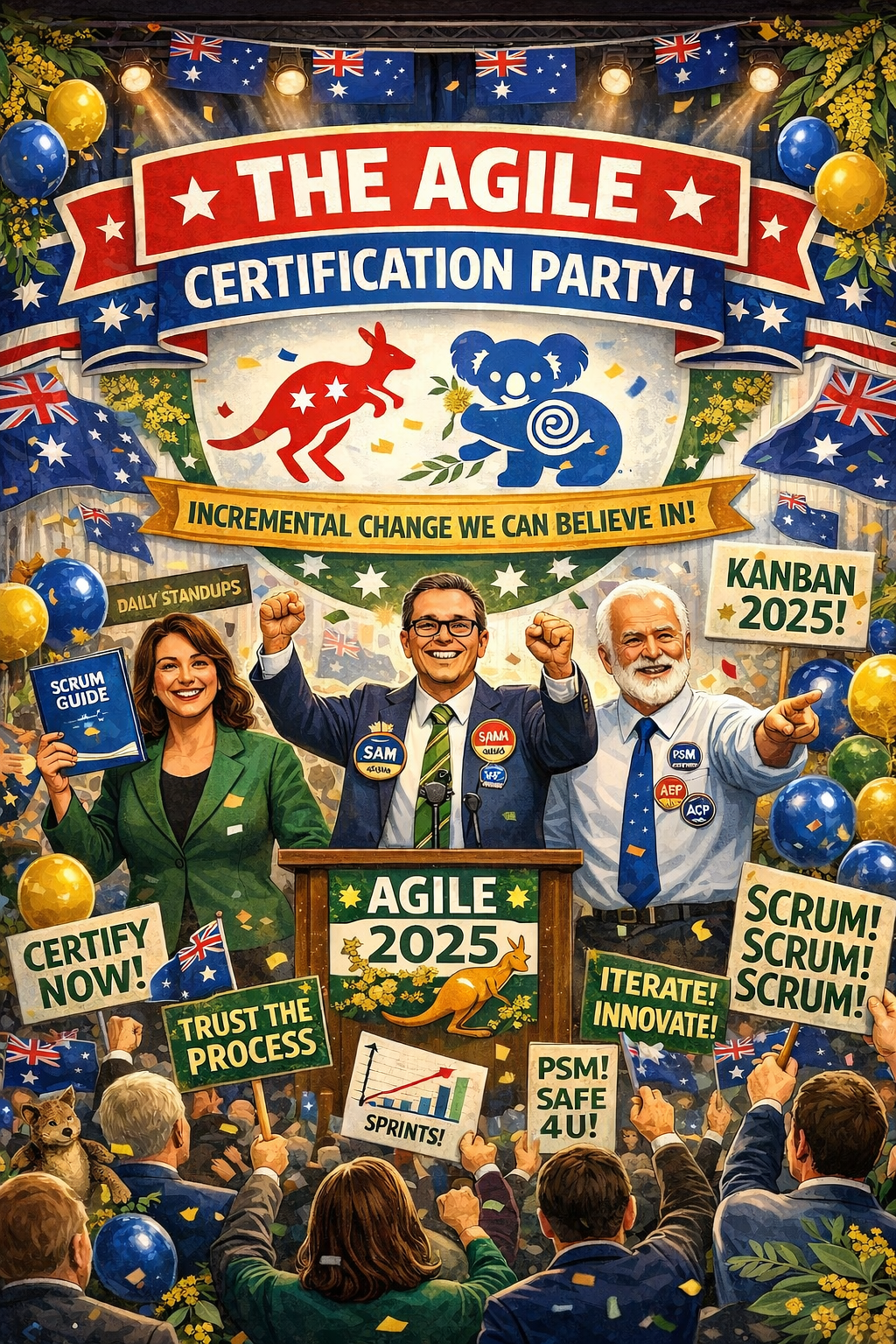
So, all this raises the question: if the various agile certifications were Australian political parties, what party would they be? Who would be our Australian Labor Party, Liberal Party of Australia and The Australian Greens parties? Do we have a contender for Pauline Hanson’s One Nation Party, the Trumpet of Patriots or the Shooters Fishers and Farmers Party?

Where does the various incarnations of Scrum fit in the political landscape? Is SAFe progressive or conservative? Do any agile certifications have their ‘bee in a bonnet’ about paper bags?

To complete this exposé of the agile political world, Daniel Luschwitz brought me in to help write this series, ads, in his words, I am an authority on the agile landscape, “40 agile methods in 40 minutes” creator, and having served on the Agile Alliance Board I am technically a retired agile politician… and we all know what happens when retired politicians talk!

What’s next?

Over the coming posts, Daniel and I plan to map well-known certifications and frameworks across the Agile Political Spectrum.

Why?

It should be a bit of fun. Plus, Daniel has told too many people he plans to write this to back out now.

However, there is a serious side to this. The market is saturated with agile certifications and in many cases participants, managers of teams and recruiters haven’t fully understood what context the certification they have received serves. Our aim is to create awareness.

In the meantime, we welcome you to join in the debate! Who is your far-right conservative agile party?

The first article in the series is: PRINCE2 Agile and One Nation

Note: This article was amended slightly form the original published by Daniel Luchwitz to be written from my perspective.

Agile Summit: 40 Agile Methods in 40 Minutes – 2022 Edition

AVSMy talk with from Agile Virtual Summit called “40 Agile Methods in 40 Minutes: 2022 Edition” is available below:

2022 – Agile Virtual Summit – 40 Agile Methods in 40 Minutes

More to come.

Agile Virtual Summit: Coaching Edition – Code of Ethical Conduct for Agile Coaching

Logo-AVS-Coaching-Edition-2022_1680x600My talk with Alex Sloley and Shane Hastie from Agile Virtual Summit: Coaching Edition called “Code of Ethical Conduct for Agile Coaching” is available on Slideshare.

People serving in an agile coaching role are expected to act ethically, but what does that mean in practice?

Agile coaching is an evolving profession encompassing many disciplines including individual, team and systemic coaching, facilitating, teaching and mentoring, all applied with an open and deliberate bias towards using agile approaches to help address a client’s needs.

The complexity of agile coaching means that you will inevitably encounter difficult situations.

What if you had a Code you could follow that would help support you when difficult decisions need to be made?

What if that same Code helped you act courageously in every situation, even if there is a personal negative impact?

A group of volunteers has been working on crafting just that code. Specifically a Code of Ethical Conduct for Agile Coaching under an Agile Alliance initiative.

This talk will present the background to the work which has been done so far, walk you through the content of the code and explain where it can go in the future.

During the session, you’ll be introduced to a few ethics scenarios that will help you identify the types of dilemmas you may face in the field. You’ll  discover some examples of appropriate and inappropriate ethical behavior in these different contexts, and how to address them.

Craig Smith

Alex And Craig

A huge thanks to Adam Weisbart for the invitation and Lyssa Adkins for supporting this message and getting us on the program. Please review the Code of Ethical Conduct for Agile Coaching and related scenarios. You can watch the video or grab the transcript by subscribing to the All Access Pass.

Agile Open Summit 2021 – Rethinking Retrospectives: Beyond the Three Columns

Agile Online Summit 2021My talk with Michael Huynh from Agile Online Summit 2021 called “Rethinking Retrospectives: Beyond the Three Columns” is available on Slideshare.

The concept of continuous improvement is to stop, pause, reflect, and make small adjustments for the team to improve. But are retrospectives really enough for your teams to improve sprint to sprint? What if your best retrospective still doesn’t yield the results desired and doesn’t move your team out of first gear? What often happens is a narrow view from a team’s perspective on the last sprint or retrospectives don’t provide enough coverage on the broader topics beyond the last iteration.

Simply put, retrospectives are no longer enough!

Join Craig and Michael as they both share their experience and taking your teams to the next level!

Episode 190: Talking Agile Live From The Man Cave with Serge Beaumont

The Agile Revolution's avatarThe Agile Revolution Podcast

Renee, Craig and Tony are together to chat with Serge Beaumont, Principal Agile Coach at Xebia, live from his man cave and despite showing their lack of mathematical skills in relation to dice they chat about:

  • In relation to culture, if the human connections are there you can handle just about anything
  • A foundational cultural aspect at Xebia is that they implemented Xebia Knowledge Exchange (XKE) – every second Tuesday the team has dinner and then has a mini-conference of about 20 streams
  • Xebia were at the foundation of the ING Agile transformation
  • Gloomhaven
  • Rode PodMic
  • You need leadership that truly believes in culture as a powerful thing
  • Renee does story maps like trees and Serge prefers to ensure that he finds his epic on the horizontal slice rather than using the activities on the vertical backbone, building towards an MVP
  • All backlogs should be tree structures
  • An…

View original post 133 more words

Episode 189: The Alistair Cockburn Fan Club with Martin Kearns

The Agile Revolution's avatarThe Agile Revolution Podcast

Tony and Craig are at Agile Australia in Melbourne and they (finally) catch up with Martin Kearns, the Chief Digital Officer at Innodev and co-organiser of Scrum Australia, and they chat about:

  • Alistair Cockburn gets mentioned at around the 2:30 minute mark, and Martin was responsible for first bringing him to Australia
  • Being coached is being open to an experience you aren’t controlling
  • Certified Agile Leadership
  • Agile is always going to hurt, need to prepare for pain and enjoy it
  • Australia 2030: Prosperity through Innovation – need to understand the environmental factors that are forcing Agility into organisations
  • Knowledge of customers is more superior than ever before – due to education and social intelligence (Target inappropriate clothing for children)
  • VUCA is here to stay – accept that you need to listen
  • Australia Post is a good agile example organisation – reinvented themselves through identity services, travel…

View original post 26 more words

Episode 184: Agile Virtual (Pizza) Summit with Adam Weisbart

The Agile Revolution's avatarThe Agile Revolution Podcast

Craig, Renee and Tony catch up with old friend and “irregular” guest Adam Weisbart about Agile Virtual Summit, Recess retrospectives, Build Your Own Scrum and making your own pizza.

  • Renee realised Washington state is nowhere near Washington, DC
  • Agile Virtual Summit 1-5 June 2020 – a collection of great speakers and registration is free!
  • Distributed retrospectives – important that people give a voice-over to the items that they add
  • Tips for Remote Agile ceremonies – recreate being in the same room with technology as much as possible, avoid the asynchronous Slack bots, actually standup,
  • At Slack, you are not allowed to hold a meeting via Slack!
  • Recess – retrospectives in a box!
  • Making virtual retrospectives fun – change them up, craft retrospectives into a story (Recess does this), remember the future (where would you be if you had the most awesome sprint ever)
  • The next thing in Agile just…

View original post 66 more words

Episode 181: Change it with the BOSSAnova with Jutta Eckstein

The Agile Revolution's avatarThe Agile Revolution Podcast

Craig and Tony are at YOW! conference in Brisbane and chat with Jutta Eckstein, author of “Agile Software Development in the Large“, “Agile Software Development with Distributed Teams“, “Retrospectives for Organisational Change” “Diving for Hidden Treasures: Uncovering the Cost of Delay in Your Project Portfolio” with Johanna Rothman and “Company-wide Agility with Beyond Budgeting, Open Space & Sociocracy: Survive & Thrive on Disruption” with John Buck

  • Smalltalk and pattern languages was where a lot of the early work and a lot of the early players converged
  • Scrum had great marketing and certification over Extreme Programming
  • Agile Software Development in the Large came out in 2004 and was probably way before its time
  • Craig Larman and Bas Vodde book “Scaling Lean & Agile Development
  • IBM book “A Practical Guide to Distributed Scrum
  • A framework is not…

View original post 224 more words

itSMF NT Q1 Meeting – 40 Agile Methods in 40 Minutes

My presentation from the itSMF NT Q1 Meeting in Darwin, Northern Territory called “40 Agile Methods in 40 Minutes” is available on Slideshare.

With 73% of the world using Scrum as their predominant Agile method, which has a direct impact on service management, this session will open up your eyes to the many other Agile and edgy Agile methods and movements in the world today. For many, Agile is a toolbox of potential methods, practices and techniques, and like any good toolbox it is often more about using the right tool for the problem that will result in meaningful results. You may also be surprised about how many methods have a direct relation or reliance on service management as well as the wider organisational structure and culture. So let’s take a rapid journey into the world of methods like Mikado, Nonban, Vanguard and movements like Holocracy, Drive and Stoos where we will uncover 40 methods and movements in 40 minutes to help strengthen your understanding and toolbox.

It was an honour to be invited to Darwin to present this talk to the Darwin tech community who are a small but extremely passionate community. Here are some photos:


Episode 139: Talking Agile Craft with Steve Elliott

The Agile Revolution's avatarThe Agile Revolution Podcast

Craig chats with Steve Elliott, the founder and CEO of Agile Craft and they discuss:

  • Dependencies are the number one thing that kills agility
  • Scaling agility across a large organisation is a 5 – 10 year journey
  • Scrum is often disconnected from the portfolio planning layer, the scaling methods are making the program level agile and predictable
  • If you want business agility you have to hinge the technology into the business
  • Sometimes it takes a few attempts for agile transformations, like tipping over a Coke machine (and unlike tipping a cow), you need to lead with results and then work on cultural change to be successful
  • If the leader of an Agile transformation left the organisation, would they go back to the old way or is Agile part of their DNA – if they would go back they have not been transformed
  • The scaling Agile frameworks are relatively new…

View original post 233 more words