
Please note: This is article 10 in a series that explores mapping agile certifications to what Daniel Luschwitz and I have coined the Agile Political Spectrum. The previous blogs in the series are available here:
- What if Agile Certifications were a Political Party?
- The Agile Political Landscape Series: PRINCE2 Agile and One Nation
- The Agile Political Landscape Series: LeSS and The Greens
- The Agile Political Landscape Series: DSDM and Katter’s Australian PartyDSDM and Katter’s Australian Party
- The Agile Political Landscape Series: DSDM and Katter’s Australian PartyDevOps and Teal Independents
- The Agile Political Landscape Series: Kanban and the Australian Democrats
- The Agile Political Landscape Series: ICAgile and the Left-Leaning Independents
- The Agile Political Landscape Series: PMI, IIBA, ISTQB and the Right-Leaning Independents
- The Agile Political Landscape Series: SAFe and the Australian Labor Party
A note on our political comparisons: These political comparisons are playful metaphors designed to illustrate philosophical positions on the agile spectrum. No certification body was harmed in the making of this analysis.
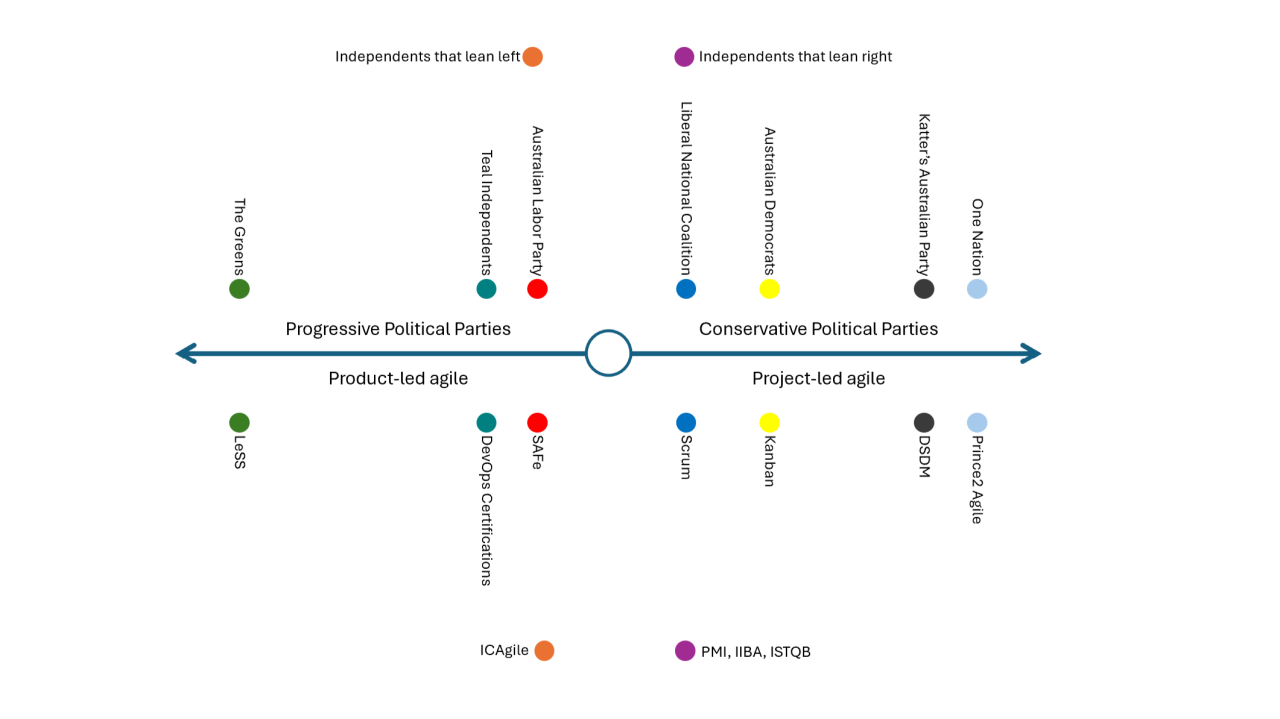
Every political spectrum has its conservative populist. The party that speaks to the mainstream, builds a broad coalition, and makes its platform feel like stability rather than ideology. The one that packaged its ideas so effectively, replicated the model so reliably, and planted its branding so deeply into the landscape that the name became synonymous with the thing itself. In the agile certification world, that party is Scrum.
Scrum’s roots run earlier than its formal founding. Jeff Sutherland began applying the practices that would become Scrum at Easel Corporation in 1993, drawing on a 1986 Harvard Business Review article by Hirotaka Takeuchi and Ikujiro Nonaka “The New New Product Development Game” which described how Japanese manufacturers like Honda and Canon were using small, cross-functional teams that worked in overlapping phases rather than sequential handoffs. Takeuchi and Nonaka borrowed the rugby term scrum to describe it. Iterative and incremental thinking had existed in software development for decades before that, practised by teams long before it had a name anyone agreed on. What Ken Schwaber and Jeff Sutherland did, when they jointly presented Scrum at OOPSLA in 1995, was package it. They took a fragmented landscape of approaches and independent practitioners, wrote a unifying document in the Scrum Guide, and built the organisational machinery that made it replicable at scale.
The certification story followed. Schwaber co-founded the Scrum Alliance in 2002, creating the Certified ScrumMaster credential that quickly became the most in-demand agile certification on the planet. Recruiters required it. Organisations mandated it. Sutherland founded Scrum Inc. in 2006, a significant force in its own right, offering training and consulting grounded in the framework’s origins. Then in 2009, Schwaber departed the Scrum Alliance after a disagreement with the board over assessment standards and founded Scrum.org, insisting that certification should require demonstrated understanding rather than simply course attendance. Scrum.org introduced open, assessment-based credentials with a higher barrier to entry. Two competing certifying bodies, overlapping training empires, one framework and beneath the rivalry, a genuine philosophical agreement about a way of working.
What the scale of Scrum’s adoption produced was remarkable: it didn’t just grow within the agile movement, it consumed the conversation entirely. Sprint, backlog, retrospective and even standup (a term Scrum didn’t originate but now effectively owns) became the vocabulary of agile itself rather than the vocabulary of one method within it. Agile and Scrum became interchangeable in boardrooms, job advertisements, and transformation programs. This created a drama the agile community is still working through. The Agile Manifesto’s four values and twelve principles were written to describe a mindset applicable across any number of practices and contexts. What the market heard instead was: do Scrum. Other approaches spent energy distinguishing themselves from Scrum, or incorporating Scrum within them, rather than explaining their own value. The distinction this series has been drawing, between a project-led and a product-led operating model, became harder to make because Scrum occupied the centre so completely, pulling both sides of the debate toward its own gravity.
Here is the tension at the heart of Scrum’s position on our spectrum. In its pure form, Scrum is a product delivery method. It assumes a Product Owner with genuine authority, a team with real autonomy, and a backlog driven by continuous value discovery. Practised as intended, it belongs on the product-led side of our divide. But the way Scrum was adopted at scale often told a different story. The Scrum Master frequently became a project manager by another name. The Product Owner tended to become a backlog manager. The sprint often diminished into mini-waterfalls with a ceremony wrapper. Scrum practitioners themselves were among the most frustrated voices. The community that had built the method watched organisations perform the rituals while ignoring the intent, and found themselves arguing not just with the project management world but with their own certification holders about what Scrum actually required. It is this pattern of adoption, shaped by the conservative organisational gravity it landed in, that places Scrum on the right side of our spectrum regardless of its original intent.
Into this environment arrived ScrumStudy. Where Scrum Alliance and Scrum.org were, in their different ways, attempting to put rigour around what Scrum competence meant, ScrumStudy saw the volume of demand and built a credential machine to collect it. The established community’s reaction was clear: ScrumStudy had created the SBOK, a Scrum Body of Knowledge that turned a deliberately minimal framework into a prescriptive, PMI-style methodology of several hundred pages. The Scrum Guide’s brevity was not an oversight. It was the point. A framework that leaves room for teams to think cannot coexist with a body of knowledge that tells them exactly what to do. Ken Schwaber was vocal in his objection but none of it slowed the growth. ScrumStudy was collecting enough of the market to assist in Scrum forming government, while feeding precisely the disconnect from genuine Scrum understanding that the established bodies were working hard to address. The two dominant bodies could do little but watch it hoover up the votes they were trying to make worth something.
So who is Scrum’s political counterpart?
As our conservative populist agile certification, Scrum maps to the Liberal National Party (the Coalition). The parallel begins with the founding moment. What Schwaber and Sutherland did in 1995 was not so different from what Robert Menzies did in 1944: they didn’t invent the ideas, but they unified a fragmented landscape into something durable and dominant. Menzies took a splintered centre-right and forged it into the Liberal Party, a vehicle that would define Australian conservative politics for generations. Schwaber and Sutherland took a fragmented movement of iterative practitioners and forged it into something the market could adopt, mandate, and certify at scale. The Scrum Guide became the party platform. And just as Menzies operated within the larger conventions of Westminster democracy, Schwaber and Sutherland were among the seventeen signatories of the Agile Manifesto. But it was their specific vehicle that came to define the centre for everyone else.
The parallel runs deeper than the founding. The Coalition has shaped Australian political life so thoroughly that every other party defines itself in relation to it: to its left, to its right, or in explicit opposition to what it represents. Scrum has done exactly the same thing to the agile landscape. Every certification in this series has had to locate itself relative to Scrum, whether by offering more rigour, more progressiveness, more specialism, or more scale. Scrum set the centre. Everyone else responded to it.
Within the coalition, the internal dynamics map cleanly. Scrum Alliance is the Liberals: community-oriented, relationship-driven, invested in the ongoing health of the ecosystem. Scrum.org is the Nationals: no-nonsense, focused on demonstrated capability, unimpressed by credentials that don’t require you to prove anything. Scrum Inc. is a significant internal faction, carrying real authority by virtue of its founding lineage but operating within the broader coalition rather than seeking to lead it. And ScrumStudy is the populist minor party the coalition never wanted but couldn’t stop: collecting votes that diluted the brand while the legitimate members tried to lift its meaning.
Both the Coalition and Scrum have faced the challenge that comes when your brand becomes large enough to attract followers who weaken rather than strengthen it. When your name becomes the default, you lose some control over what it means in practice. The Coalition has navigated this through preselection, factional discipline, and the occasional public falling out. Scrum has navigated it through competing certification standards, ongoing revisions to the Scrum Guide, and the slow, frustrating work of trying to hold a definition together across a market that long ago decided it already knew what Scrum was.
Scrum certifications remain the most widely held agile credentials on the planet. That is not an accident and it is not without merit. The method, practised with genuine understanding, has demonstrated real value in product development contexts over three decades. The Coalition governs when enough Australians decide that stability and proven capability matter more than transformation. Scrum leads the certification market for exactly the same reason.
As Menzies himself observed, more good things in life are lost by indifference than ever were lost by active hostility. He wasn’t talking about Scrum, but he could have been. Before your next sprint, it’s worth asking one question: have you adapted Scrum to suit your operating model, or have you adapted your operating model to optimise Scrum? The answer will tell you more than any certification ever could.
This article was originally published on LinkedIn by Daniel Luschwitz.









You must be logged in to post a comment.