What if Agile Certifications were a Political Party?

Over the last couple of decades, we have been pushing towards agility as a catalyst for a different way of working entirely. It’s interesting to reflect on where agility has ended up today.At the same time, traditional project management approaches talk about agile purely through a project management lens rather than a broader business and product context and as a result we aren’t always speaking the same language. To close that gap, you can use two different phrases:

“Agile within a project management operating model”
“Agility within a product management operating model”

Meeting organisations where they are matters more than ever. The agile industry took four values and twelve principles and somehow created hundreds of methods, wars between approaches, an alphabet soup of certifications, and a handful of enterprise frameworks each claiming to be the silver bullet. We’ve ended up with organisations at vastly different points on their journey and lots (and lots) of confusion in between.

Same word – agile – but very different contexts. Then it occurred to my long-time colleague Daniel Luschwitz, agile is just like politics. Both operate on a continuum left and right of centre. The further away from the centre to the right is a more conservative ideology, whereas to the left is a more progressive ideology.

In agile terms, the centre is the tipping point between:

Project-led agile (right-conservative)
Product-led agile (left-progressive)


Agile even has a constitution – the AgileManifesto. A set of 4 values and 12 principles that mostly any agile approach references and considers itself as following.

We also have a lot of ‘healthy’ debate in both politics and agile. Much like we hear in the halls of parliament “that is unconstitutional”; the agile community has been known to throw a few “that is not agile” phrases around too.

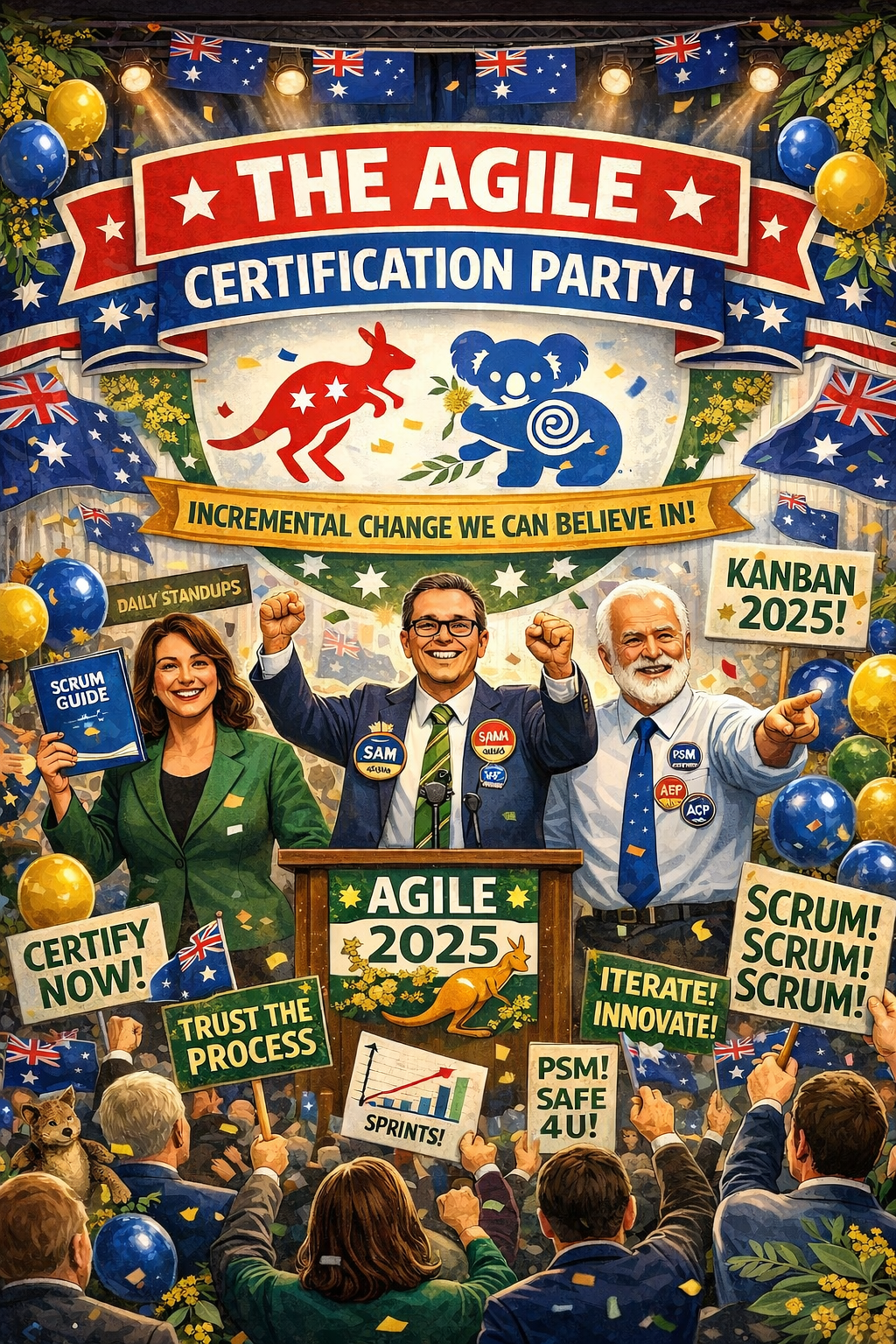
So, all this raises the question: if the various agile certifications were Australian political parties, what party would they be? Who would be our Australian Labor Party, Liberal Party of Australia and The Australian Greens parties? Do we have a contender for Pauline Hanson’s One Nation Party, the Trumpet of Patriots or the Shooters Fishers and Farmers Party?

Where does the various incarnations of Scrum fit in the political landscape? Is SAFe progressive or conservative? Do any agile certifications have their ‘bee in a bonnet’ about paper bags?

To complete this exposé of the agile political world, Daniel Luschwitz brought me in to help write this series, ads, in his words, I am an authority on the agile landscape, “40 agile methods in 40 minutes” creator, and having served on the Agile Alliance Board I am technically a retired agile politician… and we all know what happens when retired politicians talk!

What’s next?

Over the coming posts, Daniel and I plan to map well-known certifications and frameworks across the Agile Political Spectrum.

Why?

It should be a bit of fun. Plus, Daniel has told too many people he plans to write this to back out now.

However, there is a serious side to this. The market is saturated with agile certifications and in many cases participants, managers of teams and recruiters haven’t fully understood what context the certification they have received serves. Our aim is to create awareness.

In the meantime, we welcome you to join in the debate! Who is your far-right conservative agile party?

The first article in the series is: PRINCE2 Agile and One Nation

Note: This article was amended slightly form the original published by Daniel Luchwitz to be written from my perspective.

Episode 190: Talking Agile Live From The Man Cave with Serge Beaumont

The Agile Revolution's avatarThe Agile Revolution Podcast

Renee, Craig and Tony are together to chat with Serge Beaumont, Principal Agile Coach at Xebia, live from his man cave and despite showing their lack of mathematical skills in relation to dice they chat about:

  • In relation to culture, if the human connections are there you can handle just about anything
  • A foundational cultural aspect at Xebia is that they implemented Xebia Knowledge Exchange (XKE) – every second Tuesday the team has dinner and then has a mini-conference of about 20 streams
  • Xebia were at the foundation of the ING Agile transformation
  • Gloomhaven
  • Rode PodMic
  • You need leadership that truly believes in culture as a powerful thing
  • Renee does story maps like trees and Serge prefers to ensure that he finds his epic on the horizontal slice rather than using the activities on the vertical backbone, building towards an MVP
  • All backlogs should be tree structures
  • An…

View original post 133 more words

Episode 139: Talking Agile Craft with Steve Elliott

The Agile Revolution's avatarThe Agile Revolution Podcast

Craig chats with Steve Elliott, the founder and CEO of Agile Craft and they discuss:

  • Dependencies are the number one thing that kills agility
  • Scaling agility across a large organisation is a 5 – 10 year journey
  • Scrum is often disconnected from the portfolio planning layer, the scaling methods are making the program level agile and predictable
  • If you want business agility you have to hinge the technology into the business
  • Sometimes it takes a few attempts for agile transformations, like tipping over a Coke machine (and unlike tipping a cow), you need to lead with results and then work on cultural change to be successful
  • If the leader of an Agile transformation left the organisation, would they go back to the old way or is Agile part of their DNA – if they would go back they have not been transformed
  • The scaling Agile frameworks are relatively new…

View original post 233 more words

Episode 133: Rules Are For Pussies!

The Agile Revolution's avatarThe Agile Revolution Podcast

Craig and Renee are both in Sydney and catch up around the kitchen table to discuss a bunch of things happening in the Agile universe:

View original post 192 more words

Opinion: What 2017 Has in Store for Culture & Methods

InfoQWe polled the InfoQ Culture & Methods editors for their takes on what 2017 has in store for the technology industry, what are the trends which we see coming to the fore and what the implications will be for organizations around the globe.

Source: Opinion: What 2017 Has in Store for Culture & Methods

Episode 108 – SAFe from the Source with Dean Leffingwell

The Agile Revolution's avatarThe Agile Revolution Podcast

DeanLeffingwellRenee, Craig and Tony (with a lurking Em Campbell-Pretty) in a very busy corridor with random bells ringing, catch up with Dean Leffingwell, author of numerous books including “Agile Software Requirements” and “Scaling Software Agility” and the creator of the Scaled Agile Framework (SAFe) in a very candid discussion:

  • the journey to SAFe included as a developer building the Indiana Jones and the Temple of Doom ride and infusion pumps and generally a mission to make quality better
  • epiphony around Agile was the step change around how teams perform and how they like their work when they perform better
  • not everything that is old is stupid, “we are discovering new ways of developing software” and we need to ask ourselves are we still discovering
  • Scrum is the only method that defines what a software team is (roles and size)
  • SAFe is not a war it is…

View original post 170 more words

Em Campbell-Pretty on the Journey of SAFe and Thawing Middle Management

InfoQEm Campbell-Pretty shares her journey from being a business leader to an Agile Coach and early adopter of the Scaled Agile Framework, as well as how to best thaw middle management in organizations.

Em-CampbellSource: Em Campbell-Pretty on the Journey of SAFe and Thawing Middle Management

Bas Vodde and Craig Larman on Large Scale Scrum

InfoQBas Vodde and Craig Larman talk about Large Scale Scrum (LeSS), its origins, and the focus on simplicity, as well as the corresponding website and their new book “Large-Scale Scrum: More with LeSS”.

Bas-CraigSource: Bas Vodde and Craig Larman on Large Scale Scrum

Episode 90: Step Away From The Book

The Agile Revolution's avatarThe Agile Revolution Podcast

aepCraig and Renee catch up late in the evening to chat about recent Agile articles and events including:

View original post 56 more words

Agile Australia 2015: It All Starts With An Idea: Kicking Off Initiatives For Success

Agile-Australia-2015-Resources-Badge-Speaker-600x100pxMy presentation from Agile Australia 2015 called “It All Starts With An idea: Kicking Off Initiatives For Success” is available on Slideshare.

Ideas can come from many different places, but how do we best turn these ideas into initiatives and ensure we are working on the right things at the right time? We tend to throw the idea around, discuss it with our team and management, and undertake a lot of analysis to decide if it’s worth spending time and money on. Unfortunately this approach means we have already spent a bunch of time and money, often without realising it! A number of the early Agile approaches described a lifecycle for kicking off projects, but many of the newer and more popular approaches start with a backlog or an assumption that you are already building something. Go back to basics and look at different approaches for kicking off initiatives and the tools and techniques that make up what is often called the discovery, ideation or concept phase. If your team or organisation has too much work in progress or your pipeline is unclear, then learn (or re-learn) approaches to kicking off the right initiatives so you can ensure you are building the right thing! Learning Outcomes

  • Understanding techniques to kick off a project or initiative
  • Techniques such as impact mapping, idea canvas, problem pitch, finding features, etc
  • Knowing when you should proceed with an idea or park it
  • Prioritising ideas

It was awesome to have such a large audience, particularly as I was up against Dean Leffingwell in the same session. The session was recorded by InfoQ so I will add the video here when it becomes available. Thanks to all those who live tweeted throughout the session, here is a sample: