 My lecture for students in SWEN302 Agile Methods at Victoria University of Wellington called “Going All XP On Your Business” is available on Slideshare.
kanban
Fusion 2012: Going All XP On Your Business
 My presentation from Fusion 2012 called “Going All XP On Your Business” is available on Slideshare.
When XP and Scrum were devised over 10 years ago, they were created to improve the delivery of software development projects. As many enterprises have matured in the Agile adoption, many of the business users on IT projects are now attempting to use Agile approaches on their own non-IT projects.
In this session we will cover using Agile in a non-IT environment and demonstrate how the original XP practices map extremely well over to business processes. And how those in SD can help your business counterparts.
Throughout the talk I will be referencing back to specific examples and case studies that we have experienced
in our organisation as we have rolled out agile processes across the enterprise. We’ll look at:
- Agile values for non-software development, including an updated look at the agile manifesto.
- Agile principles and why they make good business sense.
- Agile practices (such as TDD, standups, retrospectives, storycard elaboration and acceptance criteria
and planning approaches) and how to adapt them effectively into a business process (using case
studies as specific examples).- Mapping the XP, Scrum and Kanban practices to work in a business context.
- Agile vs Kanban and how to decide when which is most appropriate.
- What a business storycard looks like and why the elaboration and acceptance criteria are important.
- Project delivery and how iterative delivery applies (and what delivery looks like in a non-software development project).
Episode 37: Sensational Sydney

 Craig and Renee take a revolutionary tour of Sydney and speak to Jeremie Benazra and Dominic Franco about the Agile work that they are doing in Australia’s big city including Kanban, cultural differences, safety and edgy Agile.
TheAgileRevolution-37 (26 minutes)
Agile Australia 2012 Day 1 Review
 Agile Australia 2012 was held a few weeks ago at the Hilton on the Park Melbourne in front of a record (and venue busting) 850 attendees. This year I had the privilege of being a plenary session host and speaker, present at two workshop sessions and be an MC at a number of different sessions.
Furthermore, I was a member of the advisory committee with the role of program overview along with the usual duties of reviewing and shepherding conference speakers. This year the review process was open to comments and voting from the community and overall I think we ended up with a good mix of proposals.
With all my duties I was quite busy this year, but here are my notes from day 1.
Keynote: When The Stakes Are High
Dr. Fiona Wood, Plastic Surgeon and Director of the WA Burns Unit, was the keynote speaker and undoubtedly for many people was the highlight of the conference. The advisory committee (and particularly Martin Kearns) had been aiming to get somebody from the medical profession for a couple of years, and her talk was nothing short of inspiring.
 |
| From Agile Australia 2012 |
- you either engage in the landscape or whine about it
- we need to enjoy what we do, but it is our passion that drives us
- when you see what you think is the answer, step back and look for the rest of the jigsaw
- learn something from everyday, so that tomorrow is better
- time is precious, understand what is out there rather than reinventing the wheel, start in front of the start line
- had to look for nozzles to spray skin, ended up using Italian mouth freshener!
- you need to articulate the vision so that the team will get it, passionate leadership alone won’t bring people along for the journey
- no better way to manage a disaster than having planned for it first
- how can we mould our resources to deliver at a better level
- leadership has to be very flexible
- respect those people that have changed your life, if you realise it say thank you, you may miss your opportunity in the future
- nobody does anything in life in isolation, need to communicate well so we can contribute
- why can’t we celebrate being the best we can be every day
- criticism is essential, but criticism and walking away is a total waste of time
- I use energy to find better solutions to the patients I treat rather than waste that energy arguing with somebody
- we access our thoughts by communicating, facilitating and shaking the tree
- today is not as good as it gets, that’s what gets me up in the morning
- it’s not get to the top of the mountain and stick the flag, it’s the journey
- “who am I not to dream”, dream but anchor it in reality
Keynote: Agile: Looking Back, Looking Forward: Adapt, Innovate, Collaborate & Deliver
Following on from Dr. Fiona Wood was a tough act, but in front of 850 I took the stage with Nigel Dalton, David Joyce and Simon Bristow to deliver this session. The slides are available in a separate post.
 |
| From Agile Australia 2012 |
 |
| From Agile Australia 2012 |
Mainframe Test Automation Within SCRUM – How Did We At The BNZ Get It To Work?
Bram Surti and Rob White from BNZ delivered this session. Essentially I was interested to see if they did anything different to what I had already tried myself in this space. Sadly, I didn;t learn much new, but I was pleased to see they were using a lot of the same tools and approaches that I had used myself in this space. Their slides are available here.
 |
| From Agile Australia 2012 |
- needed a Java expert to help with the writing and debugging of tests
- used Concordion – developers instrument the tests and used JUnit under the covers
- used Jenkins for continuous integration
- COBOL is a dinosaur, it is scary and big and hard
- used stored procedures to inject messages – could be dropped and tested on the mainframe and invoked from any language
- used Concordion Logging Tooltip Extension to get the debugging output
- used FreeHost 3270 to drive the green screens, old software that needed some upgrading
- got buy in from mainframe developers as driving green screens was very useful for upgrades, got exposure to another language
- took 30% longer to write test than originally thought, but testers said at the end it saved 50% of their time
- isolating data for the test suite was imperative
What Happened To People Over Process?
I was MC to this session by Sarah Taraporewalla from ThoughtWorks, her slides are available here.
 |
| From Agile Australia 2012 |
- we don’t spend enough time understanding people
- as a leader we don’t have all the answers, but we know we can do better
- Kinder Surprise in relation to people – wrapper is the actions of people, but it is a thin layer, peel off the actions you get to the attitudes that govern what we do, apply a bit of pressure and you get to the values, open up the inner canister and you get to people’s belief system
- don’t really understand our belief system until you are challenged by somebody else’s – a good example of this is people and their attitudes to attending meetings – you may need to understand what drives people
- there is a lot of literature around this!
- transactional analysis – Games People Play (Eric Berne) and I’m OK – You’re OK (Thomas A. Harris) – at any given state we have a mental state of an adult, parent or child
- child – react to world around you as if you were a child (when I grow up, I wish, I want)
- parent – react like a parent based on imprints of how our parents reacted (should, ought, could)
- adult (analytical side – who, what, why, I think)
- even if you know yourself, you don’t know jack! – people talking on the same plane have harmonious discussions, they break down across the positions (what people know about the world)
Practical Kanban for Software Development
I was MC for this session delivered by Perryn Fowler from ThoughtWorks. I had high hopes for this talk as Kanban is still not well understood in the wder community. It covered a lot of good topics (and, as he stated at the top, the talk was the thoughts of Perryn), but it fell victim to running out of time for the meaty stuff and unfortunately was a little rushed at the end. Furthermore, his slides do not seem to be available either.
 |
| From Agile Australia 2012 |
- Kanban is not just cards on a wall, even though literally it is a visual indicator
- Kanban is not an entire methodology, it is a technique
- Kanban is a tool to tackle particular situations and problems, we often treat these situations as normal, but there is a better type of normal
- limiting your WIP, the manageable level is probably a lot lower than you think
- Kanban dots – stick them on your wall to indicate WIP
- Kanban is about stop starting and start finishing
- utilisation is not throughput, high utilisation damages throughput
- Kanban is working as a team
- business goal burnup – when do we start making revenue – keep your eyes on the prize
- we are trying to achieve flow – Kanban will make poor flow visible
- layered teams (multiple technologies) – technical layer stories don’t make sense and teams get out of synch, use task cards for the work and put WIP limit on the cards
- reduce WIP to learn about your process
- bugs and rework – it counts towards WIP, can put in the development or test column, whatever you are most comfortable with
- blocked is nothing we as a team can do anything with – does not count towards the WIP limit
- people will cheat – the rules aren’t important, it is the principles you want to achieve
- use a green sticky for done rather than a done swim lane
- small cards gives us good flow
- Kanban will feel like it is causing problems, it is just making it visible
Value and Culture OVER Practices and Processes – Driving Agility at Bankwest
I was MC for this session delivered by Sandra Dalli and Sarah McAllister from BankWest. I really enjoyed this session. They kicked off the session with a great video with music and time lapse pictures (unfortunately it does not seem to be available publicly). Most enjoyable was their honesty about their journey and this mistakes they made along the way (they started by spending three months in a cubicle writing a document about Agile!). It also appears that their slides are not available currently.
 |
| From Agile Australia 2012 |
- apply Agile principles to your transformation
- you don’t have to be on an Agile project to be Agile – agility can be applied to everything
- people drive the change
- executive sponsorship is really important
Failure: A Love Story
I was MC for this session for Tom Sulston from ThoughtWorks. The highlight of this talk was the fail cake! His slides are available here.
 |
| From Agile Australia 2012 |
- fear can be a motivator, but it is not useful
- flight or fight – flight is the default response
- systematic desensitisation – common technique for getting rid of fear
- we always plan to succeed, so we don’t plan for failure
- failure is a really great learning tool – if you made the failure you know it, the hard part is sharing with the team
- taking fear of failure to the brink that you don’t know what to do is really bad
- retrospectives give you a coping mechanism – share with others and make it better
- continuous integration – fail early and stop the line
- automated testing – removes doubt, they fail for a good reason
- showcases – we find out we are going to fail early
- sustainable pace – a failure because we still get a crunch at the end of the project, allows us to build slack because you can’t run at 100%
- it’s about learning not winning
- continuous delivery – you can go to production at any time, remove the fear of go live
- aim for simplicity and feedback
- fail cake – if you break something, you need to buy cake for the team, nobody is afraid of cake, nobody can yell at you with a mouthful of cake!
Safe To Fail
I was thrilled to be MC to Phil Abernathy (he was my MC last year and I have worked alongside him for a number of years). He had a great set of slides at the start of this talk to illustrate his experience. Given I knew the content of this talk quite well I did not take any notes, but I did like his analogy around the $100 strategy (for every $100 spent, where did it go – pull the strategic levers to figure out where you can change, these become your strategic programs). His slides are available here.
 |
| From Agile Australia 2012 |
Other Stuff
At the beginning of the day, IBM sponsored a speakers breakfast, and they recorded an Agile song called “Wake Up To Jazz” (video and audio).
At the same time, Renee Troughton and I took the opportunity to record a conference kickoff podcast for the Agile Revolution.
Some of my colleagues presented talks on day 1 including Dipesh Pala (Easy Ways to Break Up) and Renee Troughton and Paul Watson (Panel: Agile Governance – The New Disinfectant).
The night wrapped up with a student event called Activate Agile. I sat in the back of a number of presentations, with the standout for me being being an overview from Andy Sheats about their journey at health.com.au.
Episode 24: Ghost In The Room
 Craig and Renee stand idly by while Tony has a rare rant on Agile versus KANBAN versus the world and they cover Stoos in depth.
- It will never work in theory
- The truth about sleep and productivity
- Agile Is A Cult.! Follow The Five Ways and Be Saved
Quotes:
TheAgileRevolution-24 (40 minutes)
Episode 22: New Years Revolutions
 Craig, Tony and Renee get together before the Christmas and New Years break to catch up on all things Agile:
- Punctuated Equilibriums, Containers, and all things complexity and where Kanban fits in by Yuval Yeret
- Warm Gun: Design for Continuous Deployment by Luke Wroblewski
- Where is the proof that Agile works? by Scott Ambler
- Is the Agile community still ‘uncovering better ways of developing software’ or just debating on whether to implement Scrum or Kanban by Jordan Bortz
- Thinker’s 50 list and Forbes post The Industrial Age has finally run out of gas: An interview with Don Tapscott
Quotes:
TheAgileRevolution-22 (47 minutes)
Episode 18: Scrum vs Kanban War
 Breaking out from our normal format Craig, Tony and Renee talk about the recent flurry of tweets from the Scrum and Kanban communities.
It all started with Jeff Sutherland and his tweet and blog cross reference: Deep analysis of #kanban by Jim Coplien
The twitter feed that was captured by us (and hence is not a comprehensive feed on the subject and contains some leetspeak cleanup) includes:
David Anderson (@agilemanager):
Interesting FUD Jeff, I thought you were more professional than this?
Jim’s post on Jeff’s blog contains lies which fly in the face of the well documented evidence with teams around the world
Jeff and Jim, I challenge you to produce the evidence to backup claims like…
“Kanban (the methodology) discourages teamwork and increases the risk of not completing agreed work”
I often wonder how people without integrity go through life and live…
View original post 857 more words
Episode 14: Quoting Agile, Lean & Kanban
 Craig, Tony and Renee talk about Lean Startups, Tony’s Agile training in India and great places to work, discuss Quotable Kanban and solve a listener problem, all in 50 minutes!
- Scientists turn brain activity into moving images
- Lean against Agile – Really? – Pyxis Technologies
- Tony’s Agile training adventures in India
- Agile vs Lean Startup – Joshua Kerievsky
- Lean Startup – Wikipedia
- The Twelve Attributes of a Truly Great Place to Work – Tony Schwarz, Harvard Business Review
- Dream Employers 2011 – ZDNet
- Review of Quotable Kanban
Renee also mentioned Kanban by David J. Anderson, Craig mentioned Kanban and Scrum: Making The Most of Both by Henrik Kniberg and Tony not to be outdone mentioned Lean From The Trenches (Beta) by Henrik Kniberg
Problem Bag:
We have a Product Mgr who’s supportive of Agile in theory, but wont do the work we need him to do. How do we…
View original post 130 more words
Episode 2: Squeeze your revolutionist today
 A fun filled podcast presented by Craig, Tony and Renee covering the following topics:
- Squeeze me but don’t tease me
- Eat your peas: A recipe for culture change
- Scott Ambler’s referred to surveys
- Tony’s Plug
- Linoit
- Pair Programming/Pair Delivery
- Chaos, Chaordism and Agile: When have you slipped away from Agile and moved into chaos? What is Chaordism? When is chaos acceptable? How do you move out of chaos?
Quotes:
“I don’t program software anymore, I program people”
TheAgileRevolution-2 (43 minutes)
Agile 2009 Day 4 Review
 The last main day of talks at Agile 2009, and once again lost the morning to preparation and presenting a talk with Paul King.
Here is an overview of the sessions I got to:
Agile Tool Hacking – Taking Your Agile Development Tools To The Next Level
The session I presented with Paul King, we got close to a full house and the session feedback forms were overwhelmingly positive. The slides are available in a separate post.


The Kanban Game
A full house to this session run by Tsutomu Yasui gives some validation to the fact that Kanban is gaining traction with the agile community. All the details and materials for the game are available at http://www.yattom.jp/trac/public/wiki/ProjectGames/TheKanbanGameEn. I only sat in on the first half of the session so I could fit in some other last minute talks.

Agile User Experience Design Emergent Practices
I had an aim to get to at least one talk by Jeff Patton (especially for bragging rights for one of my work colleagues, Teale Shapcott)! I actually got to have a brief conversation with Jeff later in the evening which was awesome.
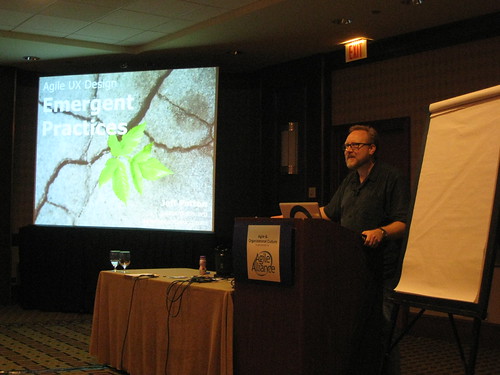
- adapting to agile difficult for UX practitioners – Jeff Patton came late to usability but early to agile usability
- five stages to agile adoption (salesforce.com) anger, denial ,bargaining, depression, acceptance
Homonyms
- design – agile (how to build product), designer (what to build based on user needs)
- iteration – agile (short time box to build software), usability (builf representation of product idea for evaluation and change)
- story – agile (short description of what user might want built), usability (agile design for goal)
- customer – agile (someone who writes a user story), usability (a person who buys a product)
- small bit of software – agile (developer can build in a few days), usability (something a user can complete is a single sitting)
- test – agile (means complete and meets acceptance criteria), usability (user can use the software and it meets their needs)
Then:
- usability practitioners view of design and development – understand business need, understand user need, personas, create and validate high level design, create and validate UI design, create and communicate design specification, develop software, usability test finished product
- you could do all that for a sprint right? – agile changes usability practice but does not have to threaten it
- patterns have emerged as usability practitioners have adapted – had to go postal or figure it out – great idea is not a pattern, great idea that multiple people use is a pattern (at least 3 companies)
The emerging best practices are:
- usability designers are part of product owner or customer team – in drivers seat, part of the planning, part of product owner team or the product owner. Product owners already take multiple roles, product owners are thinking about this release and the next release
- research, model, design up front (but only just enough) – learnt how to cut up work, high level design but just enough, task model (but agile people think they are stories), usability people need to be connected to backlog, own and leverage it
- chunk your design work – break up design work to perform incrementally throughout development, organise story into a map that helps communicate structure of the system (see The new user story backlog is a map on Jeff’s blog), organise the backlog (don’t just prioritise – communicate with user about what we are seeing)
- parallel track development to work ahead and follow behind (see Lynn Miller – Case Study of Customer Input for a Successful Product on agileproductdesign.com) – time machine essential for product owner and usability team, design and coded features pass back and forth between tracks (design ahead, look at stuff already built and stuff that is being built now)
- buy design time with complex engineering stories – product owners responsible for scheduling, sometimes highest value is to put a story that is easy to design but hard for developers to build to buy time! (Lynn Miller talks about SketchUp File – Save As as easy to design but took ages for developers to develop)
- cultivate pool of users for continuous user validation – (see Heather Williams – The UCD Perscpective on agileproductdesign.com), Salesforce have a person that coordinates this, keep feedback fresh by rotating every few months
- schedule continuous user research in a separate track from development – Kitchen Stories a silly Swedish movie has usability connotations, research is continuous, not just a phase, schedule visits with users ahead of how we know why we want to be there
- leverage time with users for multiple activities – do some usser interviewing, do prototyping, show and review current software (one mand band), use RITE to iterative UI (rapid iterative testing and evaluation) (see numerous RITE articles on agileproductdesign.com), use time before sprint to refine design, test something and fix it to burn down failures
- prototype in low fidelity – prototype in public so people can see what you are doing, look at Balsamiq as a tool
- treat prototype as a specification – have a discussion
- designer developers iterate design outside development iteration (eg. CSS, HTML and visual design), “art is never finished, only abandoned” (Da Vinci)
- become a design facilitator – designers do collaboration and facilitation, practices like design studio and sketchboard technique to get developers involved, sick of developers armchairing their design (get them to sketch it out, developers get to weigh in good ideas, developers get their design ripped apart, usability people get people to read their designs)
Finally, most usability designers won’t go back after doing agile!
Agile By The Numbers: What People Are Really Doing In Practice
I was keen to go and see Scott Amber speak, you can view the session or view the data. According to Scott, this is what people are doing in practice and this talk is exploring some myths.

Majority of organisations doing agile?
- Agile Adoption Survey 2008, 69% yes (biased survey)
- State of the IT Union Survey – 76% yes (not as biased because not related to title of the survey)
- just because majority doing agile, not everybody needs to do agile
- CONFIRMED
Majority of teams doing agile?
- in 76% of organisations, 44% of project teams doing agile
- BUSTED
- numbers claiming to be doing agile, can’t test this theory, expect number is high
- how do you measure agile?
Pretty much all development in agile?
- agile practices that most effective – CI (65%), daily standup (47%), TDD, (47%) iteration plan, refactoring, retrospectives, pair programming, stakeholder participation, shippable software, bundown tracking
- practices that want to adapt – almpot all technical – acceptance and developer TDD at top of list
- PLAUSIBLE
Agile is just for small teams?
- 1-5 and 6-10 success, starts to taper off for teams 11 and up, but success at all sizes of teams
- BUSTED
Does not apply to regulatory situations?
- 33% need to apply to legislation
- BUSTED
Agile and CMMI don’t work together?
- yes 9%, only small amount of people doing it
- no statistical differenece between CMMI and non-CMMI agile projects
- BUSTED
Agile process empirical?
- teams collect and act on metrics, 51% collect but do it manually (according to Scott Ambler, don’t trust manual metrics as they are behind and altered to tell a better story and meet bureaucracy), 26% no and 19% majority automated
- CONFIRMED
Agile teams doing greenfield development?
- 78% working with legacy in some way, 57% evolving legacy code
- BUSTED
- need to start sharing the real work because Michael Feather’s book Working Effectively with Legacy Code and Scott Ambler’s book on Refactoring Databases about the only books out there
Becoming a Certified Scrum Master is a good idea (2 days)?
- 78% think certification is meaningless
- nobody respects this, shame on certification trainers, better way to earn a living, step up, 2 days on a business card is not a good idea, preach less and act more
- BUSTED
- Ambler certified for a good laugh
Most agile teams are co-located?
- 42% co-located – good thing, reduces risks, 17% same building, 13% driving distance, 29% very distant
- a third of teams have geographic sistribution issues
- BUSTED, majority of teams distributed in some way
Agile teams don’t provide up front estimates?
- majority of teams do up front estimates
- need estimate to tell senior management to get project off the ground
- 36% reasonable guess by experienced person
- BUSTED
Agile teams just start coding
- on average takes almost 4 weeks to warm up – modeling, set up environment, design, …
- BUSTED
Agile follows common development guidelines?
- practice in XP
- 49% project / enterprise conventions (19% enterprise level conventions)
- 22% UI convention, 25% data conventions, expect lower than development because not as cool as code
- PLAUSIBLE (but borderlne) – room for improvement
Rights and responsibilites are part of agile culture?
- 58% defined for development team vs 35% for stakeholders
- PLAUSIBLE
Agile test often and test early?
- developer TDD 71%, 52% still doing reviews / inspections, 45% end of lifecycle testing, acceptance TDD 40%, one third of teams have independent team who look at system independently
- CONFIRMED – doing testing throughout lifecycle
Agile don’t do up front requirements modelling?
- 76% do this, need to come up with stack of cards now
- 52% capture in word processor, 45% capture as tests
- BUSTED
Agile don’t do upfront architecture?
- 70% high level architecture modeling
- metaphor is a total waste of time
- organising a conference is just like organising a conference…
- BUSTED
Agile write interim documentation?
- 56% yes
- CONFIRMED
Agile produce supporting documentation?
- 70% write these, minimal amount of stuff that need to be developed
- CONFIRMED
- sometimes when compared, agile write more
Agile works better than traditional?
- hell yes!
- all approaches reasonably close 65% vs 80%
- quality much better
- functionality delivered higher
- make money – good, but hacking better off
- time much better
- so similar, but better way to spend money wisely
- CONFIRMED
Finally:
- difference between what we say and what we do
- just because some people succeed, doesn’t mean you will
- visit ambysoft.com if designing a survey – there are too many crap surveys!
Open Space – Scrum Is Evil…
Jeff Frederick ran his Scrum Is Evil session that I had first seen at CITCON in Brisbane earlier in the year. It was interesting to see that the outcomes were exactly the same half way around the world!

Conference Banquet & Keynote User Interface Engineering
It’s very hard to take notes in a banquet with the lights dimmed, but Jared M. Spool gave a very entertaining keynote on User Interface Engineering, including some iPod vs Zune bashing and an old Apple video on future design.
Here is another post I found from this session: http://www.agilitrix.com/2009/09/user-interface-engineering-agile-2009-banquet/
The night was finished off with a Chicago Blues band and some conversation late into the night at the hotel bar!


You must be logged in to post a comment.