Please note: This is the third article in a series that explores mapping agile certifications to what Daniel Luschwitz and I have coined the Agile Political Spectrum. The previous blogs in the series are available here:
What if Agile Certifications were a Political Party?
The Agile Political Landscape Series: PRINCE2 Agile and One Nation
A note on our political comparisons: These political comparisons are playful metaphors designed to illustrate philosophical positions on the agile spectrum. No certification body was harmed in the making of this analysis.
Every political spectrum needs its idealists – parties that refuse to compromise on their principles that would make the world a better place. In the agile certification world, that is Large-Scale Scrum which decided to “choose a vowel” and became known as LeSS.
LeSS emerged in 2005 from the work of Craig Larman and Bas Vodde, early adopters of Scrum who were attempting to scale the framework across multiple teams. In those early days, Larman and Vodde were among the few voices addressing Scrum at scale, pioneering territory with their books and experiments. Over a decade of work involving more than 500 experiments, they discovered something fundamental: the problem wasn’t that Scrum didn’t scale, the problem was that traditional organisational thinking prevented it from scaling.
This insight became the foundation of LeSS. Fewer roles, fewer artefacts, fewer processes. They stripped away the organisational debt accumulated over decades of hierarchical thinking and proposed doing more with less. The framework is deliberately minimal as its primary purpose is descaling through simplification. One product owner, one product backlog, multiple teams working together in coordinated sprints. No scaling roles, artefacts, or ceremonies beyond what teams need to coordinate. LeSS acknowledges it’s not for every business context as it focuses on two clear objectives: building adaptability and delivering customer value.
LeSS describes itself as “barely sufficient methodology”, providing minimal rules to establish empirical process control and whole-product focus, then expecting organisations to think, learn, and adapt. For organisations aligned with these objectives, LeSS offers ten guiding principles with certain mandatory practices that define the start of the journey. Beyond this, there are no detailed prescriptions or step-by-step playbooks. Instead, LeSS provides rules (the minimum framework), principles (the thinking foundation), guides (recommendations worth trying), and experiments (situational options). This isn’t a methodology you implement; it’s a framework that defines a minimum standard and invites you to apply systems thinking and lean thinking to continuously improve your organisation toward your objectives.
So on our spectrum of agile certifications, who is LeSS’ political counterpart? As our far-left progressive agile certification, LeSS is equivalent to The Greens.
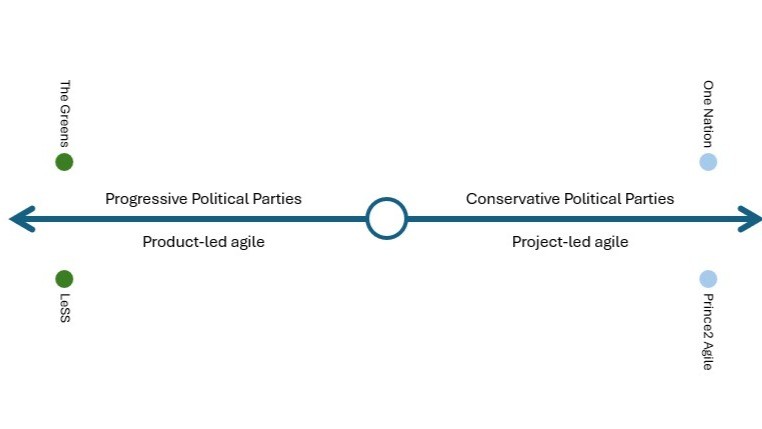
The parallels are immediate and striking.
Both emerged from direct experience with key problems being treated as negotiable. The Greens because environmental degradation was compromised away by major parties, LeSS because Larman and Vodde discovered that scaling Scrum required removing organisational impediments, not adding structure. Both demand systemic transformation: The Greens challenge capitalism’s growth imperative and advocate for radical power redistribution; LeSS eliminates command-and-control hierarchies and redistributes authority to self-organising teams.
Both champion grassroots empowerment and systems thinking. Both define a minimum acceptable state and argue that anything less undermines the outcomes they seek to achieve.
Both also share a common challenge: translating a principled vision into change within complex, existing systems. The Greens articulate a clear picture of sustainable societies while facing scrutiny over transition pathways within current economic structures. Similarly, LeSS articulates a clear minimum state for effective agility, while deliberately avoiding prescriptive transformation roadmaps. Both describe a minimum standard for an acceptable state and invites us to confront the gap between the current reality and meeting this standard. For some, this clarity is liberating; for others, it can feel confronting.
This explains why LeSS has such polarising appeal. For organisations genuinely committed to transformation, for leaders willing to challenge their own authority, for teams ready to take on real responsibility, LeSS provides a clear and uncompromising path – it’s honest about what’s required and doesn’t pretend you can have agility without changing power structures. The certifications reflect this philosophy: training will provide you with this acceptable standard, however, if you are operating in a project-led structure even this might seem like an insurmountable barrier.
LeSS appeals to an organisational profile that is looking to optimise towards adaptability and value delivery. If you’re working in a more traditional organisation with entrenched hierarchies, established governance structures, and risk-averse cultures, the radical simplification and structural changes LeSS requires will feel frustratingly disconnected from your reality. This doesn’t mean that LeSS is wrong, it likely means your organisation is optimising toward different objectives. In that case, LeSS becomes a reference point for what agile at scale could look like, rather than a framework that serves your current needs.
In many ways, LeSS resembles the Australian Greens party in politics – it articulates an ambitious, principle-driven vision of how things ought to work, appealing strongly to those who share its values. However, like the Greens operating within Australia’s established political system, LeSS can struggle to gain traction if your worldview is on the right-side of the spectrum.
There’s nothing wrong with unwavering principles and minimum standards. Progress requires people willing to articulate a vision, to refuse compromise, to insist that systemic problems require systemic solutions. The Greens serve this role in politics. LeSS serves this role in the agile political landscape.
For organisations ready to genuinely transform, LeSS might be exactly what you need. For organisations needing to navigating current realities such as command-and-control leadership and heavy bureaucracy, you may need to look elsewhere on the spectrum to address these constraints first. Like its political counterpart, LeSS isn’t trying to win over the pragmatists. It’s trying to inspire the revolutionaries.
Special thanks to Venkatesh Krishnamurthy, Australia’s first Certified LeSS Trainer for his contributions to this article.
Footnote: In this article we specifically focused on LeSS as it fits within our requirement of offering an agile certification, however, we would like to acknowledge its place alongside others in what we have deemed the “ideal state movement”. This entire movement is rich with various approaches addressing work differently. Examples include Holacracy‘s elimination of hierarchy, FAST‘s fluid teaming and network structures, XScale‘s descaling and elimination of command-and-control, and Teal organisations‘ evolutionary purpose made famous in Laloux’s cultural model.
This article was originally published on LinkedIn by Daniel Luschwitz. The next article in the Agile Political Landscape series is: DSDM and Katter’s Australian Party








You must be logged in to post a comment.