Please note: This is the fourth article in a series that explores mapping agile certifications to what Daniel Luschwitz and I have coined the Agile Political Spectrum. The previous blogs in the series are available here:
- What if Agile Certifications were a Political Party?
- The Agile Political Landscape Series: PRINCE2 Agile and One Nation
- The Agile Political Landscape Series: LeSS and The Greens
- The Agile Political Landscape Series: DSDM and Katter’s Australian Party
A note on our political comparisons: These political comparisons are playful metaphors designed to illustrate philosophical positions on the agile spectrum. No certification body was harmed in the making of this analysis.
Every political spectrum needs its bridge-builders. Movements that refuse to fit neatly into traditional categories, that challenge established divides, and that prioritise outcomes over ideological purity. In the agile certification world, that’s DevOps.
DevOps emerged in the late 2000s from frustration with the fundamental divide between software development and IT operations. Developers wanted speed and change; operations wanted stability and control. The result was organisational silos, blame cultures, and slow, unreliable software delivery. In 2009, Patrick Debois organised the first DevOpsDays conference in Belgium, crystallising a movement that had been brewing in organisations struggling with this dysfunction.
The core insight of DevOps was never primarily technical, it was cultural. Yes, automation, continuous integration, and infrastructure as code became associated practices, but the fundamental shift was breaking down the wall between Dev and Ops: shared responsibility, collaborative problem-solving, and optimising for the whole system rather than individual silos. You can’t buy DevOps in a box. You must become it.
There is no single definition of DevOps as it became a set of practices and principles defined by the community. A number of bodies and vendors emerged offering certifications, including those focussed on culture and principles (DevOps Institute, ICAgile, and SAFe), and those on technical implementation (AWS, Microsoft, Google, and others). Like the Teal Independents, these certifications are themselves independent. There is no single governing authority, no party platform, only a shared set of principles. This is part of what makes DevOps sometimes misunderstood. And like the Independents movement itself, the ecosystem continues to grow, with DevSecOps, GitOps, and MLOps extending the same philosophy into new domains.
So who is DevOps’s political counterpart? As our left-progressive but pragmatic certification movement, DevOps maps to the Teal Independents.
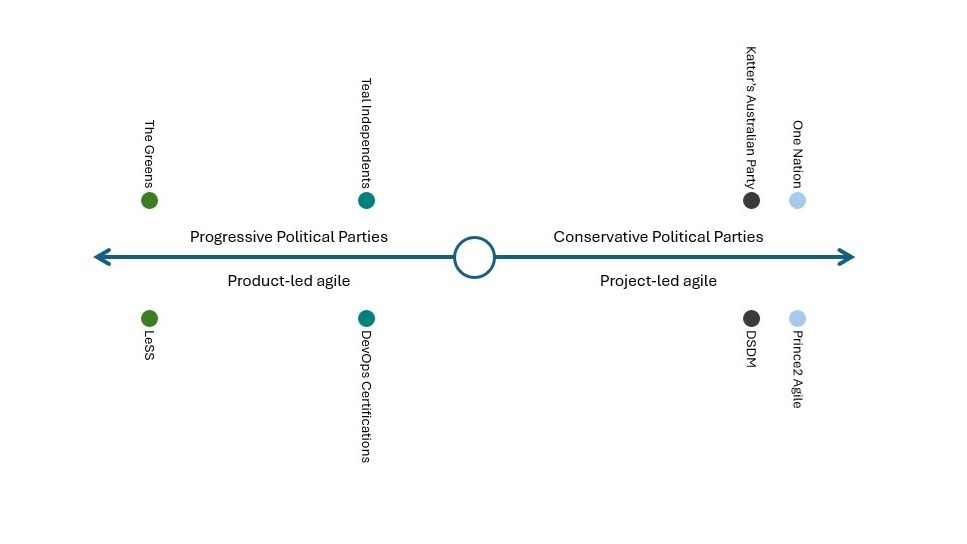
The Teals emerged in 2022, winning traditionally Liberal seats by offering something that didn’t fit conventional party lines. They are progressive on social and environmental issues, yet centre-right on economic policy, focused on fiscal responsibility and business effectiveness. They rejected the false choice between environmental action and economic pragmatism.
DevOps certifications mirror this exactly. Progressive on culture by breaking down silos, challenging hierarchies, emphasising collaboration; but pragmatic on delivery through efficiency, automation, reliable systems, measurable outcomes. Just as the Teals blended blue economics with green values, DevOps blends cultural progressiveness with operational pragmatism. Both movements emerged from rejecting a false dichotomy that had paralysed their respective fields.
This positioning explains where DevOps sits on the agile political spectrum. It sits firmly on the left-progressive side because it enables something fundamental – continuous delivery. The technical foundation that makes product operating models possible.
Think of it this way. An organisation might reorganise around product teams, leadership might embrace product thinking, but if it still takes weeks to get a change into production with manual testing, change approval boards, scheduled release windows and the like, then the organisation chart has changed but the operating model hasn’t. DevOps is what closes that gap. Without it, the transition to product-led ways of working stalls at the delivery pipeline.
For practitioners, DevOps certifications provide essential frameworks for understanding software delivery as a sociotechnical system. It speaks to developers who need to care about operational concerns, and to operations professionals who need to embrace change and automation. For organisations, DevOps practices aren’t optional extras to bolt on after establishing product teams. The capability to deliver continuously must be built deliberately, and that requires both cultural change and significant technical investment.
Like a good independent MP, DevOps certifications won’t hand you a four-phase implementation plan. But they will help you understand what genuinely needs to change (culturally and technically) to make continuous delivery real.
This article was originally published on LinkedIn by Daniel Luschwitz. The next article in the series is Kanban and the Australian Democrats.


You must be logged in to post a comment.