The Agile Political Landscape Series: SAFe and the Australian Labor Party

Please note: This is article 9 in a series that explores mapping agile certifications to what Daniel Luschwitz  and I have coined the Agile Political Spectrum. The previous blogs in the series are available here:

  1. What if Agile Certifications were a Political Party?
  2. The Agile Political Landscape Series: PRINCE2 Agile and One Nation
  3. The Agile Political Landscape Series: LeSS and The Greens
  4. The Agile Political Landscape Series: DSDM and Katter’s Australian PartyDSDM and Katter’s Australian Party
  5. The Agile Political Landscape Series: DSDM and Katter’s Australian PartyDevOps and Teal Independents
  6. The Agile Political Landscape Series: Kanban and the Australian Democrats
  7. The Agile Political Landscape Series: ICAgile and the Left-Leaning Independents
  8. The Agile Political Landscape Series: PMI, IIBA, ISTQB and the Right-Leaning Independents

A note on our political comparisons: These political comparisons are playful metaphors designed to illustrate philosophical positions on the agile spectrum. No certification body was harmed in the making of this analysis.

Every political spectrum has its broad church. The party that was born from a genuinely progressive cause, that carries real reform in its DNA, but that has spent decades learning how to win the mainstream rather than just inspire the faithful. It speaks the language of workers and battlers, of fairness and inclusion, but it governs from the centre because that is where elections are won. It is not the party of the purist. It is the party of the possible, shaped as much by what the electorate will accept as by what its founders believed.

In the agile certification world, that party is SAFe, the Scaled Agile Framework.
SAFe emerged in 2011 from the work of Dean Leffingwell, who had spent years wrestling with a problem that the agile community was actively working to solve: how do you apply agile thinking across a large enterprise? The approaches on offer at the time were serious and principled, but they came with a significant ask. They required the enterprise to restructure, to dismantle hierarchy, to rethink governance from the ground up. Leffingwell took a different view. He met the enterprise where it was, building a framework that could live inside existing structures rather than demanding their removal as a precondition for entry. And in a move that would prove either inspired or irresistible depending on your perspective, he called it SAFe. Whatever you think of the framework, you have to admire the marketing. In an industry that had spent years arguing about whether agile was safe for the enterprise, naming your scaled framework the Scaled Agile Framework and shortening it to SAFe was a masterstroke. The enterprise heard the name and felt reassured before they’d read a single principle.

The result was a comprehensive, layered framework that acknowledged the realities of large organisations. Portfolio management, programme governance, release trains, PI planning ceremonies, architectural runway, business owners, RTE roles: SAFe gave the enterprise agile in a language the enterprise already spoke. The framework grew steadily, expanding with each version and by the time most practitioners encountered it, SAFe had become less a framework and more an ecosystem, complete with certifications, consulting partners, tooling integrations, and a global community of practice.

That breadth is both SAFe’s greatest strength and the source of its most persistent criticism. On one side, practitioners who have lived through failed agile transformations will tell you that SAFe gave them something to stand on, a common vocabulary, a planning cadence, a way to connect team-level delivery to portfolio-level priorities. On the other side, those with deeper roots in the progressive agile tradition will argue that SAFe reintroduces the very management layers and handoff points that agility was designed to remove, that it preserves the project-based operating model while calling it something new, and that its certifications prioritise fluency in the framework over genuine understanding of the underlying principles.

Both sides are, in important respects, correct. The published evidence base on SAFe outcomes is thin and contested, with most claims coming from parties with a commercial interest in the answer, which leaves practitioners to draw their own conclusions based on their experiences, rather than data.

So who is SAFe’s political counterpart?

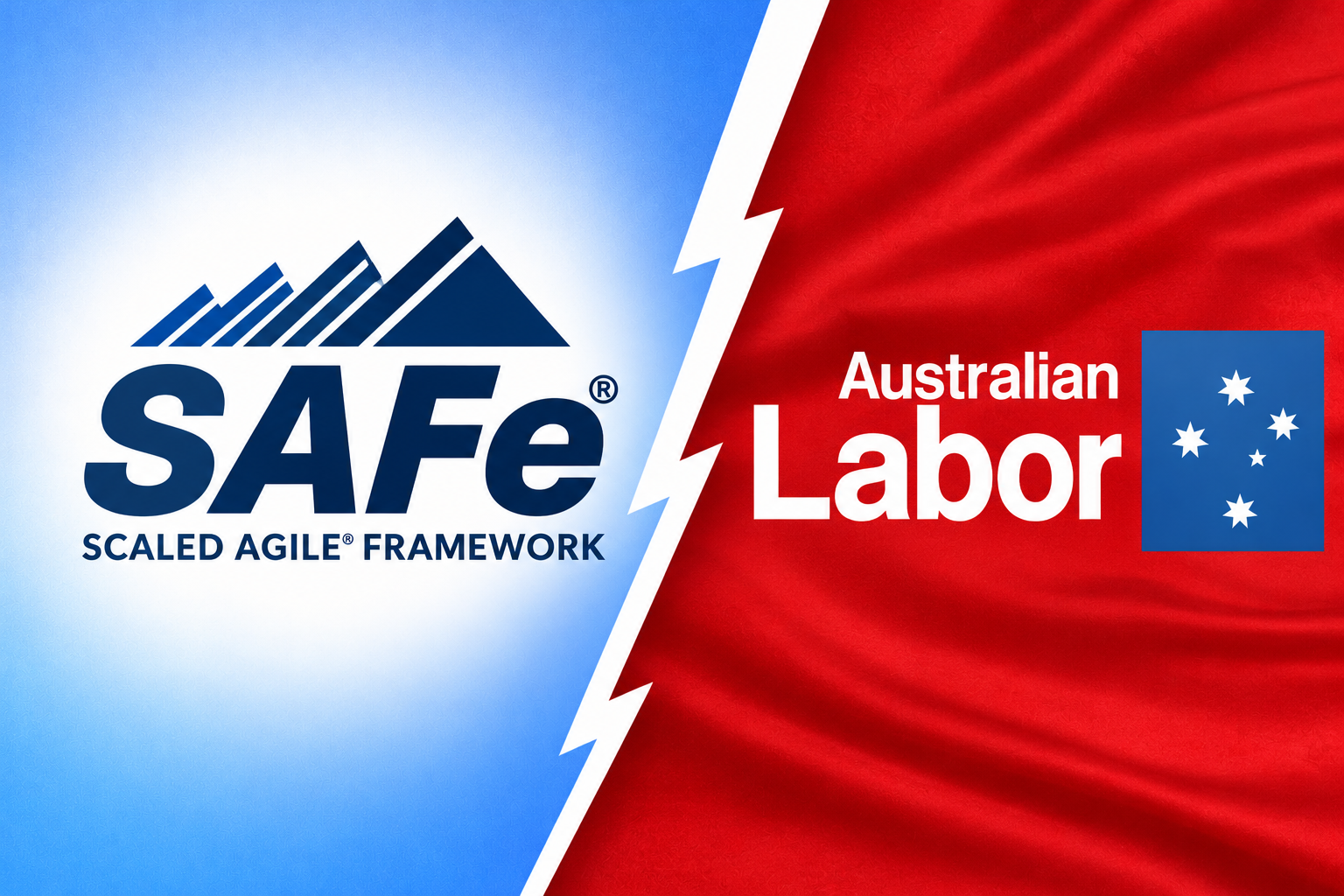
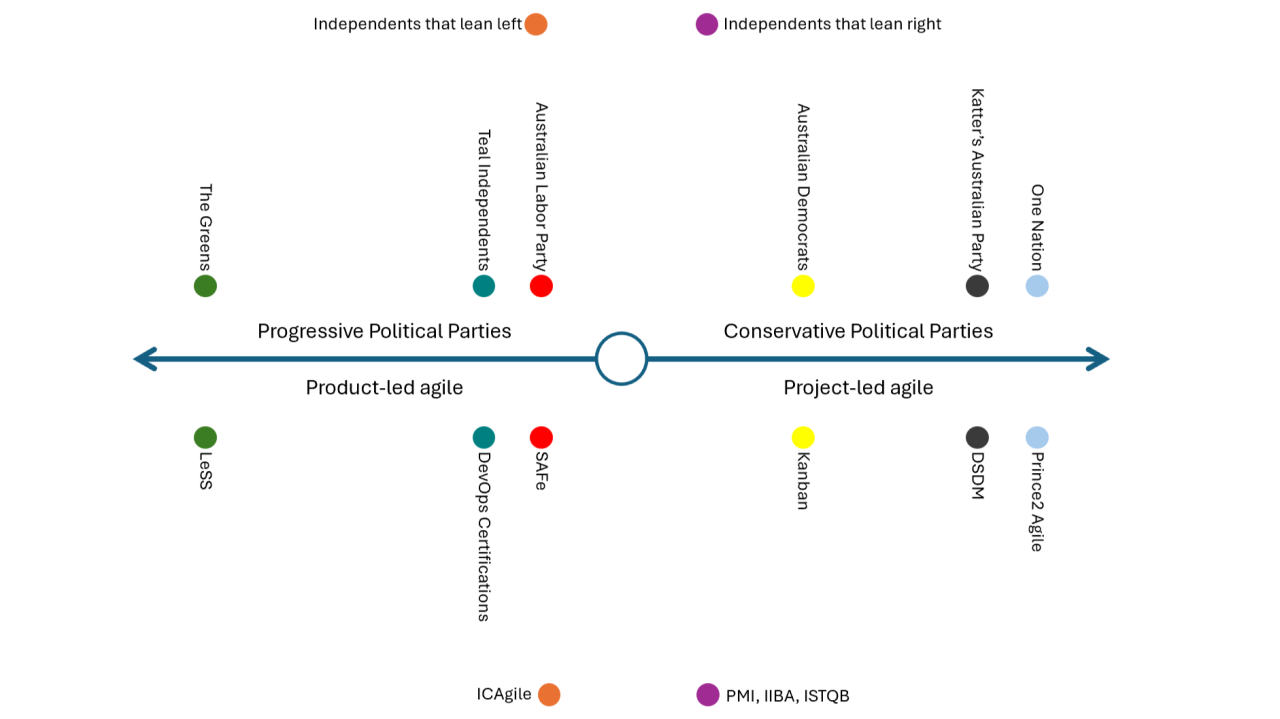
As our large-scale, institutionally progressive, pragmatic agile framework, SAFe maps to the Australian Labor Party.

The parallels run deeper than they might initially appear. The ALP was founded on the conviction that working people deserved better conditions, fairer systems, and a genuine voice in how institutions operated. It is, at its heart, a progressive movement. But Labor has always understood something that the parties further to its left tend to underestimate – you don’t win government by being right. You win it by being electable. And that means translating progressive values into policies that can carry constituencies well beyond the converted.

SAFe operates with exactly this logic. The agile movement had the right values: collaboration, flow, customer focus, empirical thinking. But enterprise adoption required more than values. It required structure that PMOs could recognise, reporting lines that executives could work within, and a rollout model that HR and finance could plan around. SAFe provided all of it. It didn’t so much compromise agile as it packaged agile for an audience that would never have signed up to the original proposition without that packaging.

Labor has always understood that reach requires infrastructure, not just principle. The ALP built its base through affiliated institutions and organised constituencies, individual unions folding their cause into the broader movement, each one extending the party’s reach into communities it couldn’t have accessed alone. SAFe’s partner model works the same way. The network of certified consultants and implementation partners created an ecosystem with a remarkably low barrier to entry. Complete a four-day course, pass the exam, and you were a SAFe Practice Consultant (SPC), empowered with the courseware and authorised to deliver training. The credential created the constituency, and the constituency grew the framework. Critically, SAFe gave that constituency something the rest of the agile world hadn’t managed to offer at scale: a framework with enough structure and governance that leadership could see themselves in it. Executives had a model. Portfolio managers had a layer. Programme leads had a planning cadence. From a scaling perspective, the rest of the agile world was offering radical models that required a shift in mindset before they could take hold. SAFe was already in the building.

There is something recognisably Labor in the tension that sits at SAFe’s centre. Labor has always attracted people whose values sit well to the left of the party platform, people who made their peace with the compromise because the alternative was no seat at the table at all. SAFe drew exactly that kind of practitioner. Coaches and consultants who cared deeply about product thinking, genuine agility, and organisational transformation found that SAFe got them through the door of enterprises that would never have engaged them otherwise. For those practitioners, SAFe was training wheels, a pragmatic starting point from which the real work of shifting mindsets could begin. The problem is that the framework is large enough, and complex enough, that for most organisations it became the destination rather than the departure point. The training wheels never came off. And the practitioners who always intended to remove them found themselves maintaining a system they had hoped to transcend.

For practitioners, SAFe certifications provide genuine value for people working in large enterprise contexts who need to navigate the intersection of agile delivery and traditional governance. The PI planning approach, when implemented well, creates real alignment across teams that previously had no shared rhythm. The portfolio-level thinking addresses a genuine gap that team-level agile methods leave almost entirely unaddressed. And the common vocabulary SAFe establishes across a programme or portfolio is not a small thing. When practitioners from different disciplines can have a productive conversation about capacity, priorities, and dependencies without translating between frameworks, that shared language is valuable.

At the same time, be clear about the limitations. SAFe certifications, particularly at the foundational levels, often produce practitioners who are knowledgeable in SAFe rather than fluent in agile. The distinction matters. An organisation that has implemented SAFe has changed how it coordinates and plans. It has not necessarily changed how it thinks about value, customers, or the nature of the work. The transformation has often reached the programme layer and stopped there, leaving the underlying operating assumptions, particularly the assumption that work is best managed as a sequence of projects rather than as continuous product development, largely intact.

The Australian Labor Party rarely governs from its most progressive position. It wins by being electable, implements by being pragmatic, and makes its peace with the fact that the transformation it delivers will always be partial. SAFe carries the same character. Organisations that adopt it do move, structures loosen, delivery improves, conversations about value and flow begin to happen that simply weren’t happening before. But it has also, in many implementations, made a comfortable home for exactly the kind of governance and hierarchy that agile was supposed to challenge. Whether you view that as a reasonable compromise or a fundamental betrayal says a great deal about where you sit on the Agile Political Spectrum.

Just don’t be surprised when SAFe, like Labor, occasionally needs to negotiate with its own right faction to get anything across the line. Breadth has always come at a price.

This article was originally published on LinkedIn by Daniel Luschwitz.
The Agile Political Landscape Series: PMI, IIBA, ISTQB and the Right-Leaning Independents

Please note: This is article 8 in a series that explores mapping agile certifications to what Daniel Luschwitz and I have coined the Agile Political Spectrum. The previous blogs in the series are available here:

  1. What if Agile Certifications were a Political Party?
  2. The Agile Political Landscape Series: PRINCE2 Agile and One Nation
  3. The Agile Political Landscape Series: LeSS and The Greens
  4. The Agile Political Landscape Series: DSDM and Katter’s Australian PartyDSDM and Katter’s Australian Party
  5. The Agile Political Landscape Series: DSDM and Katter’s Australian PartyDevOps and Teal Independents
  6. The Agile Political Landscape Series: Kanban and the Australian Democrats
  7. The Agile Political Landscape Series: ICAgile and the Left-Leaning Independents

A note on our political comparisons: These political comparisons are playful metaphors designed to illustrate philosophical positions on the agile spectrum. No certification body was harmed in the making of this analysis.

Every political spectrum has its right-leaning independents. Not party loyalists, not ideologues, but professionals who built their authority within an established discipline, created a constituency around it, and when the political winds shifted, didn’t abandon their ground. They absorbed the new language, translated it into terms their community already understood, and carried on.

In the agile certification world, that role belongs to PMI, IIBA and ISTQB.

The Project Management Institute (PMI), the International Institute of Business Analysis (IIBA), and the International Software Testing Qualifications Board (ISTQB) weren’t born from the agile movement. Each was built on the conviction that project management, business analysis, and software testing were distinct professional disciplines, each deserving its own body of knowledge, its own structured credential, and its own seat at the table. All three had developed substantial, globally recognised certification architectures on that premise long before agile became the dominant conversation in solutions delivery. And when that conversation became impossible to ignore, all three made the same move: they added agile to what they already offered, on their own terms.

PMI was the earliest and perhaps the most deliberate about it. The Project Management Institute had spent decades building the PMP into arguably the most recognised project management credential on the planet. When agile began reshaping how solutions were delivered, PMI had a problem: the profession it represented was being told, by increasingly loud voices, that its core assumptions were wrong. Rather than engage with that critique, PMI launched the PMI Agile Certified Practitioner, the PMI-ACP, in 2011. The message was clear: agile is a toolkit, and project managers can learn to use it. The PMI-ACP covers a broad range of agile and hybrid approaches, drawing on methodologies from across the spectrum to demonstrate that agile competency is an addition to the project manager’s repertoire, not a replacement for it. The role stayed intact. The credential adapted around it.

The absorption deepened from there. In 2019, PMI acquired Disciplined Agile from Scott Ambler and Mark Lines, and weeks later FLEX from Al Shalloway‘s Net Objectives; some of the more thoughtful independent voices in the agile community. Then came PMBOK 7 in 2021, the most complete move of all. The Guide abandoned the architecture that had defined the profession for decades – ten knowledge areas, forty-nine processes, the full procedural edifice – and restructured itself around twelve principles and eight performance domains, with a new vocabulary of value delivery, stewardship, and tailoring. Every principle could be reconciled with agile, lean, traditional, or hybrid ways of working. Presented as modernisation, it was also a reframing broad enough that almost no position within the delivery community sat outside it. The Guide no longer committed itself to a method; it committed itself to being the container within which methods live.

IIBA and ISTQB followed the same instinct. Because the question agile was really asking, whether specialist roles like the BA and the dedicated tester needed to exist in their traditional form within self-organising teams, was precisely the question neither body had any institutional interest in answering honestly. So they answered a different one. They asked how agile delivery changes the context these disciplines operate in, and built certifications around that. IIBA demonstrated this instinct directly: business analysis became “agile analysis”, the BABOK grew an agile extension, and a new certification emerged to recognise competency in delivering analysis within an agile context. ISTQB followed the same pattern. The vocabulary changed. The disciplines they described did not.

They weren’t alone in this approach. Across the professional credentialling landscape, a number of established bodies followed the same instinct, extending their frameworks to acknowledge agile without disturbing the structures those frameworks were built to protect. The pattern is consistent: take the new vocabulary, demonstrate how your discipline remains relevant within it, and issue a credential that bridges the two worlds. It’s not cynical. It’s what professional bodies do. They exist to conserve something, and they’re good at it.

So who are PMI, IIBA and ISTQB’s political counterparts?

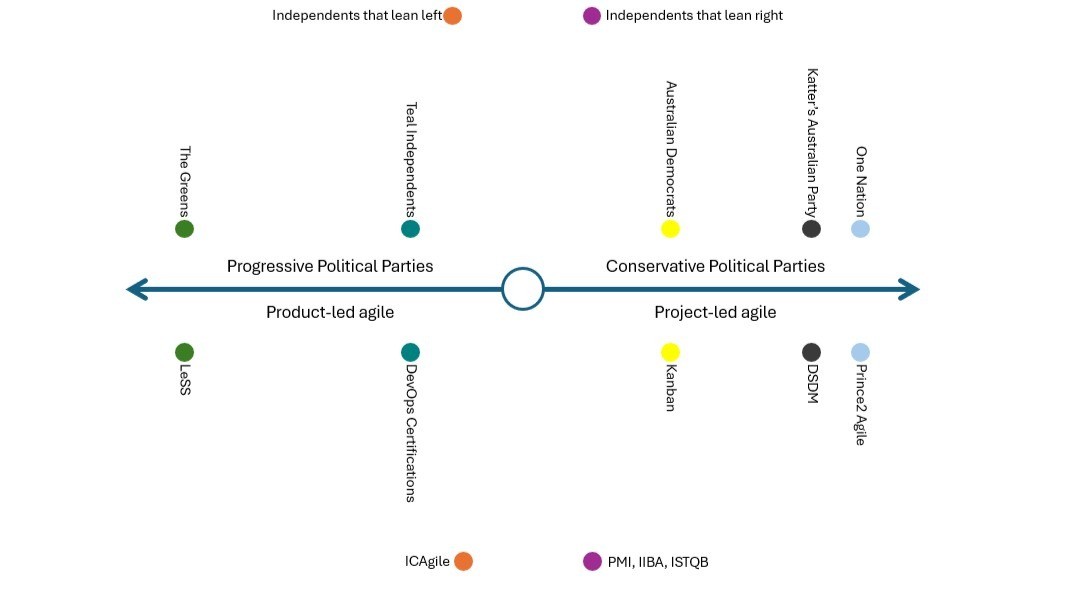
As our discipline-first, reframe-rather-than-reform agile certifications, they map to the right-leaning independents: professionals who enter the political arena not to change the system but to make sure their constituency is protected within it. Independent of the major parties, pragmatic in their dealings, and deeply conservative in the one area that matters most: the continued relevance of the professional community they represent.

The parallels are direct. Right-leaning independents don’t arrive in parliament with a transformation agenda. They arrive with a specific brief: protect these jobs, represent this industry, make sure this community isn’t left behind by whatever the major parties decide to do next. PMI, IIBA and ISTQB carry exactly that brief. Their mandate isn’t to reimagine how solutions are built. It’s to ensure that project managers, business analysts, and testers retain a credentialled, respected place in whatever delivery model their organisations adopt. Agile is the context. It is not the cause.

This is also why the agile content within these certifications tends to feel like an additional module rather than a rewrite of the core. It is worth acknowledging that PMI made genuine strides here: the shift to a principles-based model in their later standards represented real philosophical movement, not just rebranding. But even with that evolution, the agile extensions across all three bodies still sit on top of established role structures, the knowledge domains, the professional boundaries, all remain structurally intact. Agile is introduced as a context the discipline now operates within, not a lens that reexamines whether the discipline, in its current form, is still the right tool. The project manager still manages. The BA still analyses. The tester still tests. The world changed around them, and the certification acknowledges that. The professional identity at the centre did not move.

Right-leaning independents are notably pragmatic about language. When the political winds shift, they update their messaging before they update their positions. All three bodies demonstrated this instinct. All three speak agile fluently, and they mean it, but the fluency is in service of protecting the ground they already hold. The translation is genuine. The priorities underneath it are unchanged.

For practitioners, that’s not necessarily a problem. A project manager holding the PMI-ACP brings something real to an agile context: breadth across multiple approaches, familiarity with hybrid environments, and a structured lens for managing complexity. An experienced business analyst who understands stakeholder facilitation, business value, and how to navigate complex organisational constraints brings real value to an agile team. A tester with genuine capability in risk, coverage, and quality thinking is an asset in any delivery environment. These certifications offer a structured bridge between deep existing expertise and the agile context it now operates within. That’s worth something, and it shouldn’t be dismissed.

For organisations, understand what you’re investing in: practitioners equipped to apply their discipline within agile delivery, not practitioners equipped to question whether that discipline, as currently structured, is what the team actually needs. In environments where project management, BA, and testing functions are well established and role clarity matters, these may be exactly the right credentials. In environments genuinely rethinking their operating model, the role boundaries these certifications reinforce may be part of what you’re trying to move beyond.

Right-leaning independents serve a real constituency and they serve it honestly. They’re not in parliament to lead a revolution. They’re there to make sure that when the revolution arrives, the people they represent still have a seat at the table. PMI, IIBA and ISTQB do exactly the same thing. They didn’t reshape agile. They made sure agile had room for the professionals who were already in the room. Whether that’s the credential you need depends entirely on whether your goal is to fit agile around your existing structure, or to let agile challenge it.

This article was originally published on LinkedIn by Daniel Luschwitz.
Episode 169: A Slice of Agile Pi with Betsy Kauffman and Oscar Rodriquez

The Agile Revolution's avatarThe Agile Revolution Podcast

Craig is in Charlotte, North Carolina and catches up with Betsy Kauffman from Agile Pi and Oscar Rodriquez and they chat about:

TheAgileRevolution-169 (56 minutes)

View original post

Episode 168: Agile 2019 (Un)bagging

The Agile Revolution's avatarThe Agile Revolution Podcast

Craig and Renee are in Washington, DC at Agile 2019 and ahead of day one have some fun and decide to open up the swag bag after collecting the badges and see what is inside:

View original post 111 more words

Episode 84: Retrospectives in Middle Earth with Rachael Tempest Wood

The Agile Revolution's avatarThe Agile Revolution Podcast

P1020445Rachael Tempest Wood from Nomad8 in Wellington joins Tony and Craig in the Brisbane Queen Street Mall over lunch with a bonus busker on saxophone and they discuss:

TheAgileRevolution-84 (25 minutes)

View original post

Episode 65: Becoming Agile… with Greg Smith

The Agile Revolution's avatarThe Agile Revolution Podcast

GregSmithAt Agile 2013 in Nashville, TN, Craig catches up with his old friend Greg Smith (no relation), co-author of “Becoming Agile… In An Imperfect World” and Agile Coach at GS Solutions Group. Greg regularly assists Fortune 500 with their adoption of Agile and the quote of the podcast has to be “discipline or good software practices are proportionally inverse to how much money you make!”. Some of the topics of conversation were:

View original post 12 more words

Mike Griffiths on DSDM, Agile and the PMI

Mike Griffiths shares his journey on the creation of DSDM through to his more recent work with the PMI around the Agile Community of Practice and the PMBOK v5 Guide and Software Extension.

Source: Mike Griffiths on DSDM, Agile and the PMI

Episode 44: Typhoid Tony

The Agile Revolution's avatarThe Agile Revolution Podcast

PillsCraig, Renee and a little bit of Tony continue on their Agile journey covering…

Quotes:

TheAgileRevolution-44 (41  minutes)

View original post