
Please note: This is article 6 in a series that explores mapping agile certifications to what Daniel Luschwitz and I have coined the Agile Political Spectrum. The previous blogs in the series are available here:
- What if Agile Certifications were a Political Party?
- The Agile Political Landscape Series: PRINCE2 Agile and One Nation
- The Agile Political Landscape Series: LeSS and The Greens
- The Agile Political Landscape Series: DSDM and Katter’s Australian PartyDSDM and Katter’s Australian Party
- The Agile Political Landscape Series: DSDM and Katter’s Australian PartyDevOps and Teal Independents
A note on our political comparisons: These political comparisons are playful metaphors designed to illustrate philosophical positions on the agile spectrum. No certification body was harmed in the making of this analysis.
Every political spectrum has its quietly effective parties. Not the idealists demanding systemic overhaul. Not the establishment parties jostling for the centre. But the movements that do serious, disciplined work, build a loyal following, and somehow never quite break through to the mainstream because a louder, more charismatic neighbour took all the air out of the room.
In the agile certification world, that party is Kanban.
Ask most practitioners if they ‘use Kanban’ and a majority will say yes. Ask them whether they actively limit work in progress, track flow metrics, use service level expectations, or practice evolutionary change discipline and the numbers drop sharply.
David J. Anderson, who pioneered the Kanban Method for knowledge work, has himself declared “Kanban is ubiquitous, it’s time to declare victory.” And in one sense, he’s right. Kanban boards are everywhere however the Kanban Method is far less common than you might think. That gap, between widespread adoption of the surface and shallow understanding of the substance, is precisely what makes Kanban one of the most underappreciated certifications on our Agile Political Spectrum.
Kanban’s roots stretch back to post-war Japan and the Toyota Production System, not as ideology, but as operational discipline. The original Kanban was a signalling card used to trigger replenishment in a pull-based production line. No manifesto. No cultural revolution. A control mechanism designed to reduce inventory risk and improve flow.
When Anderson introduced the Kanban Method to knowledge work in the mid-2000s, he was deliberate about what it was and wasn’t. He made the positioning explicit from the outset: start with what you do now, respect current roles and responsibilities, and pursue incremental, evolutionary improvement.
Kanban does not require new roles, it does not demand reorganisation or assume that hierarchy must be dismantled. Instead, it asks organisations to visualise their work, limit work in progress, measure flow, manage risk, and improve gradually over time. This is not structural reform. It is structural preservation combined with operational discipline.
Over time, Kanban matured into a serious professional discipline. Kanban University formalised the certification pathway, building a rigorous body of knowledge around flow metrics, service-level expectations, probabilistic forecasting, and the Kanban Maturity Model. The emphasis was never on ceremonies or team rituals. It was on service delivery systems and organisational capability.
So who is Kanban’s political counterpart?
As our right-of-centre, disciplined, and chronically underrated agile certification, Kanban maps to the Australian Democrats.
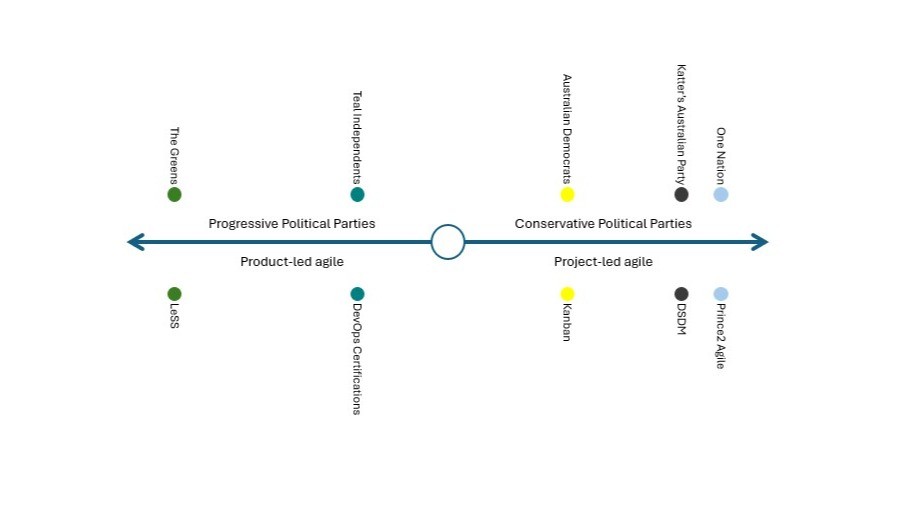
The Australian Democrats were a centrist party founded in 1977, best known for holding the balance of power in the Senate and their rallying cry: “keeping the bastards honest.” At their peak they wielded influence well beyond their vote share, doing serious legislative work while louder voices on both sides dominated the headlines.
The parallels with Kanban are immediate and striking.
Both built serious, rigorous bodies of knowledge and operated with genuine discipline. Both accumulated loyal, knowledgeable followings that punched above their weight in terms of real-world influence. And both were ultimately drowned out, not because their ideas were wrong, but because a louder movement captured the room.
Against the noise of certification ecosystems that scaled aggressively through the 2000s and 2010s, Kanban University’s comparatively modest global network barely registers. And yet, in organisations that genuinely implement it, the Kanban Method consistently delivers improved flow, reduced risk, greater predictability, and a cleaner picture of organisational capacity.
The Democrats were never trying to win government. They were trying to make the system work better. Kanban was never trying to replace whatever else was in the room. It was trying to improve how work flows through whatever system already exists. Both found meaningful influence in that role. Neither got the recognition their contribution deserved.
Kanban boards have become so ubiquitous that many practitioners genuinely believe they are “doing Kanban” simply by moving cards across columns in a tool or on a physical whiteboard. Far fewer implement WIP limits with discipline. Fewer still track cycle time, use probabilistic forecasting, or develop capability in flow analytics. The Kanban Maturity Model, one of the more thoughtful frameworks for understanding organisational development in the agile world, is largely unknown outside the Kanban community itself.
This creates a peculiar market dynamic. Kanban suffers not from bad press, but from misrepresentation by familiarity. Nobody declares Kanban adoption a failure. They just assume they’re already doing it. The certification therefore struggles to communicate its genuine depth to a market that thinks it already knows what Kanban is.
The agile world generated years of passionate debate, consultant wars, and certification inflation around louder frameworks, which paradoxically gave them more visibility. Kanban slipped in the back door, got implemented on whiteboards everywhere, and then got largely forgotten as a serious discipline.
Kanban sits on the right-conservative side of our Agile Political Spectrum, but in a particular way. It is not conservative because it adds bureaucracy or resists change. It is conservative because it genuinely respects existing structures and pursues improvement within them rather than demanding their replacement.
This makes Kanban valuable in a range of contexts that more progressive certifications struggle to serve. For teams operating in complex, highly regulated, or politically sensitive environments where structural redesign is simply not on the table, Kanban offers a credible, evidence-based path to improvement. For leaders who need to demonstrate results without triggering a governance revolt, Kanban’s language of flow, throughput, and risk is far more accessible than the vocabulary of transformation.
For organisations genuinely committed to a product operating model and cultural transformation, Kanban may feel insufficient on its own, though it often becomes essential as a delivery discipline within that broader journey. The ability to visualise and manage flow doesn’t become less important once you’ve reorganised around products. It becomes more important.
If you are an organisation wondering whether Kanban ‘counts’ as agile, or whether it’s just a board tool, the answer is that the board is the least interesting part. The discipline underneath it is where the value lives.
The Australian Democrats may no longer exist as a political party. Their legacy, however, is woven into the fabric of Australian legislative history in ways that rarely get acknowledged. Kanban risks a similar fate, its ideas absorbed into every tool and methodology without credit, its depth largely undiscovered.
Like a good Democrats senator, Kanban won’t promise you a revolution. But it will make the system you already have work considerably better. If you are attempting to reduce waste, bottlenecks and the invisible work quietly choking your organisation then Kanban might be just what you need in keeping the bastards honest.
This article was originally published on LinkedIn by Daniel Luschwitz. The next article in the series is ICAgile and the Left-Leaning Independents.





 Marcus Hammarberg



You must be logged in to post a comment.