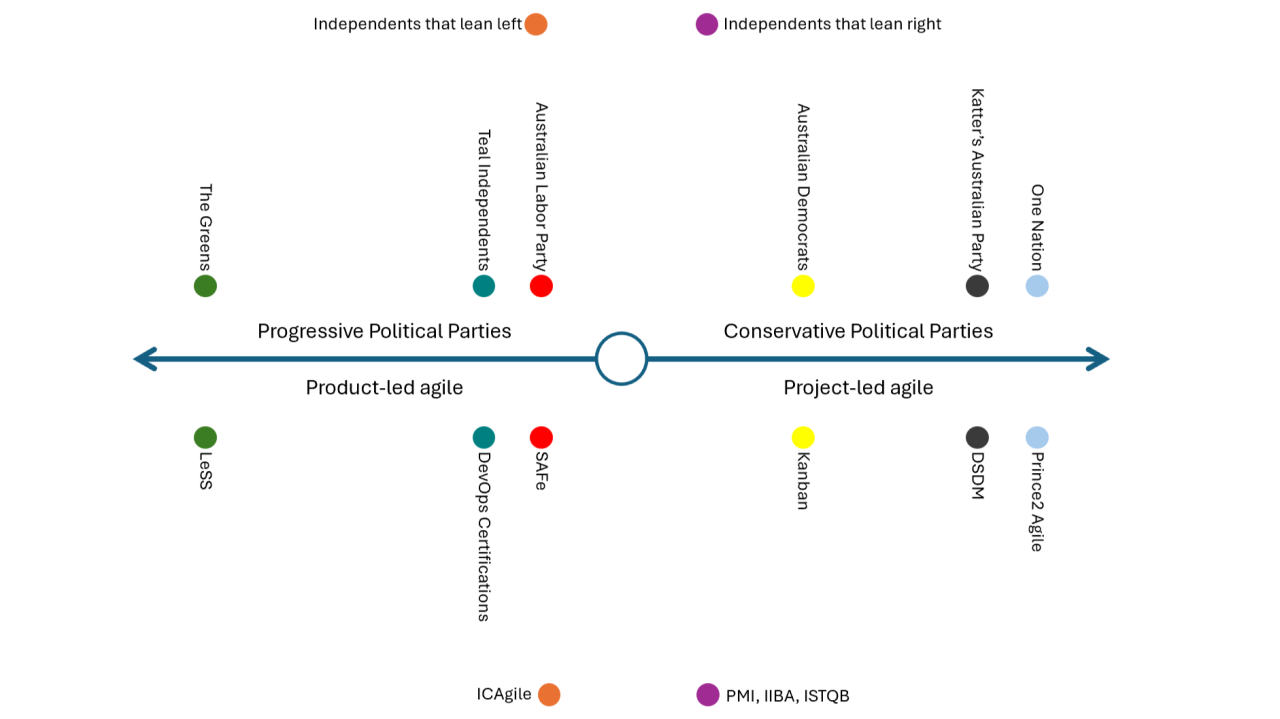
Please note: This is article 9 in a series that explores mapping agile certifications to what Daniel Luschwitz and I have coined the Agile Political Spectrum. The previous blogs in the series are available here:
- What if Agile Certifications were a Political Party?
- The Agile Political Landscape Series: PRINCE2 Agile and One Nation
- The Agile Political Landscape Series: LeSS and The Greens
- The Agile Political Landscape Series: DSDM and Katter’s Australian PartyDSDM and Katter’s Australian Party
- The Agile Political Landscape Series: DSDM and Katter’s Australian PartyDevOps and Teal Independents
- The Agile Political Landscape Series: Kanban and the Australian Democrats
- The Agile Political Landscape Series: ICAgile and the Left-Leaning Independents
- The Agile Political Landscape Series: PMI, IIBA, ISTQB and the Right-Leaning Independents
A note on our political comparisons: These political comparisons are playful metaphors designed to illustrate philosophical positions on the agile spectrum. No certification body was harmed in the making of this analysis.
Every political spectrum has its broad church. The party that was born from a genuinely progressive cause, that carries real reform in its DNA, but that has spent decades learning how to win the mainstream rather than just inspire the faithful. It speaks the language of workers and battlers, of fairness and inclusion, but it governs from the centre because that is where elections are won. It is not the party of the purist. It is the party of the possible, shaped as much by what the electorate will accept as by what its founders believed.
In the agile certification world, that party is SAFe, the Scaled Agile Framework.
SAFe emerged in 2011 from the work of Dean Leffingwell, who had spent years wrestling with a problem that the agile community was actively working to solve: how do you apply agile thinking across a large enterprise? The approaches on offer at the time were serious and principled, but they came with a significant ask. They required the enterprise to restructure, to dismantle hierarchy, to rethink governance from the ground up. Leffingwell took a different view. He met the enterprise where it was, building a framework that could live inside existing structures rather than demanding their removal as a precondition for entry. And in a move that would prove either inspired or irresistible depending on your perspective, he called it SAFe. Whatever you think of the framework, you have to admire the marketing. In an industry that had spent years arguing about whether agile was safe for the enterprise, naming your scaled framework the Scaled Agile Framework and shortening it to SAFe was a masterstroke. The enterprise heard the name and felt reassured before they’d read a single principle.
The result was a comprehensive, layered framework that acknowledged the realities of large organisations. Portfolio management, programme governance, release trains, PI planning ceremonies, architectural runway, business owners, RTE roles: SAFe gave the enterprise agile in a language the enterprise already spoke. The framework grew steadily, expanding with each version and by the time most practitioners encountered it, SAFe had become less a framework and more an ecosystem, complete with certifications, consulting partners, tooling integrations, and a global community of practice.
That breadth is both SAFe’s greatest strength and the source of its most persistent criticism. On one side, practitioners who have lived through failed agile transformations will tell you that SAFe gave them something to stand on, a common vocabulary, a planning cadence, a way to connect team-level delivery to portfolio-level priorities. On the other side, those with deeper roots in the progressive agile tradition will argue that SAFe reintroduces the very management layers and handoff points that agility was designed to remove, that it preserves the project-based operating model while calling it something new, and that its certifications prioritise fluency in the framework over genuine understanding of the underlying principles.
Both sides are, in important respects, correct. The published evidence base on SAFe outcomes is thin and contested, with most claims coming from parties with a commercial interest in the answer, which leaves practitioners to draw their own conclusions based on their experiences, rather than data.
So who is SAFe’s political counterpart?
As our large-scale, institutionally progressive, pragmatic agile framework, SAFe maps to the Australian Labor Party.
The parallels run deeper than they might initially appear. The ALP was founded on the conviction that working people deserved better conditions, fairer systems, and a genuine voice in how institutions operated. It is, at its heart, a progressive movement. But Labor has always understood something that the parties further to its left tend to underestimate – you don’t win government by being right. You win it by being electable. And that means translating progressive values into policies that can carry constituencies well beyond the converted.
SAFe operates with exactly this logic. The agile movement had the right values: collaboration, flow, customer focus, empirical thinking. But enterprise adoption required more than values. It required structure that PMOs could recognise, reporting lines that executives could work within, and a rollout model that HR and finance could plan around. SAFe provided all of it. It didn’t so much compromise agile as it packaged agile for an audience that would never have signed up to the original proposition without that packaging.
Labor has always understood that reach requires infrastructure, not just principle. The ALP built its base through affiliated institutions and organised constituencies, individual unions folding their cause into the broader movement, each one extending the party’s reach into communities it couldn’t have accessed alone. SAFe’s partner model works the same way. The network of certified consultants and implementation partners created an ecosystem with a remarkably low barrier to entry. Complete a four-day course, pass the exam, and you were a SAFe Practice Consultant (SPC), empowered with the courseware and authorised to deliver training. The credential created the constituency, and the constituency grew the framework. Critically, SAFe gave that constituency something the rest of the agile world hadn’t managed to offer at scale: a framework with enough structure and governance that leadership could see themselves in it. Executives had a model. Portfolio managers had a layer. Programme leads had a planning cadence. From a scaling perspective, the rest of the agile world was offering radical models that required a shift in mindset before they could take hold. SAFe was already in the building.
There is something recognisably Labor in the tension that sits at SAFe’s centre. Labor has always attracted people whose values sit well to the left of the party platform, people who made their peace with the compromise because the alternative was no seat at the table at all. SAFe drew exactly that kind of practitioner. Coaches and consultants who cared deeply about product thinking, genuine agility, and organisational transformation found that SAFe got them through the door of enterprises that would never have engaged them otherwise. For those practitioners, SAFe was training wheels, a pragmatic starting point from which the real work of shifting mindsets could begin. The problem is that the framework is large enough, and complex enough, that for most organisations it became the destination rather than the departure point. The training wheels never came off. And the practitioners who always intended to remove them found themselves maintaining a system they had hoped to transcend.
For practitioners, SAFe certifications provide genuine value for people working in large enterprise contexts who need to navigate the intersection of agile delivery and traditional governance. The PI planning approach, when implemented well, creates real alignment across teams that previously had no shared rhythm. The portfolio-level thinking addresses a genuine gap that team-level agile methods leave almost entirely unaddressed. And the common vocabulary SAFe establishes across a programme or portfolio is not a small thing. When practitioners from different disciplines can have a productive conversation about capacity, priorities, and dependencies without translating between frameworks, that shared language is valuable.
At the same time, be clear about the limitations. SAFe certifications, particularly at the foundational levels, often produce practitioners who are knowledgeable in SAFe rather than fluent in agile. The distinction matters. An organisation that has implemented SAFe has changed how it coordinates and plans. It has not necessarily changed how it thinks about value, customers, or the nature of the work. The transformation has often reached the programme layer and stopped there, leaving the underlying operating assumptions, particularly the assumption that work is best managed as a sequence of projects rather than as continuous product development, largely intact.
The Australian Labor Party rarely governs from its most progressive position. It wins by being electable, implements by being pragmatic, and makes its peace with the fact that the transformation it delivers will always be partial. SAFe carries the same character. Organisations that adopt it do move, structures loosen, delivery improves, conversations about value and flow begin to happen that simply weren’t happening before. But it has also, in many implementations, made a comfortable home for exactly the kind of governance and hierarchy that agile was supposed to challenge. Whether you view that as a reasonable compromise or a fundamental betrayal says a great deal about where you sit on the Agile Political Spectrum.
Just don’t be surprised when SAFe, like Labor, occasionally needs to negotiate with its own right faction to get anything across the line. Breadth has always come at a price.
This article was originally published on LinkedIn by Daniel Luschwitz.


You must be logged in to post a comment.