Please note: This is the third article in a series that explores mapping agile certifications to what Daniel Luschwitz and I have coined the Agile Political Spectrum. The previous blogs in the series are available here:
- What if Agile Certifications were a Political Party?
- The Agile Political Landscape Series: PRINCE2 Agile and One Nation
- The Agile Political Landscape Series: LeSS and The Greens
A note on our political comparisons: These political comparisons are playful metaphors designed to illustrate philosophical positions on the agile spectrum. No certification body was harmed in the making of this analysis.
DSDM emerged in 1994 from a consortium of UK organisations frustrated with failed IT projects. At the time, Rapid Application Development (RAD) was popular for its rapid prototyping and faster development, however, the movement was unstructured inviting some “cowboy” practices and issues around quality. DSDM was created by practitioners actually looking for more governance and stricter controls. They weren’t ideologists trying to revolutionise project delivery, they were pragmatists trying to find a balance between speed and quality. The result was one of the first true agile methods, with Arie van Bennekum representing the DSDM Consortium at the signing of the Agile Manifesto in 2001.
The DSDM philosophy centres on eight principles, including “focus on the business need”, “deliver on time”, and “build incrementally from firm foundations”. DSDM acknowledges that organisations need governance, stakeholders need confidence, and projects need structure, but it also wanted to allow teams to deliver value incrementally and adapt to change.
DSDM introduced some common agile practices still used today. Have you heard of MoSCoW prioritisation, timeboxing, iterative development, and continuous stakeholder involvement? These all came about in the creation of DSDM.
Yet DSDM remains unmistakably a project management approach. It defines roles like Business Sponsor, Project Manager, and Team Leader. It organises work into projects with defined phases: pre-project, feasibility, foundations, evolutionary development, deployment, and post-project. It emphasises business cases, feasibility studies, and formal review points.
In 2010, the DSDM Consortium partnered with APMG International offering three main certifications for Project Management, Business Analysis and Program Management –cementing DSDM’s positioning on the spectrum.
In 2016, the DSDM Consortium rebranded as the Agile Business Consortium and launched their Framework for Business Agility. On the surface, this looked like an evolution – moving beyond project delivery to address organisational agility. But here’s where the certification business model creates tension. The Agile Business Consortium now promotes business agility while their flagship offering remains AgilePM… Agile Project Management.
This is where DSDM faces the classic certification scale-up challenge: they built a successful business on project management certifications, saw the opportunity in business agility, but seemingly didn’t challenge their revenue stream far enough. They added to the market confusion that has inspired this series. How many of the 200,000+ AgilePM certification holders associate their credential with “business agility” because of the framework and branding? It’s a Kodak moment in reverse. Instead of a new technology disrupting the old business model, we saw the new concept (business agility) being absorbed into the old business model (agile project management).
DSDM has very specific appeal, typically chosen at an organisational level for its governance and control capabilities, often representing a logical evolutionary step from waterfall or RUP. While the framework itself is an organisational choice, it appeals strongly to project managers seeking an agile project management certification, offering them a structured approach that bridges traditional project governance with agile delivery.
So who is DSDM’s political counterpart? As our right-conservative, tactical agile certification, DSDM is equivalent to Katter’s Australian Party.
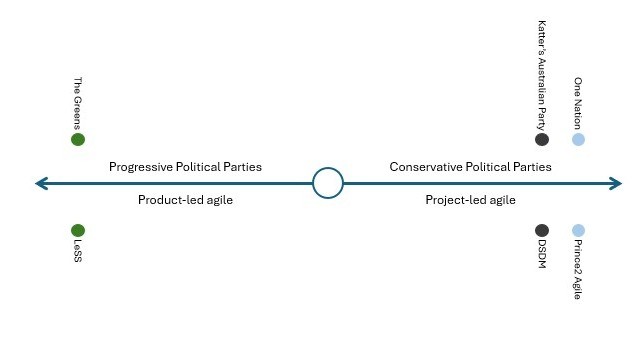
Katter’s Australian Party (KAP) is a right-conservative party, but not in the polished, establishment sense. It occupies a similar position in Australian politics that DSDM holds in the agile spectrum, both having carved out distinct identities outside the mainstream. KAP operates beyond the major party duopoly, while DSDM sits apart from dominant frameworks like Scrum and SAFe.
Both are conservative, but pragmatic rather than ideological. KAP blends traditional values with whatever works for regional communities; DSDM maintains project management foundations whilst adopting agile flexibility when needed. Neither appeals to purists or revolutionaries, instead they serve constituents who need practical solutions within existing constraints, valuing stability and proven approaches alongside necessary flexibility.
Both prioritise tangible results over theoretical purity. KAP focuses on concrete outcomes for rural and regional areas; DSDM emphasises delivering business value over perfect processes. And both have strong but geographically concentrated followings rather than global dominance, KAP in regional and rural Queensland, DSDM in the UK and European public sector organisations.
We are not sure about the parallels with crocodiles, or if cowboy hats are optional though.
DSDM has a valuable place in the market, particularly for project managers navigating the transition to agile. DSDM embraces the Project Manager, explicitly defining it as a key role responsible for traditional project management concerns while enabling teams to work iteratively.
If you’re a Project Manager looking for an “Agile Project Management” certification, AgilePM offers a straightforward and relatively affordable pathway. The Foundation and Practitioner structure provides clear progression without requiring continuous learning credits or subscription models – making it an accessible option for practitioners in conservative organisations with established PMOs and governance structures.
For organisations seeking business agility, continuous product delivery, or transformation of their operating model, understand what you’re getting: a tactical, right-conservative, project-based approach to agile delivery. The Agile Business Consortium branding might imply broader ambitions toward business agility, but the certification portfolio tells a different story. DSDM remains firmly project-focused.
Like its political counterpart, DSDM serves a specific constituency that values practical delivery within conservative structures. Just don’t mistake the “business agility” branding for a framework that challenges project-based thinking – because that would require challenging the very certification business that sustains it.
This article was originally published on LinkedIn by Daniel Luschwitz. The next article in the Agile Political Landscape Series is: DevOps and Teal Independents


You must be logged in to post a comment.