Agile 2012 Day 1 Review

Agile 2012With a bit of last responsible moment planning, I made the trek to Dallas (well actually Grapevine) in Texas, USA for the Agile 2012 conference. This year I was once again a reviewer on the Testing and Quality Assurance stage. This was the first year in four years that I did not have a submission accepted, however with my role as an Agile editor for InfoQ, part of my journey was to interview interesting Agile folks on camera (how cool is that!)

When somebody says that things are always bigger in Texas they are not kidding! The Gaylord Texan Hotel and Conference Center is huge, in ways that cannot be explained without seeing it. Everything is accessible without really needing to leave the enclosure (which is great because you don’t need to experience the 110 degree heat outside.

From Agile 2012
From Agile 2012

Here are my notes from the sessions that I attended on day 1.

From Agile 2012

Bad-Assed Double-Loop Learning: From Judgmental to Good Judgement

This was a workshop led by Derek W. Wade and Susan Eller. Susan comes from a medical background while Derek has experience in health care and aviation. Their presentation is available here.

From Agile 2012
  • 70% of health care errors happen due to lack of communication, similar numbers for aviation
  • transparency is starting to be accepted as a given, but still opaque in communication (people apply filters)
  • the “core protocols” help transparency
  • people in health care often perform non-health care scenarios (for a scenario that is unfamiliar to them)

We were then given a clinical scenario to watch in which a doctor is giving a medical update to a parent.

  • we observed that: the doctor gave out a broad range of data, the senior doctor fled the scene, the doctor was not looking to the parent at eye level, there was lots of technical jargon
  • our coaching advise to the doctor would be: sit down, don’t be alarming, wait for a response from the parent and address any  concerns, focus on the more likely data at the moment, know the patient, get the senior doctor to introduce the new doctor and stick around for the discussion, ask the parent if he has any needs

We then launched into talking about feedback:

  •  judgemental feedback – “I wouldn’t have done that”
  • non-judgemental feedback – sounds like you are being nice, but are actually statements that make people defensive, “the wolf in sheep’s clothing”, “do you think you could have done better?”
  • frames (mental models) – context is king, match our context to the other person and determine what frame they are in
  • ladder of inference – we can observe data and experiences as well as the actions, but everything else is within, are you basing conclusions on something observed or something inferred (The Fifth Discipline Fieldbook)

Ladder of Inference

  • you need to check in with yourself – are you using observable or inferred data
  • like the donkey’s balls vide, you need to have a WTF moment – what is your cue? Ask “where’s that from” when you have a mismatch rather than rage with WTF!!!
  • single loop interaction – inferred frame, “why we think they did it” (do something and get an outcome, repeat) as opposed to double frame interaction asking “why they did it” (do something, get an outcome, learn from the interaction on why)
  • not all about how you did it, but the way you deliver the message, need to bring to the attention of other person what you saw (your frame), need to understand why they did it
  • uncover your own thinking, use lots of “I” statements to remove defensive stance, “here is what I noticed”, “here is what I do”
  • data -> advocacy -> inquiry
  • balance with inquiry
  • as a coach if you understand the appropriateness rather than just telling them, you are doing double loop learning
  • you have a level of knowledge, so you need to understand but still use good judgement
  • “I noticed…”, “why did you do that?”, “I observed you were polling for status at the scrum… Why did you do that?” In this case, the answer was respecting the time box. Responded, “I understand that…”, “but it is my view that…”, “what do you think about that?”
  • can also do this with your spouse, teenagers (gets through the pain quicker), can also do via email, it’s not the medium it’s yourself (are you genuinely curious)?

The debrief stages are:

  • reaction – not “how did that go”, but “how did that feel”, chance to vent about any feelings
  • description – ensure we are all asking about the same problem, can you give a summary of what happened
  • analysis – use advocacy / inquiry and ask how that related and expose frames
  • generalisation – look for outstanding examples, how can we apply this learning to reinforce

Finally, when you hear yourself thinking “WTF!”, balance that with “What’s that from”

Agile Inception Deck – 10 Questions You’d Be Crazy Not To Ask Before Starting Your Project

This workshop was led by Jonathan Rasmusson, author of the Agile Samurai. Much of this workshop was common sense and very close to the Concept process I have been using and teaching for the last few years. His presentation is available here.

From Agile 2012
  • we start projects thinking we are aligned, but often we are not
  • ten questions – good for 1-6 months of planning, should take a couple of days to a week to complete
  • the last thing executives want is the team asking for more money – they prefer a larger number up front
  • at the front of a project is the time to ask the hard tough questions
  1. ask why we are here – why are we spending shareholder money and capital on this, most projects skip this, if you can go and spend time at the client site
  2. create an elevator pitch – in 30 seconds you have to be concise, in Crossing the Chasm by Geoffrey Moore there is a template for an elevator pitchfor (number one customer constituent)
    who (the problem)the (name of the project)
    is a (type of project)
    that (the intent)
    unlike (competitors)
    our (differentiation)
  3. product box – what would it look like, what are the features and the related benefits – a list the benefits; b) create a slogan; c) draw your creation
  4. create a not list – focus on what we are not going to resolve – in, unresolved and out of scope
  5. meet your neighbours – your project community is always bigger than you think ,core team -> people to start building relationships with -> then everyone else, stakeholder map
  6. show the solution – pick your architecture when you pick your team, be aware that people bring baggage, knock together a high level architectural diagram, show the challenges to the sponsors (eg. no test instances), also show the out of scope and unresolved architecture, understand gaps of licensing, etc…
  7. what keeps you up at night – risks worth taking and those that aren’t
  8. size it up – we don’t know how big – estimate in month-ers, go through the master story list, it’s a guess, not a commitment, think small, no project should take longer than 6 months
  9. be clear on what’s going to give – the secret of agile is that it does the same thing you do when you have too much to do and not enough time, dropping agile is just dropping cost (“or just sending the problem downstream to another manager” as per someone from the audience), the furious four, agile likes to bend on scope, use trade-off sliders, if they don’t want to make a decision you need to remind them that at some stage someone will make a decision, do other important stuff on a separate slider
  10. what’s it going to take – be clear on your team (who do you need, what skills, make sure you have your stakeholders on there as well to be clear on commitments), clarify who is calling the shots (especially when you have multiple stakeholders) and who will make the final decisions from a customer stakeholder point of view (who is the person with the goal), come up with a rough back of the napkin budget
  • should be 10 slides in PowerPoint or keynote – clarity, creative, drives conversation, easy to participate

Here is the deck that the table I was working with created:

From Agile 2012

A blank deck and summary is also available. Jonathan also posted some notes and pictures of the session.

Jonathan also made some time to speak to me briefly on the podcast below.

Podcast

Finally, I recorded a short audio podcast for The Agile Revolution wrapping up Day 1 of the conference, including a short interview with Jonathan Rasmusson.

Episode 43: Agile 2012 Day 5

The Agile Revolution's avatarThe Agile Revolution Podcast

Agile 2012The final day (day 5) at the Agile 2012 conference in Dallas, and a couple of really inspiring keynotes around using Agile for social good.

In-depth notes can be found on Craig’s blog.

TheAgileRevolution-43 (14 minutes)

View original post

Episode 42: Agile 2012 Days 3 and 4

The Agile Revolution's avatarThe Agile Revolution Podcast

Agile 2012Days 3 and 4 at the Agile 2012 conference in Dallas. In between roaming the corridors and talking people for the podcast (look for upcoming recordings) and video interviews for InfoQ, he attended a bunch of sessions and mingled at the after dark events.

In-depth notes can be found on Craig’s blog.

TheAgileRevolution-42 (14 minutes)

View original post

Episode 41: Agile 2012 Day 2

The Agile Revolution's avatarThe Agile Revolution Podcast

Agile 2012Day 2 at the Agile 2012 conference in Dallas. Craig covers the introductory keynote and some of the other notable sessions he attended.

In-depth notes can be found on Craig’s blog.

TheAgileRevolution-41 (11 minutes)

View original post

Episode 40: Agile 2012 Day 1 plus The Agile Samurai

The Agile Revolution's avatarThe Agile Revolution Podcast

Agile SamuraiDay 1 at the Agile 2012 conference in Dallas was workshop day. Craig recaps the sessions he attended and has a quick chat with Jonathan Rasmusson about his Agile Inception Deck workshop and his book The Agile Samurai amongst other things.

In-depth notes can be found on Craig’s blog.

TheAgileRevolution-40 (14 minutes)

View original post

AAFTT Workshop 2012 (Dallas)

Agile AllianceThe Agile Alliance Functional Testing Tools Workshop (AAFTT), was one again held this year the day before the Agile 2012 conference in Dallas. Despite there being only a small group there this year, the discussion was still open and free flowing under the facilitation of Matt Barcomb and the organisation of Joseph Wilk and Elisabeth Hendrickson.

From Agile 2012

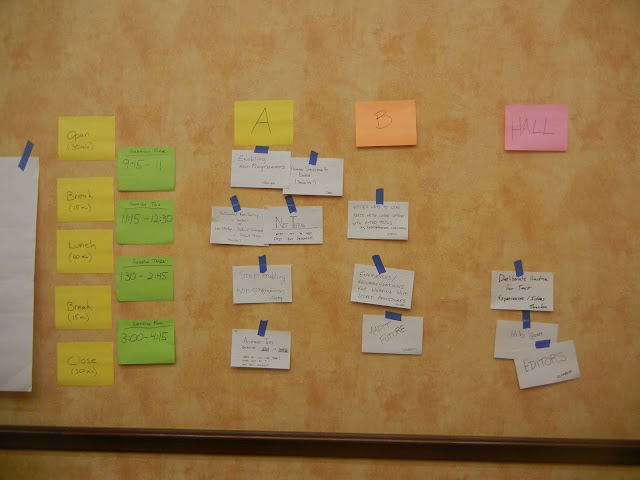
We created an agenda for the day:

From Agile 2012
From Agile 2012

Here are my notes from the day:

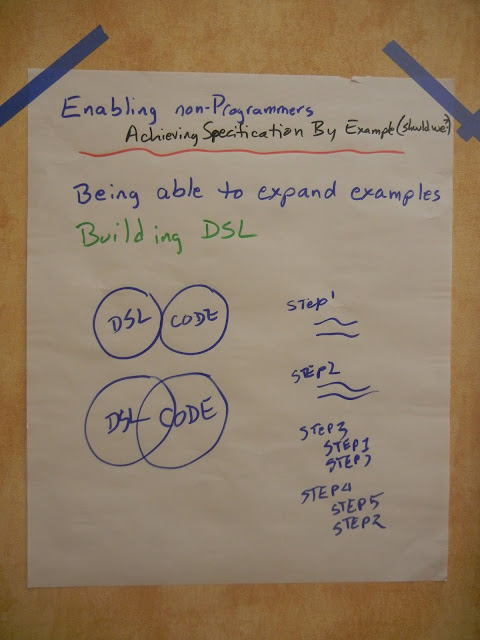
Enabling Non-Programmers

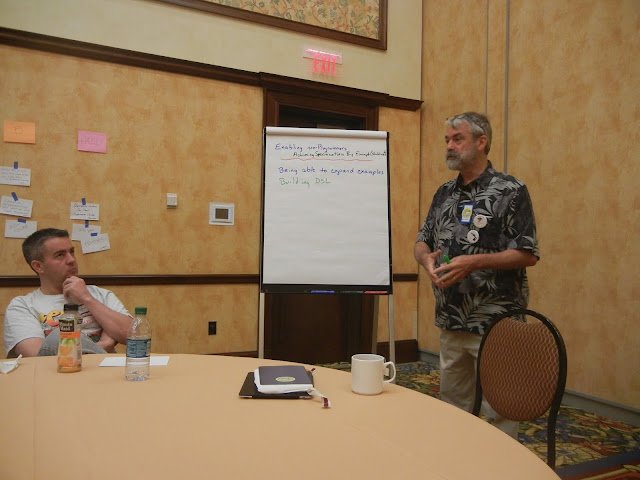
George Dinwiddie led this session which turned into a lively discussion! I had proposed what I thought was a related session on Specification By Example and had combined them, but the conversation never really had a chance of getting onto that topic!

From Agile 2012
  • George expects the business people to be able to read and understand the tests
  • non-programmers should not be writing automation, it is the programmers responsibility
  • wants to be able to extract working tests into a step definition rather than needing to rewrite in Ruby (George Dinwiddie)
  • there is a difference between a specification and testing (Christian Hassa), this is a fundamental shift
  • building a DSL – talk about terminology and how we explore our domain – essential step
  • you don’t create a DSL, you build it
  • not a problem with the toolset but our training in thinking in a procedural way rather than an example way of thinking (Corey Haines
  • testers new to automation create large scripts because it’s their only hope in creating some sort of repetition (@chzy), it does not take a lot of effort and most business people are open to working this way
  • enable non-programmers by getting them to come work with us every day (Woody Zuill)
  • George is helping people make a transition, don’t want people to throw away what they have,
  • ideal is not to have step definitions call step definitions, Cucumber community is becoming a community of programmers and are moving away from this
  • Robot Framework is more keyword driven, more aligned to non-programmers, you can also make a mess, “it is a double edged sword” (Elisabeth Hendrickson)
  • testers like to test the negative cases, should they be expressed at a high level or expressed as a unit test by pairing developers and testers
  • if you are testers and you cannot write simple Ruby scripts, then you have no place on my team (Corey Haines), this opinion is probably shared by the Cucumber community (George disagreed…)
  • need to use the same design patterns in both Robot and Cucumber (@chzy)
  • in an environment that is test centric and BDD, Cucumber is the tool (usually environments with little to no QA),  in a business centric environment where you an get the business involved Robot Framework is your tool
  • Corey works in environments where there is very few Cucumber specifications per scenario, backed by lots of unit tests
  • Cucumber came out of environments where the team is predominantly developers, hence the desire to drill down to Ruby code sooner
  • at a large household name company – theyexpect testers to be more technical, happening more in the industry, eliminated the role of tester due to different pay grades (@chzy)
  • moving traditional organizations to a collaborative way of working is hard (@chzy)
  • wants simple refactorings that are are a bridge from one place to another (George Dinwiddie)
From Agile 2012
From Agile 2012

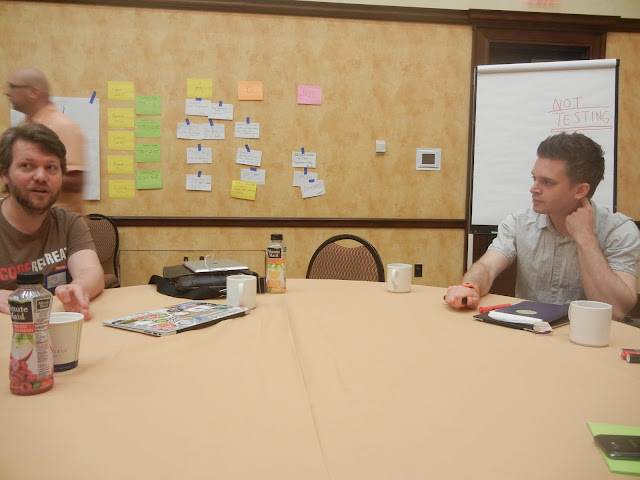
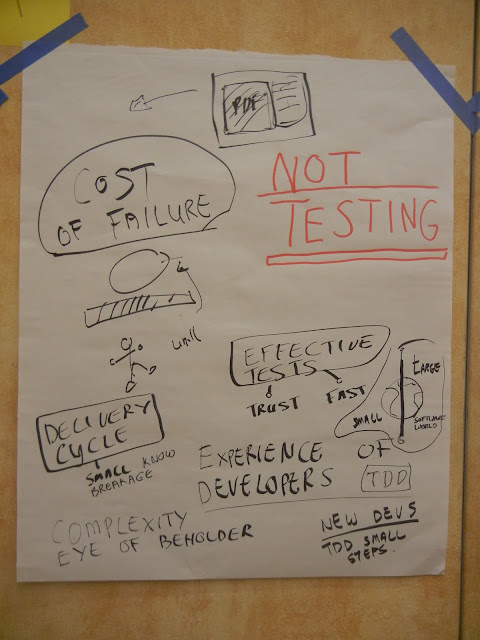
Not Testing

Joseph Wilk led this discussion on thoughts that are coming from the Lean Startup movement.

From Agile 2012
  • at a startup Joseph was at, tests were taking up to 8 hours to run and costs for distributed architecture was high
  • Forward Internet (London) – let developers do what they want – by not testing they could be faster and more interactive than their competitors – did testing in Production, a risk that sometimes things could fail – testing should not block deployment
  • in some situations it is just worth hacking it out, particularly in a lean startup
  • if it is faster to rewrite rather than maintain it, then don’t write tests (Fred George via Corey Haines)
  • a big question of this is the skill level of your developers – do you have the skill level to make the choice to not do it (Corey Haines), primary impact of success is the skill level of your developers
  • cost of failure?
  • complexity is in the eye of the beholder
  • Etsycheck error rates in Production (and decide whether to roll back or not)
  • Scribd – were having trouble with test speed and found out the developers were scared of breaking the PDF (which is the heart of the business) – they separated the PDF out to speed up development (so developers weren’t worried about breaking it)
  • quick delivery – need the quick feedback cycle to make this work, simulate production
  • need effective tests – small suite of tests that are 5-10 minutes long
  • test what you are most scared of
  • Silicon Valley’s issue is hiring – Facebook is stealing developers from Google because they hire good people and enable them to just hack it out
  • 2 software industries – small companies and large corporations, very different worlds
  • question everything – can only do this if you have experienced it before and understand it
  • need a model to help others adopt this
From Agile 2012

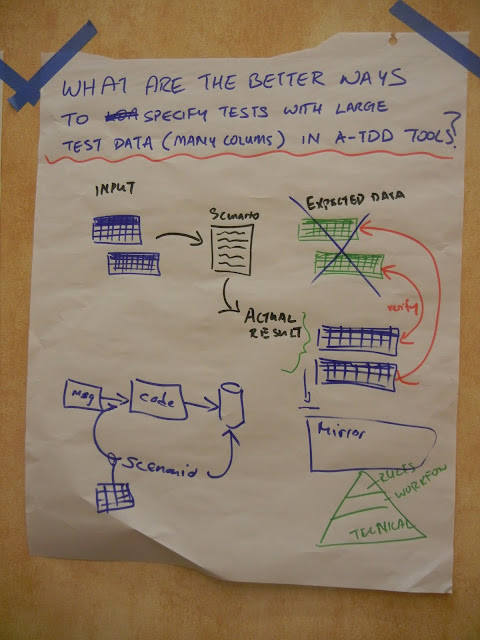
What Are The Better Ways To Specify Tests With Large Test Data

I unfortunately did not get to this session as it was running at the same time as the No Testing session, but here is the output from that session.

From Agile 2012
From Agile 2012
From Agile 2012

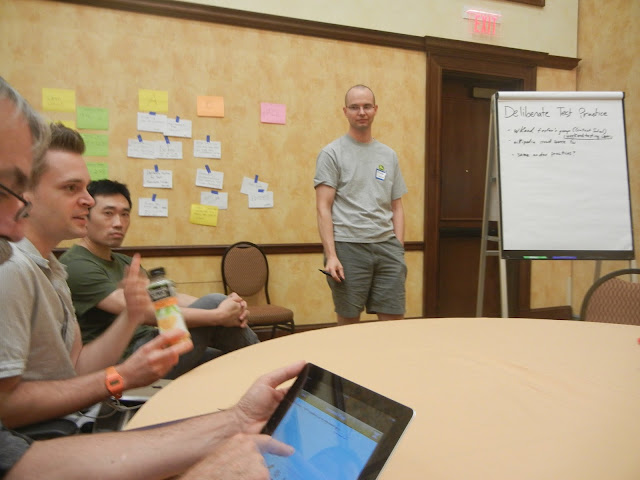
Deliberate Test Practice

Brandon Leiran led this session, trying to see if there was a testing equivalent of coding katas.

From Agile 2012
  • weekend testing group – choose a target, collaborate on Skype on their findings
  • Wikimedia Foundation – looking at ways crowd source testing to test infrastructure (rather than content) – more on this initiative to be announced in the near future
  • why is it any different to coding katas? Safer and smaller so you get more practice, practice collaboration too
  • organise a community like a book club
  • code roast – put the code up and everybody critiques it, be careful not to attach to a person!
  • get practice at driving different interfaces – Triangle Tester exercise, parking lot calculator
  • hard to practice test automation as it takes a lot of time upfron
  • take time to do charter writing sessions or test different items like cheap toys (how would you test this toy?)
  • demonstrate value of quality using simulations eg. origami games
  • add tests to open source – many of the existing tests are average
From Agile 2012
From Agile 2012

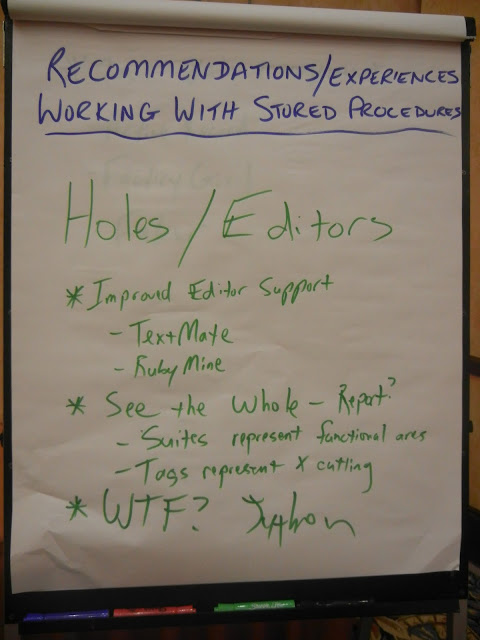
Holes / Editors

Chzy led this discussion to discuss holes in the existing frameworks.

From Agile 2012
  • the HTML report from Cucumber is very average – chzy is releasing a new gem based on discussion from a recent testing conference in Austin
  • editors – people now bundling these in TextMate, Eclipse and Visual Studio
  • JetBrainsRubyMine has gherkin support and refactoring support for Ruby, plus a lot of support for steps in Cucumber
  • big picture view of feature coverage – would be cool to map this to Sonar, suites represent functional areas, tags to represent cross-cutting concerns
  • SpecFlow is trying to map to story maps using SpecLog
  • Relish allows you to create higher level specification of your scenarios
  • there is a plugin for Cucumber that allows github integration
  • Thucydides has a built in feature coverage report
  • Twist has Cucumber support
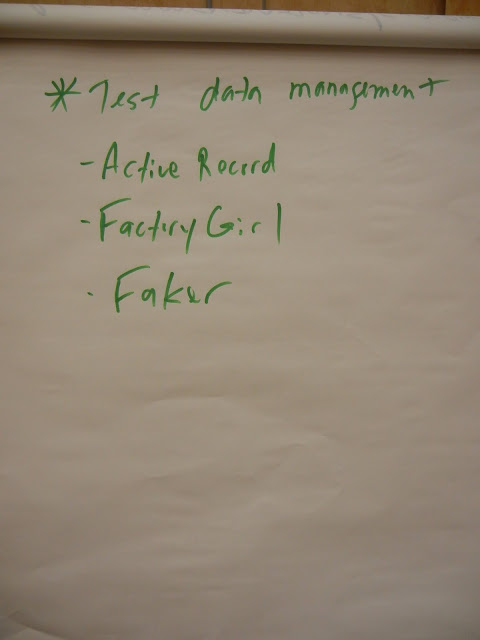
  • test data management – FactoryGirl gem – build up snapshots but want to be able manipulate values down the stack, Faker, ActiveRecord
From Agile 2012
From Agile 2012

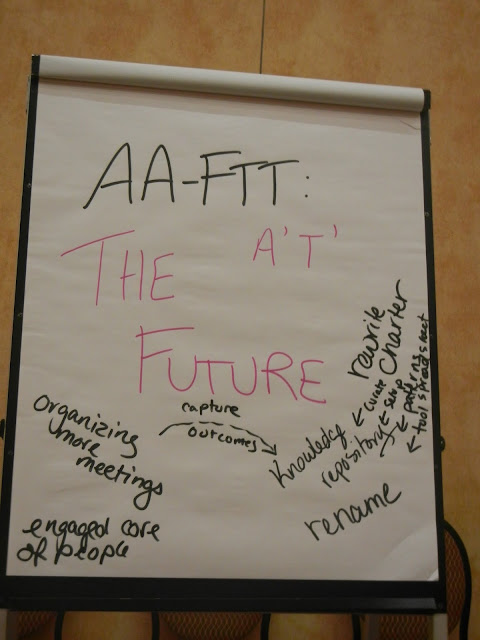
AA-FTT – The Future

Elisabeth Hendrickson led this session as part of her handing the leadership over to Joseph Wilk.

From Agile 2012
  • mission is to advance the state of the art of functional testing tools
  • community building is the best way to spend the money, tool builders and tool users
  • Yahoo group is main repository of knowledge, current wiki probably needs to be moved
  • need people who have time and energy and interest to take this forward
  • biggest issues with wikis is managing all the wiki spam
  • have a leadership issue to curate the content and grow the community
  • the other options are to create static content, like business analysts and leadership
  • important to have a knowledge repository that at least captures outcomes
  • would like have more organised meetings worldwide
  • is our mandate just functional testing? It has really been just about “agile testing”
  • probably need to rewrite the charter
From Agile 2012

Wrap Up

We finished up the open space by writing what action we were taking from the day and giving them to another participant to keep us honest (mine was to write this post!)

From Agile 2012

Another good open space, and good to catch up with many of the leaders in the testing community once again.

Podcast

I recorded a short audio podcast for The Agile Revolution wrapping up AAFTT.

Episode 39: Agile 2012 Day 0

The Agile Revolution's avatarThe Agile Revolution Podcast

Agile 2012Craig is in Dallas, Texas, USA at the Agile 2012 conference. Today was day 0 and the annual AA-FTT workshop.

In-depth notes can be found on Craig’s blog.

TheAgileRevolution-39 (8 minutes)

View original post

Episode 38: Coding With Exceptions (The Agile Story)

The Agile Revolution's avatarThe Agile Revolution Podcast

Mark Derricutt & Craig AspinallThis is a special mashup episode recorded in Auckland, New Zealand. Craig catches up with Mark Derricut from the Illegal Argument podcast and Craig Aspinall from the Coding By Numbers podcast. Not your usual Agile podcast, the discussion starts around the definition of Agile (“crash often, crash regulary”) and trying to define quality and ends up in a chat about wicked problems, devops and software development skillsets.

This episode has been released on the other channels as well (take a listen if you haven’t already)

  • Illegal Argument (Episode 83)
  • Coding By Numbers (Episode 37)

TheAgileRevolution-38 (67 minutes)

View original post

Episode 37: Sensational Sydney

The Agile Revolution's avatarThe Agile Revolution Podcast

Jeremie BenazraCraig and Renee take a revolutionary tour of Sydney and speak to Jeremie Benazra and Dominic Franco about the Agile work that they are doing in Australia’s big city including Kanban, cultural differences, safety and edgy Agile.

TheAgileRevolution-37 (26 minutes)

View original post

Agile Australia 2012 Day 2 Review

Day 2 of Agile Australia 2012, and another busy day of MC’ing and attending sessions.

The first (hastily rescheduled) keynote session was from Roy Singham from ThoughtWorks.

From Agile Australia 2012

The second keynote was supposed to be Mark “Bomber” Thompson from the Essendon Football Club but he was an unexplained no show. After an impromptu thankyou speech from me and breaking the conference for an early break, James Hird arrived to substitute and did an impromptu talk. As a result of the scheduling changes, I unfortunately did not get to see much of either session.

From Agile Australia 2012

How Lonely Planet Used Agile With SAP and Delighted Customers

I sat in the back of this session delivered by Ed Cortis from Lonely Planet. His slides are available here.

From Agile Australia 2012
  • failed, needed twice as many people after implementation
  • ran net promoter scores internally, -40!
  • attempted Agile customer management – planning meetings took 3 hours, attendance dropped, SAP team became prioritisers
  • NPS dropped to about -35
  • changed team structure and in-sourced, positive NPS
  • got agile working – 4 week sprint, 40 minunte presentation, stakeholders turn up because if you are not there you don’t get prioritised
  • developed a prioritisation matrix – business value versus effort, colour coded cards for skillset, sets order for prioritisation
  • pre work is required for the meeting – know how many points of effort for every available person
  • prioritisation board – built the backlog as part of the session
  • no spreadsheets!

The Trouble With Time Machine

I was MC for this session delivered by Matthew Hodgson from Zen Ex Machina. He gets extra marks for working Doctor Who and bow tie references into the talk. His slides are available here.

From Agile Australia 2012
  • UX people are time travelers
  • time machine pattern – work an iteration or more ahead of the development team
  • UX is primarily about design, we are in two different worlds
  • embed the time machine pattern within Scrum
  • personas – focus on the pragmatic face of our users (David Hussman) – synthesise what we understand at the moment
  • added to GWT… Given I am a role AND I VALUE, When… Then…
  • grooming is the forgotten ceremony
  • involved the users in planning poker – got clear perspective in the context of their environment]
  • demo became a cognitive walk through

Emerging Paradigms in Software Testing

I was MC for this session for Kristan Vingrys from ThoughtWorks. I have known Kristan for a number of years, and I resonate very closely with his views on testing and testers. His slides are available here.

From Agile Australia 2012
  • you have to build quality into the product
  • ATDD is a good way to break down the barriers between developers and testers
  • need to change focus to preventing defects rather than finding defects – measure yourself that more defects is bad
  • fast feedback – embrace continuous integration, automation and the test pyramid
  • involve everyone – crowd source your problems, tests are an asset, version control your test cases
  • change focus from how I prevent this going into production onto how I get this into production
  • build pipeline- stage build to run different tests in different stages in the pipeline
  • tester needs to inform the team of quality, not be responsible for quality
  • target testing to things that are changing, not just scatter gun
  • it’s about the principles, not the practices
  • test code is code – treat it like any other code
  • it’s important to know what you are not covering, more than what we are covering (Model Based Testing)

Design Eye For A Dev Guy

I was MC for this session delivered by Julian Boot from Majitek. This was one of the highlight sessions that I attended at the conference and as I remarked when thanking Julian, it reaffirmed how much I don’t know about good design. His slides are available here.

From Agile Australia 2012
  • you gotta love it, you gotta be able to do it and it needs to deliver a bag load of cash
  • people now expect a fit and finish, design is now expected
  • people over process, not everyone is a good designer so let people play to their strengths as weaknesses get in the way of excellence – need to understand it though
  • design is related to visual processing – what we see is what we design, design can be taught
  • highlight individual items – contrast, colour, shape, white space, underlining
  • grouping – proximity, continuity, enclosure, connection
  • proportion, substance and harmony are important
  • subtle changes dramatically affect the visualization
  1. use a grid like CSS Grid and Twitter Bootstrap
  2. focus on data over labels – make the data bigger, keep your headings close to your data so you don’t get lost
  3. hierarchy of actions, but use them properly
  4. colour – use a designer, but if not use 3 colours in one shade and two others (using three grey is the best pro tip and two others)
  5. let design be your brand, don’t overuse the brand

Agile Executive: The Naked Truth!

I was MC for this session led by Kelly Waters from ThoughtWorks and author of the All About Agile blog. I unfortunately did not get to see much of this presentation, the slides for which are available here.

From Agile Australia 2012

Agile Development on Large Legacy Architecture

I was MC for this session delivered by Tony Young from Integrated Research. This session was designated as “Expert” but there is nothing in this that I could see that made it that level. His slides are available here.

From Agile Australia 2012
  • teams find it hard to focus at 7-8 people and they saw parallel development, sweet spot was 5+/- 1
  • changed because competitors moving faster and customers questioned our quality
  • used agile guidelines, not rules – had must dos and bendys
  • product team deliver using Scrum and give to a QA team that uses Kanban !
  • the peer pressure to try is key
  • use Lego board for backlog to see resource impacts

Other Stuff

One of my colleagues who presented a talk on day 2 was Colin McCririck (who is the Executive Manager of a team I coached for some time) and he spoke on Leadership Secrets for Agile Adoption).

Rosie X recorded an interview with me during the conference which was a lot of fun.

Renee Troughton and I took some time out from talks to record a podcast interview with Ilan Goldstein for the Agile Revolution.

Renee also recorded a podcast with Kim Ballestrin on Cynefin.

We also recorded a wrapup podcast.

I also did some short interviews for InfoQ, which resulted in a wrap-up story.