Episode 41: Agile 2012 Day 2

The Agile Revolution's avatarThe Agile Revolution Podcast

Agile 2012Day 2 at the Agile 2012 conference in Dallas. Craig covers the introductory keynote and some of the other notable sessions he attended.

In-depth notes can be found on Craig’s blog.

TheAgileRevolution-41 (11 minutes)
View original post

Episode 40: Agile 2012 Day 1 plus The Agile Samurai

The Agile Revolution's avatarThe Agile Revolution Podcast

Agile SamuraiDay 1 at the Agile 2012 conference in Dallas was workshop day. Craig recaps the sessions he attended and has a quick chat with Jonathan Rasmusson about his Agile Inception Deck workshop and his book The Agile Samurai amongst other things.

In-depth notes can be found on Craig’s blog.

TheAgileRevolution-40 (14 minutes)
View original post

AAFTT Workshop 2012 (Dallas)

Agile AllianceThe Agile Alliance Functional Testing Tools Workshop (AAFTT), was one again held this year the day before the Agile 2012 conference in Dallas. Despite there being only a small group there this year, the discussion was still open and free flowing under the facilitation of Matt Barcomb and the organisation of Joseph Wilk and Elisabeth Hendrickson.

From Agile 2012

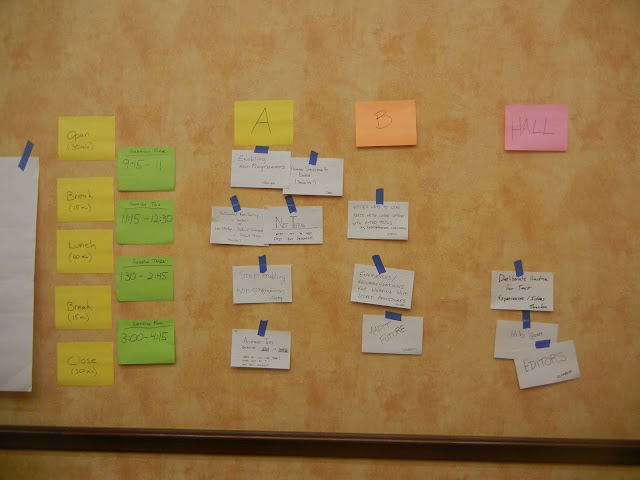
We created an agenda for the day:

From Agile 2012
From Agile 2012

Here are my notes from the day:

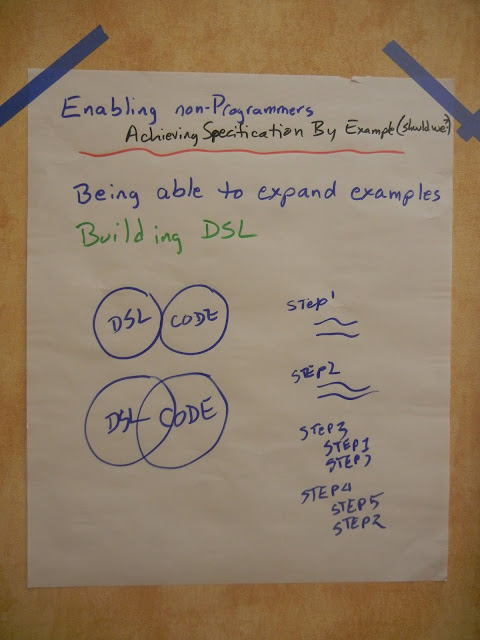
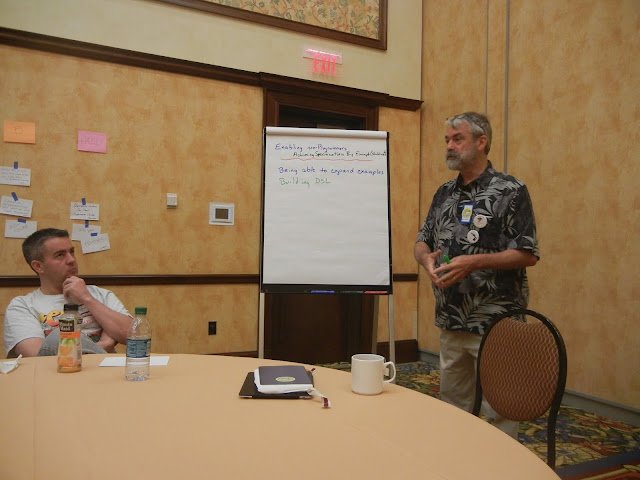
Enabling Non-Programmers

George Dinwiddie led this session which turned into a lively discussion! I had proposed what I thought was a related session on Specification By Example and had combined them, but the conversation never really had a chance of getting onto that topic!
From Agile 2012
  • George expects the business people to be able to read and understand the tests
  • non-programmers should not be writing automation, it is the programmers responsibility
  • wants to be able to extract working tests into a step definition rather than needing to rewrite in Ruby (George Dinwiddie)
  • there is a difference between a specification and testing (Christian Hassa), this is a fundamental shift
  • building a DSL – talk about terminology and how we explore our domain – essential step
  • you don’t create a DSL, you build it
  • not a problem with the toolset but our training in thinking in a procedural way rather than an example way of thinking (Corey Haines
  • testers new to automation create large scripts because it’s their only hope in creating some sort of repetition (@chzy), it does not take a lot of effort and most business people are open to working this way
  • enable non-programmers by getting them to come work with us every day (Woody Zuill)
  • George is helping people make a transition, don’t want people to throw away what they have,
  • ideal is not to have step definitions call step definitions, Cucumber community is becoming a community of programmers and are moving away from this
  • Robot Framework is more keyword driven, more aligned to non-programmers, you can also make a mess, “it is a double edged sword” (Elisabeth Hendrickson)
  • testers like to test the negative cases, should they be expressed at a high level or expressed as a unit test by pairing developers and testers
  • if you are testers and you cannot write simple Ruby scripts, then you have no place on my team (Corey Haines), this opinion is probably shared by the Cucumber community (George disagreed…)
  • need to use the same design patterns in both Robot and Cucumber (@chzy)
  • in an environment that is test centric and BDD, Cucumber is the tool (usually environments with little to no QA),  in a business centric environment where you an get the business involved Robot Framework is your tool
  • Corey works in environments where there is very few Cucumber specifications per scenario, backed by lots of unit tests
  • Cucumber came out of environments where the team is predominantly developers, hence the desire to drill down to Ruby code sooner
  • at a large household name company – theyexpect testers to be more technical, happening more in the industry, eliminated the role of tester due to different pay grades (@chzy)
  • moving traditional organizations to a collaborative way of working is hard (@chzy)
  • wants simple refactorings that are are a bridge from one place to another (George Dinwiddie)
From Agile 2012
From Agile 2012

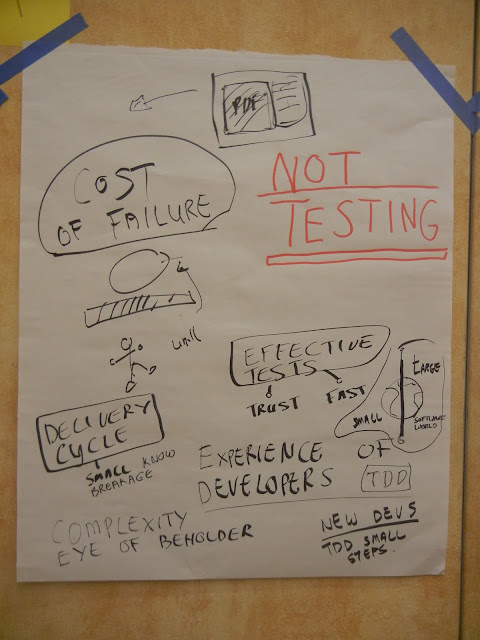
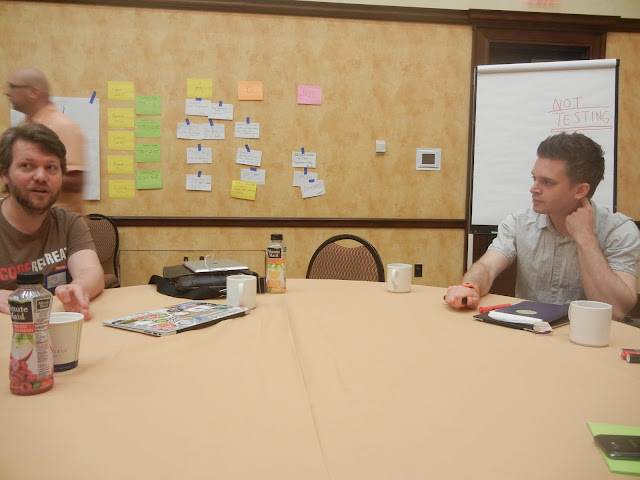
Not Testing

Joseph Wilk led this discussion on thoughts that are coming from the Lean Startup movement.
From Agile 2012
  • at a startup Joseph was at, tests were taking up to 8 hours to run and costs for distributed architecture was high
  • Forward Internet (London) – let developers do what they want – by not testing they could be faster and more interactive than their competitors – did testing in Production, a risk that sometimes things could fail – testing should not block deployment
  • in some situations it is just worth hacking it out, particularly in a lean startup
  • if it is faster to rewrite rather than maintain it, then don’t write tests (Fred George via Corey Haines)
  • a big question of this is the skill level of your developers – do you have the skill level to make the choice to not do it (Corey Haines), primary impact of success is the skill level of your developers
  • cost of failure?
  • complexity is in the eye of the beholder
  • Etsycheck error rates in Production (and decide whether to roll back or not)
  • Scribd – were having trouble with test speed and found out the developers were scared of breaking the PDF (which is the heart of the business) – they separated the PDF out to speed up development (so developers weren’t worried about breaking it)
  • quick delivery – need the quick feedback cycle to make this work, simulate production
  • need effective tests – small suite of tests that are 5-10 minutes long
  • test what you are most scared of
  • Silicon Valley’s issue is hiring – Facebook is stealing developers from Google because they hire good people and enable them to just hack it out
  • 2 software industries – small companies and large corporations, very different worlds
  • question everything – can only do this if you have experienced it before and understand it
  • need a model to help others adopt this
From Agile 2012

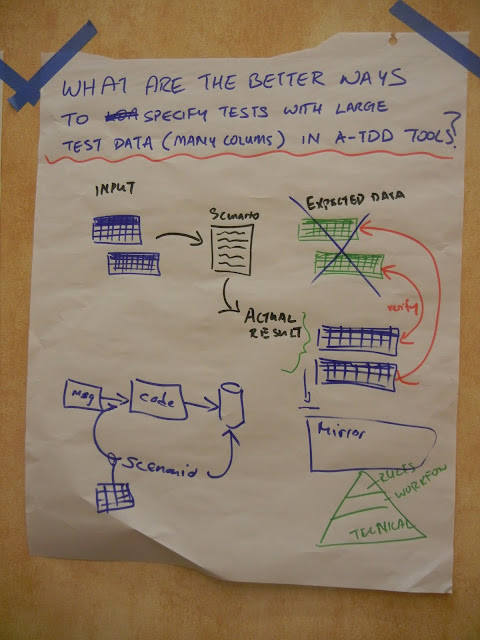
What Are The Better Ways To Specify Tests With Large Test Data

I unfortunately did not get to this session as it was running at the same time as the No Testing session, but here is the output from that session.
From Agile 2012
From Agile 2012
From Agile 2012

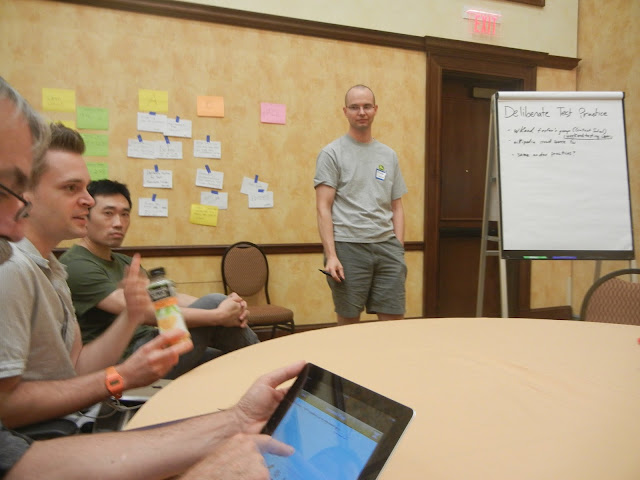
Deliberate Test Practice

Brandon Leiran led this session, trying to see if there was a testing equivalent of coding katas.
From Agile 2012
  • weekend testing group – choose a target, collaborate on Skype on their findings
  • Wikimedia Foundation – looking at ways crowd source testing to test infrastructure (rather than content) – more on this initiative to be announced in the near future
  • why is it any different to coding katas? Safer and smaller so you get more practice, practice collaboration too
  • organise a community like a book club
  • code roast – put the code up and everybody critiques it, be careful not to attach to a person!
  • get practice at driving different interfaces – Triangle Tester exercise, parking lot calculator
  • hard to practice test automation as it takes a lot of time upfron
  • take time to do charter writing sessions or test different items like cheap toys (how would you test this toy?)
  • demonstrate value of quality using simulations eg. origami games
  • add tests to open source – many of the existing tests are average
From Agile 2012
From Agile 2012

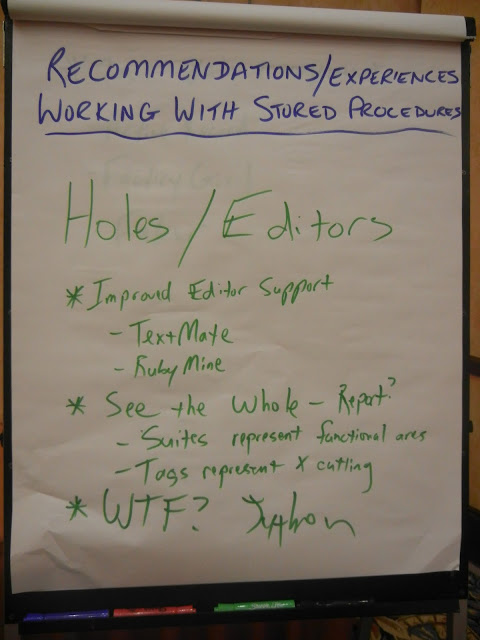
Holes / Editors

Chzy led this discussion to discuss holes in the existing frameworks.

From Agile 2012
  • the HTML report from Cucumber is very average – chzy is releasing a new gem based on discussion from a recent testing conference in Austin
  • editors – people now bundling these in TextMate, Eclipse and Visual Studio
  • JetBrainsRubyMine has gherkin support and refactoring support for Ruby, plus a lot of support for steps in Cucumber
  • big picture view of feature coverage – would be cool to map this to Sonar, suites represent functional areas, tags to represent cross-cutting concerns
  • SpecFlow is trying to map to story maps using SpecLog
  • Relish allows you to create higher level specification of your scenarios
  • there is a plugin for Cucumber that allows github integration
  • Thucydides has a built in feature coverage report
  • Twist has Cucumber support
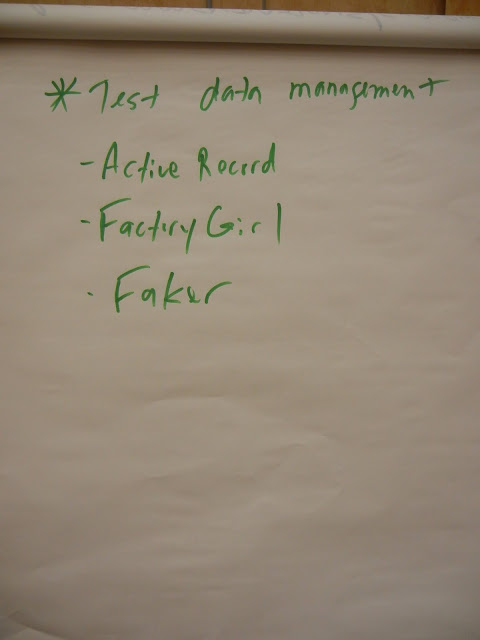
  • test data management – FactoryGirl gem – build up snapshots but want to be able manipulate values down the stack, Faker, ActiveRecord
From Agile 2012
From Agile 2012

AA-FTT – The Future

Elisabeth Hendrickson led this session as part of her handing the leadership over to Joseph Wilk.

From Agile 2012
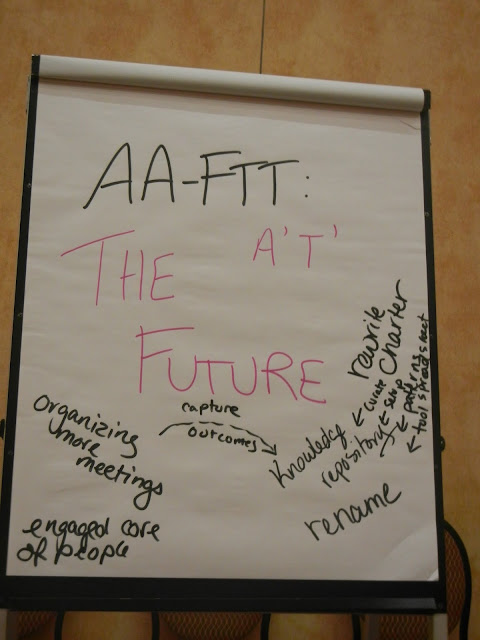
  • mission is to advance the state of the art of functional testing tools
  • community building is the best way to spend the money, tool builders and tool users
  • Yahoo group is main repository of knowledge, current wiki probably needs to be moved
  • need people who have time and energy and interest to take this forward
  • biggest issues with wikis is managing all the wiki spam
  • have a leadership issue to curate the content and grow the community
  • the other options are to create static content, like business analysts and leadership
  • important to have a knowledge repository that at least captures outcomes
  • would like have more organised meetings worldwide
  • is our mandate just functional testing? It has really been just about “agile testing”
  • probably need to rewrite the charter
From Agile 2012

Wrap Up

We finished up the open space by writing what action we were taking from the day and giving them to another participant to keep us honest (mine was to write this post!)

From Agile 2012

Another good open space, and good to catch up with many of the leaders in the testing community once again.

Podcast

I recorded a short audio podcast for The Agile Revolution wrapping up AAFTT.

Episode 39: Agile 2012 Day 0

The Agile Revolution's avatarThe Agile Revolution Podcast

Agile 2012Craig is in Dallas, Texas, USA at the Agile 2012 conference. Today was day 0 and the annual AA-FTT workshop.

In-depth notes can be found on Craig’s blog.

TheAgileRevolution-39 (8 minutes)

View original post

Episode 38: Coding With Exceptions (The Agile Story)

The Agile Revolution's avatarThe Agile Revolution Podcast

Mark Derricutt & Craig AspinallThis is a special mashup episode recorded in Auckland, New Zealand. Craig catches up with Mark Derricut from the Illegal Argument podcast and Craig Aspinall from the Coding By Numbers podcast. Not your usual Agile podcast, the discussion starts around the definition of Agile (“crash often, crash regulary”) and trying to define quality and ends up in a chat about wicked problems, devops and software development skillsets.

This episode has been released on the other channels as well (take a listen if you haven’t already)

  • Illegal Argument (Episode 83)
  • Coding By Numbers (Episode 37)

TheAgileRevolution-38 (67 minutes)

View original post

Episode 37: Sensational Sydney

The Agile Revolution's avatarThe Agile Revolution Podcast

Jeremie BenazraCraig and Renee take a revolutionary tour of Sydney and speak to Jeremie Benazra and Dominic Franco about the Agile work that they are doing in Australia’s big city including Kanban, cultural differences, safety and edgy Agile.

TheAgileRevolution-37 (26 minutes)

View original post

Episode 36: Revolution World Tour

The Agile Revolution's avatarThe Agile Revolution Podcast

World TourCraig, Renee and Tony talk about Fed… no, Ship It! days, recent changes to Yammer and LinkedIn and the 10 agile bloggers you should know about. We also review Tony’s recent excursion to BA World and Renee’s journey to KLRAT and ponder just why Tony has such an obsession with pants…

Quotes:

View original post 73 more words

Agile Australia 2012 Day 2 Review

Day 2 of Agile Australia 2012, and another busy day of MC’ing and attending sessions.

The first (hastily rescheduled) keynote session was from Roy Singham from ThoughtWorks.

From Agile Australia 2012

The second keynote was supposed to be Mark “Bomber” Thompson from the Essendon Football Club but he was an unexplained no show. After an impromptu thankyou speech from me and breaking the conference for an early break, James Hird arrived to substitute and did an impromptu talk. As a result of the scheduling changes, I unfortunately did not get to see much of either session.

From Agile Australia 2012

How Lonely Planet Used Agile With SAP and Delighted Customers

I sat in the back of this session delivered by Ed Cortis from Lonely Planet. His slides are available here.

From Agile Australia 2012
  • failed, needed twice as many people after implementation
  • ran net promoter scores internally, -40!
  • attempted Agile customer management – planning meetings took 3 hours, attendance dropped, SAP team became prioritisers
  • NPS dropped to about -35
  • changed team structure and in-sourced, positive NPS
  • got agile working – 4 week sprint, 40 minunte presentation, stakeholders turn up because if you are not there you don’t get prioritised
  • developed a prioritisation matrix – business value versus effort, colour coded cards for skillset, sets order for prioritisation
  • pre work is required for the meeting – know how many points of effort for every available person
  • prioritisation board – built the backlog as part of the session
  • no spreadsheets!

The Trouble With Time Machine

I was MC for this session delivered by Matthew Hodgson from Zen Ex Machina. He gets extra marks for working Doctor Who and bow tie references into the talk. His slides are available here.

From Agile Australia 2012
  • UX people are time travelers
  • time machine pattern – work an iteration or more ahead of the development team
  • UX is primarily about design, we are in two different worlds
  • embed the time machine pattern within Scrum
  • personas – focus on the pragmatic face of our users (David Hussman) – synthesise what we understand at the moment
  • added to GWT… Given I am a role AND I VALUE, When… Then…
  • grooming is the forgotten ceremony
  • involved the users in planning poker – got clear perspective in the context of their environment]
  • demo became a cognitive walk through

Emerging Paradigms in Software Testing

I was MC for this session for Kristan Vingrys from ThoughtWorks. I have known Kristan for a number of years, and I resonate very closely with his views on testing and testers. His slides are available here.

From Agile Australia 2012
  • you have to build quality into the product
  • ATDD is a good way to break down the barriers between developers and testers
  • need to change focus to preventing defects rather than finding defects – measure yourself that more defects is bad
  • fast feedback – embrace continuous integration, automation and the test pyramid
  • involve everyone – crowd source your problems, tests are an asset, version control your test cases
  • change focus from how I prevent this going into production onto how I get this into production
  • build pipeline- stage build to run different tests in different stages in the pipeline
  • tester needs to inform the team of quality, not be responsible for quality
  • target testing to things that are changing, not just scatter gun
  • it’s about the principles, not the practices
  • test code is code – treat it like any other code
  • it’s important to know what you are not covering, more than what we are covering (Model Based Testing)

Design Eye For A Dev Guy

I was MC for this session delivered by Julian Boot from Majitek. This was one of the highlight sessions that I attended at the conference and as I remarked when thanking Julian, it reaffirmed how much I don’t know about good design. His slides are available here.

From Agile Australia 2012
  • you gotta love it, you gotta be able to do it and it needs to deliver a bag load of cash
  • people now expect a fit and finish, design is now expected
  • people over process, not everyone is a good designer so let people play to their strengths as weaknesses get in the way of excellence – need to understand it though
  • design is related to visual processing – what we see is what we design, design can be taught
  • highlight individual items – contrast, colour, shape, white space, underlining
  • grouping – proximity, continuity, enclosure, connection
  • proportion, substance and harmony are important
  • subtle changes dramatically affect the visualization
  1. use a grid like CSS Grid and Twitter Bootstrap
  2. focus on data over labels – make the data bigger, keep your headings close to your data so you don’t get lost
  3. hierarchy of actions, but use them properly
  4. colour – use a designer, but if not use 3 colours in one shade and two others (using three grey is the best pro tip and two others)
  5. let design be your brand, don’t overuse the brand

Agile Executive: The Naked Truth!

I was MC for this session led by Kelly Waters from ThoughtWorks and author of the All About Agile blog. I unfortunately did not get to see much of this presentation, the slides for which are available here.

From Agile Australia 2012

Agile Development on Large Legacy Architecture

I was MC for this session delivered by Tony Young from Integrated Research. This session was designated as “Expert” but there is nothing in this that I could see that made it that level. His slides are available here.

From Agile Australia 2012
  • teams find it hard to focus at 7-8 people and they saw parallel development, sweet spot was 5+/- 1
  • changed because competitors moving faster and customers questioned our quality
  • used agile guidelines, not rules – had must dos and bendys
  • product team deliver using Scrum and give to a QA team that uses Kanban !
  • the peer pressure to try is key
  • use Lego board for backlog to see resource impacts

Other Stuff

One of my colleagues who presented a talk on day 2 was Colin McCririck (who is the Executive Manager of a team I coached for some time) and he spoke on Leadership Secrets for Agile Adoption).

Rosie X recorded an interview with me during the conference which was a lot of fun.

Renee Troughton and I took some time out from talks to record a podcast interview with Ilan Goldstein for the Agile Revolution.

Renee also recorded a podcast with Kim Ballestrin on Cynefin.

We also recorded a wrapup podcast.

I also did some short interviews for InfoQ, which resulted in a wrap-up story.

Agile Australia 2012 Day 1 Review

Agile Australia 2012 was held a few weeks ago at the Hilton on the Park Melbourne in front of a record (and venue busting) 850 attendees. This year I had the privilege of being a plenary session host and speaker, present at two workshop sessions and be an MC at a number of different sessions.

Furthermore, I was a member of the advisory committee with the role of program overview along with the usual duties of reviewing and shepherding conference speakers. This year the review process was open to comments and voting from the community and overall I think we ended up with a good mix of proposals.

With all my duties I was quite busy this year, but here are my notes from day 1.

Keynote: When The Stakes Are High

Dr. Fiona Wood, Plastic Surgeon and Director of the WA Burns Unit, was the keynote speaker and undoubtedly for many people was the highlight of the conference. The advisory committee (and particularly Martin Kearns) had been aiming to get somebody from the medical profession for a couple of years, and her talk was nothing short of inspiring.

From Agile Australia 2012
  • you either engage in the landscape or whine about it
  • we need to enjoy what we do, but it is our passion that drives us
  • when you see what you think is the answer, step back and look for the rest of the jigsaw
  • learn something from everyday, so that tomorrow is better
  • time is precious, understand what is out there rather than reinventing the wheel, start in front of the start line
  • had to look for nozzles to spray skin, ended up using Italian mouth freshener!
  • you need to articulate the vision so that the team will get it, passionate leadership alone won’t bring people along for the journey
  • no better way to manage a disaster than having planned for it first
  • how can we mould our resources to deliver at a better level
  • leadership has to be very flexible
  • respect those people that have changed your life, if you realise it say thank you, you may miss your opportunity in the future
  • nobody does anything in life in isolation, need to communicate well so we can contribute
  • why can’t we celebrate being the best we can be every day
  • criticism is essential, but criticism and walking away is a total waste of time
  • I use energy to find better solutions to the patients I treat rather than waste that energy arguing with somebody
  • we access our thoughts by communicating, facilitating and shaking the tree
  • today is not as good as it gets, that’s what gets me up in the morning
  • it’s not get to the top of the mountain and stick the flag, it’s the journey
  • “who am I not to dream”, dream but anchor it in reality

Keynote: Agile: Looking Back, Looking Forward: Adapt, Innovate, Collaborate & Deliver

Following on from Dr. Fiona Wood was a tough act, but in front of 850 I took the stage with Nigel DaltonDavid Joyce and Simon Bristow to deliver this session. The slides are available in a separate post.

From Agile Australia 2012

Mainframe Test Automation Within SCRUM – How Did We At The BNZ Get It To Work?

Bram Surti and Rob White from BNZ delivered this session. Essentially I was interested to see if they did anything different to what I had already tried myself in this space. Sadly, I didn;t learn much new, but I was pleased to see they were using a lot of the same tools and approaches that I had used myself in this space. Their slides are available here.

From Agile Australia 2012
  • needed a Java expert to help with the writing and debugging of tests
  • used Concordion – developers instrument the tests and used JUnit under the covers
  • used Jenkins for continuous integration
  • COBOL is a dinosaur, it is scary and big and hard
  • used stored procedures to inject messages – could be dropped and tested on the mainframe and invoked from any language
  • used Concordion Logging Tooltip Extension to get the debugging output
  • used FreeHost 3270 to drive the green screens, old software that needed some upgrading
  • got buy in from mainframe developers as driving green screens was very useful for upgrades, got exposure to another language
  • took 30% longer to write test than originally thought, but testers said at the end it saved 50% of their time
  • isolating data for the test suite was imperative

What Happened To People Over Process?

I was MC to this session by Sarah Taraporewalla from ThoughtWorks, her slides are available here.

From Agile Australia 2012
  • we don’t spend enough time understanding people
  • as a leader we don’t have all the answers, but we know we can do better
  • Kinder Surprise in relation to people – wrapper is the actions of people, but it is a thin layer, peel off the actions you get to the attitudes that govern what we do, apply a bit of pressure and you get to the values, open up the inner canister and you get to people’s belief system
  • don’t really understand our belief system until you are challenged by somebody else’s – a good example of this is people and their attitudes to attending meetings – you may need to understand what drives people
  • there is a lot of literature around this!
  • transactional analysis – Games People Play (Eric Berne) and I’m OK – You’re OK (Thomas A. Harris) – at any given state we have a mental state of an adult, parent or child
  • child – react to world around you as if you were a child (when I grow up, I wish, I want)
  • parent – react like a parent based on imprints of how our parents reacted (should, ought, could)
  • adult (analytical side – who, what, why, I think)
  • even if you know yourself, you don’t know jack! – people talking on the same plane have harmonious discussions, they break down across the positions (what people know about the world)

Practical Kanban for Software Development

I was MC for this session delivered by Perryn Fowler from ThoughtWorks. I had high hopes for this talk as Kanban is still not well understood in the wder community. It covered a lot of good topics (and, as he stated at the top, the talk was the thoughts of Perryn), but it fell victim to running out of time for the meaty stuff and unfortunately was a little rushed at the end. Furthermore, his slides do not seem to be available either.

From Agile Australia 2012
  • Kanban is not just cards on a wall, even though literally it is a visual indicator
  • Kanban is not an entire methodology, it is a technique
  • Kanban is a tool to tackle particular situations and problems, we often treat these situations as normal, but there is a better type of normal
  • limiting your WIP, the manageable level is probably a lot lower than you think
  • Kanban dots – stick them on your wall to indicate WIP
  • Kanban is about stop starting and start finishing
  • utilisation is not throughput, high utilisation damages throughput
  • Kanban is working as a team
  • business goal burnup – when do we start making revenue – keep your eyes on the prize
  • we are trying to achieve flow – Kanban will make poor flow visible
  • layered teams (multiple technologies) – technical layer stories don’t make sense and teams get out of synch, use task cards for the work and put WIP limit on the cards
  • reduce WIP to learn about your process
  • bugs and rework – it counts towards WIP, can put in the development or test column, whatever you are most comfortable with
  • blocked is nothing we as a team can do anything with – does not count towards the WIP limit
  • people will cheat – the rules aren’t important, it is the principles you want to achieve
  • use a green sticky for done rather than a done swim lane
  • small cards gives us good flow
  • Kanban will feel like it is causing problems, it is just making it visible

Value and Culture OVER Practices and Processes – Driving Agility at Bankwest

I was MC for this session delivered by Sandra Dalli and Sarah McAllister from BankWest. I really enjoyed this session. They kicked off the session with a great video with music and time lapse pictures (unfortunately it does not seem to be available publicly). Most enjoyable was their honesty about their journey and this mistakes they made along the way (they started by spending three months in a cubicle writing a document about Agile!). It also appears that their slides are not available currently.

From Agile Australia 2012
  • apply Agile principles to your transformation
  • you don’t have to be on an Agile project to be Agile – agility can be applied to everything
  • people drive the change
  • executive sponsorship is really important

Failure: A Love Story

I was MC for this session for Tom Sulston from ThoughtWorks. The highlight of this talk was the fail cake! His slides are available here.

From Agile Australia 2012
  • fear can be a motivator, but it is not useful
  • flight or fight – flight is the default response
  • systematic desensitisation – common technique for getting rid of fear
  • we always plan to succeed, so we don’t plan for failure
  • failure is a really great learning tool – if you made the failure you know it, the hard part is sharing with the team
  • taking fear of failure to the brink that you don’t know what to do is really bad
  • retrospectives give you a coping mechanism – share with others and make it better
  • continuous integration – fail early and stop the line
  • automated testing – removes doubt, they fail for a good reason
  • showcases – we find out we are going to fail early
  • sustainable pace – a failure because we still get a crunch at the end of the project, allows us to build slack because you can’t run at 100%
  • it’s about learning not winning
  • continuous delivery – you can go to production at any time, remove the fear of go live
  • aim for simplicity and feedback
  • fail cake – if you break something, you need to buy cake for the team, nobody is afraid of cake, nobody can yell at you with a mouthful of cake!

Safe To Fail

I was thrilled to be MC to Phil Abernathy (he was my MC last year and I have worked alongside him for a number of years). He had a great set of slides at the start of this talk to illustrate his experience. Given I knew the content of this talk quite well I did not take any notes, but I did like his analogy around the $100 strategy (for every $100 spent, where did it go – pull the strategic levers to figure out where you can change, these become your strategic programs). His slides are available here.

From Agile Australia 2012

Other Stuff

At the beginning of the day, IBM sponsored a speakers breakfast, and they recorded an Agile song called “Wake Up To Jazz” (video and audio).

At the same time, Renee Troughton and I took the opportunity to record a conference kickoff podcast for the Agile Revolution.

Some of my colleagues presented talks on day 1 including Dipesh Pala (Easy Ways to Break Up) and Renee Troughton and Paul Watson (Panel: Agile Governance – The New Disinfectant).

The night wrapped up with a student event called Activate Agile. I sat in the back of a number of presentations, with the standout for me being being an overview from Andy Sheats about their journey at health.com.au.
Episode 35: Scrum Shortcuts Without Cutting Corners

The Agile Revolution's avatarThe Agile Revolution Podcast

Ilan GoldsteinRenee, Craig and Ilan Goldstein talk at Agile Australia 2012 about Scrum Masters, conferences, writing a book and the state of Agile amongst other things.

Ilan is the Director at AxisAgile, and he is the author of the Scrum Shortcuts Without Cutting Corners blog. He is currently writing a new book with the working title “Scrum Shortcuts Without Cutting Corners” for Addison Wesley as part of the Mike Cohn Signature Series.

TheAgileRevolution-35 (33 minutes)

View original post