bitten by the Agile bug by demonstrating something embarrassingly small at the end of a sprint and yet he found the stakeholders were overjoyed at just seeing movement
Agile has changed many things that used to manual to be automated, such as testing and deployment, to fit in short cycles
Fred George’s talk “Agile Roots: Use JIT to Go Faster” at YOW! West (slides / video)
Marcus’ talks at YOW! West “Kanban in Action – A Practical Whirlwind Tour of Kanban” (slides
Check out her slides for the full summary of her talk, but here are my notes from the talk:
distance does not make a huge difference once you are not co-located – whether a floor away or across the world
challenges – time zones, culture, accountability, multiple competing stakeholders, latency in communication, availability and willingness, no body language
Korrine Korr
Albert Mehrabian principle – to interpret meaning it comes from 7% words, 38% tome and 55% non verbals – which explains why we have so much breakdown in virtual communication, on the phone the breakdown is 8% words and 82% tone
success factors – top notch leadership, clear goals, periodic face to face, frequent communications, attention to cultural differences, maximised communication quality
a virtual leader needs to amp up the skillet of a good leader – communication, listening, open dialogue, goals, team dynamics, culturally sensitive, results focussed, handle conflict
need to develop a shared team vision
develop a social contract – ask what are the values, then to get around understand and cultural differences ask them to explain what that will look like
fave to face inductions for new starters has a better chance for success
high clarity processes, the team performance grows as the dispersion grows
select people who are self starters, tech savvy, autonomous, actively reach out to collaborate
manage by outcomes not activity (as you can’t see them) – so need to agree the objectives, collectively make a plan, collectively monitor performance
GROW coaching model works well for remote workers, ask them what the goal is, what’s happening now, where are you at, what could you do, what do you need from me
build one on one relationships – regular deliberate contact, focus on those most remote, have purely social conversations to build connection
swift trust – trust that builds easily, SES has this because they know others have training, but one breakdown in conversation this breaks down
need to move from swift trust to real trust – do you know the needs and expectations that you team needs from you and you need from them, these need to me be met for trust, it’s a simple conversation we often don’t have, you may need to lead the conversation for others to reciprocate
virtual meeting – need to amp up how you chair, what are the protocols (eg mute when not speaking, raise hands, etc)
virtual celebrations – have lunch or celebrations at each end
have a ritual or something at the start of a call – a fun example is 2 truths and a lie or a list of words that can be snuck into a conversation
consider the richness of your tools
Korrine alluded to these YouTube videos on virtual meetings, worth a watch!
Craig and Tony wander the lunchtime floor on day 2 of Agile Australia conference in Sydney, looking for more interesting people in the Australian Agile community. They chatted to the ones who couldn’t quite run fast enough away from the microphone including:
Craig and Tony are once again roaming the floor, this time at the Agile Australia conference in Sydney, looking for interesting people in the Australian Agile community. While walking around the floor they run into:
Rachel Slattery (SlatteryIT) – organiser of Agile Australia talks about the record crowd, selection of speakers and the number of first timers new to Agile
It was great to have Martin Fowler back in Australia and host him in conjunction with ThoughtWorks for a YOW! Night in Sydney (he was also in Melbourne but I was unfortunately not able to attend).
Martin followed his usual approach of breaking his talk into three mini talks on Microservices, Event Sourcing and Infrastructure as Code. Here are the videos I shot from the session for YOW!
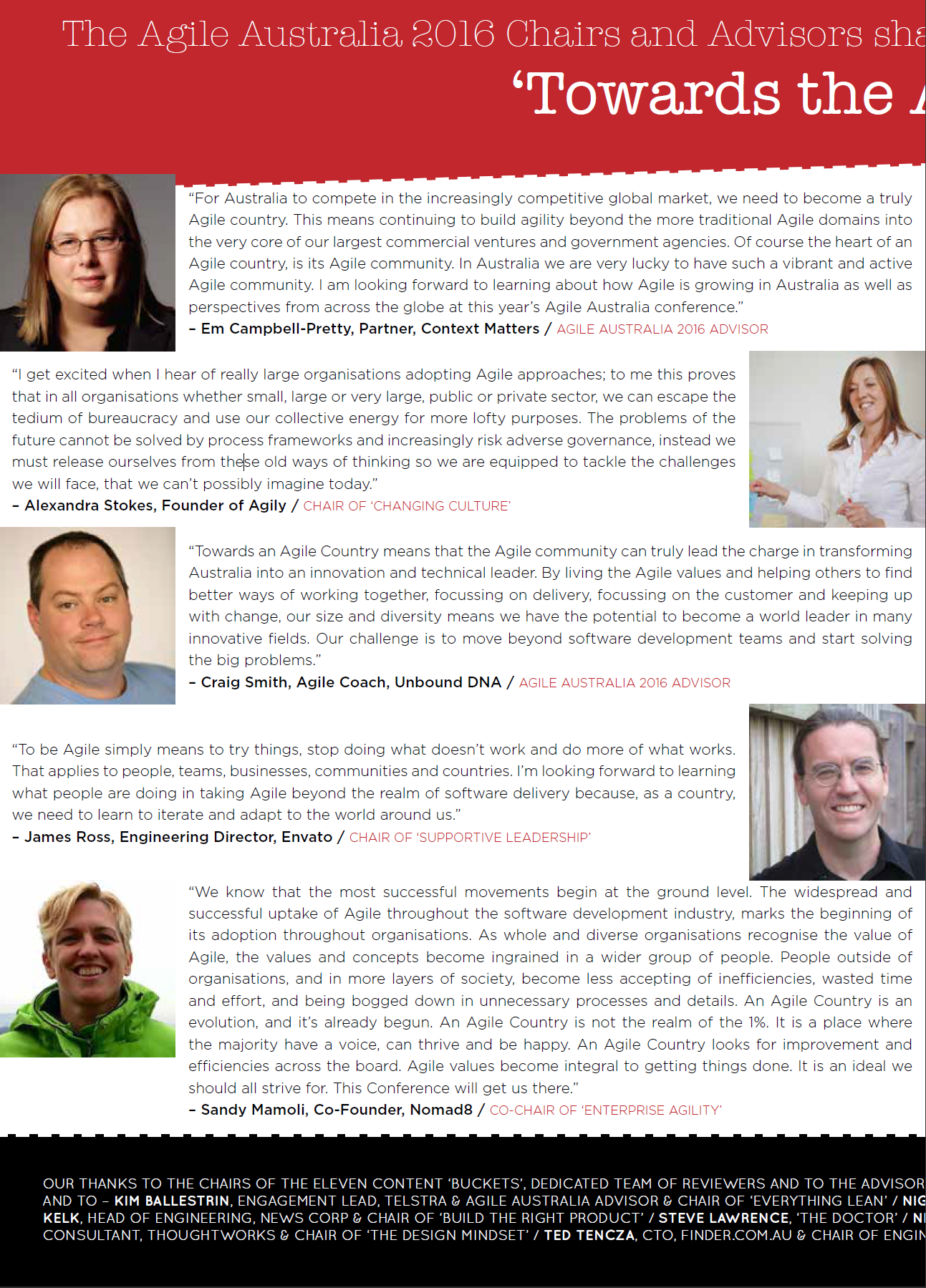
AgileTODAY is a publication associated with the Agile Australia conference. In the March 2016 edition I was invited to share my vision for the conference theme as part of my role as a conference advisor.
“Towards an Agile Country means that the Agile community can truly lead the charge in transforming Australia into an innovation and technical leader. By living the Agile values and helping others to find better ways of working together, focussing on delivery, focussing on the customer and keeping up with change, our size and diversity means we have the potential to become a world leader in many innovative fields. Our challenge is to move beyond software development teams and start solving the big problems.”
So I was looking through some recent Agile postings today, and I saw a reference to a lightning talk given at the recent All Things Open Series by Jen Krieger which caught my attention for a quick watch.
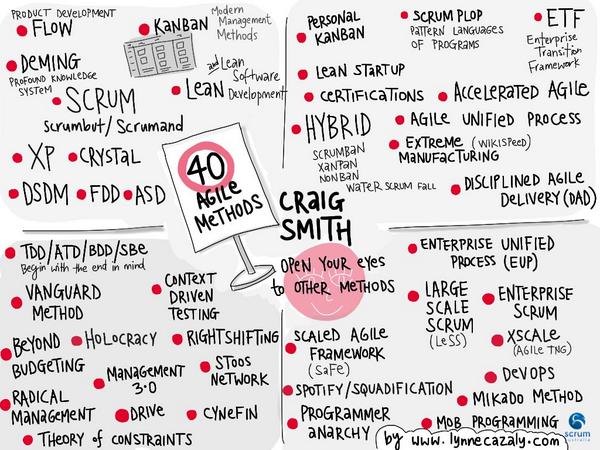
You can imagine my surprise as she was addressing myths about Agile, the graphic drawing from my 40 Agile Methods in 40 Minutes talk by Lynne Cazaly popped up within the talk.
Awesome to see that the output from my talk is spreading (although it is somewhat unfortunate that the accreditation is always the graphic drawing and not the original content).
Tony and Craig are at YOW! Conference and in the hallway ambush Scott Shaw, the Director of Technology (Australia) at ThoughtWorks and talk about the state of microservices and Agile:
Cloud and infrastructure as code has changed the way we look at applications and have allowed microservices
The essence of Agile is the team taking ownership of the business success of whatever it is they are building and keeping that ownership over the longer…
Craig catches up with two luminaries in the Agile and Lean space, Mary and Tom Poppendieck at YOW! Conference to talk about agile, lean, rapid feedback, culture and leadership. The discussion points include:
Making the link between lean and software development and discovering that waterfall makes no sense

 Marcus Hammarberg, co-author of “Kanban in Action” talks with Craig at YOW! West in Perth in a sometimes noisy coffee shop at the Parmelia Hilton Perth: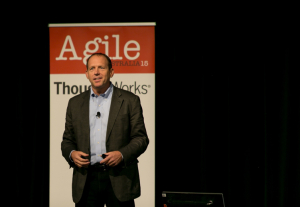


 Korrine Korr





 Craig Smith
You must be logged in to post a comment.