Craig and Renee, sitting in a shoe-box sized hotel room in Sydney eating peanut M&Ms, decided to rustle through the mailbag and answer a bunch of outstanding questions.
Note: this episode is not sponsored or endorsed by M&Ms but we certainly enjoy their product!
Crossing The Chasm
more and more organisations seem to be crossing the chasm to Agile, but too many are still just doing and not being Agile
inimal viable product (MVP) is still the trend word, the next stage is Minimal Viable Experience and then Minimal Viable Robustness to Minimal Marketable Product and finally Continuously Evolving Product
When you look for inspiration in the Agile coaching community, the name Gordon Ramsay is probably not the first name to come to mind. He has been known to be belligerent, condescending and downright rude, but underneath this brute facade is a treasure trove of skills and talents that influence change.
In this presentation we will draw insights from Ramsay’s Kitchen Nightmares escapades and explore parallels with how much his work aligns with that of an Agile Coach and the goal to successfully drive change. We will introduce a number of models and techniques that are indispensable in the coaching toolkit.
The talk was also recorded and is available to view on InfoQ.
Craig joins guest co-host Shane Hastie to talk with Luke Hohmann, author of “Innovation Games”, founder and CEO of Conteneo, Inc. and co-founder of Every Voice Engaged at the Agile 2015 conference after his inspirational opening keynote and they chat about:
The Agile community has lost a thought leader, influencer and friend, Jean Tabaka, who passed away earlier this week. She was best known through her work as an Agile Fellow at CA Technologies (formerly Rally Software) and author of the book ‘Collaboration Explained: Facilitation Skills for Software Product Leaders’.
“Java Modeling in Color with UML” book mentioned Feature Driven Development (an Australian Agile method!), learnt a valuable lesson to pay attention to the financials and, no matter how much you talk to your customer, seeing is not enough (they need to use it)
“Extreme Programming Explained“, both editions are the same problem but coming from different experiences with the benefit of seven years of experience
the bulk of the “Art of Agile Development” book, particularly section 2, is mostly online, the major thing that probably needs to be updated is the section on customer testing
the journey to SAFe included as a developer building the Indiana Jones and the Temple of Doom ride and infusion pumps and generally a mission to make quality better
epiphony around Agile was the step change around how teams perform and how they like their work when they perform better
not everything that is old is stupid, “we are discovering new ways of developing software” and we need to ask ourselves are we still discovering
Scrum is the only method that defines what a software team is (roles and size)
bitten by the Agile bug by demonstrating something embarrassingly small at the end of a sprint and yet he found the stakeholders were overjoyed at just seeing movement
Agile has changed many things that used to manual to be automated, such as testing and deployment, to fit in short cycles
Fred George’s talk “Agile Roots: Use JIT to Go Faster” at YOW! West (slides / video)
Marcus’ talks at YOW! West “Kanban in Action – A Practical Whirlwind Tour of Kanban” (slides
Atlassian, makers of development tools such as JIRA and Confluence, have just released version 5.11 of their continuous delivery tool Bamboo with a host of new features to help teams scale and collaborate. The key feature in this new release is the ability to scale from 100 to 250 elastic build agents.
Check out her slides for the full summary of her talk, but here are my notes from the talk:
distance does not make a huge difference once you are not co-located – whether a floor away or across the world
challenges – time zones, culture, accountability, multiple competing stakeholders, latency in communication, availability and willingness, no body language
Korrine Korr
Albert Mehrabian principle – to interpret meaning it comes from 7% words, 38% tome and 55% non verbals – which explains why we have so much breakdown in virtual communication, on the phone the breakdown is 8% words and 82% tone
success factors – top notch leadership, clear goals, periodic face to face, frequent communications, attention to cultural differences, maximised communication quality
a virtual leader needs to amp up the skillet of a good leader – communication, listening, open dialogue, goals, team dynamics, culturally sensitive, results focussed, handle conflict
need to develop a shared team vision
develop a social contract – ask what are the values, then to get around understand and cultural differences ask them to explain what that will look like
fave to face inductions for new starters has a better chance for success
high clarity processes, the team performance grows as the dispersion grows
select people who are self starters, tech savvy, autonomous, actively reach out to collaborate
manage by outcomes not activity (as you can’t see them) – so need to agree the objectives, collectively make a plan, collectively monitor performance
GROW coaching model works well for remote workers, ask them what the goal is, what’s happening now, where are you at, what could you do, what do you need from me
build one on one relationships – regular deliberate contact, focus on those most remote, have purely social conversations to build connection
swift trust – trust that builds easily, SES has this because they know others have training, but one breakdown in conversation this breaks down
need to move from swift trust to real trust – do you know the needs and expectations that you team needs from you and you need from them, these need to me be met for trust, it’s a simple conversation we often don’t have, you may need to lead the conversation for others to reciprocate
virtual meeting – need to amp up how you chair, what are the protocols (eg mute when not speaking, raise hands, etc)
virtual celebrations – have lunch or celebrations at each end
have a ritual or something at the start of a call – a fun example is 2 truths and a lie or a list of words that can be snuck into a conversation
consider the richness of your tools
Korrine alluded to these YouTube videos on virtual meetings, worth a watch!

 Craig and Renee, sitting in a shoe-box sized hotel room in Sydney eating peanut M&Ms, decided to rustle through the mailbag and answer a bunch of outstanding questions.





 Marcus Hammarberg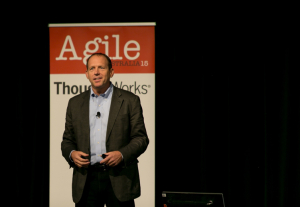


 Korrine Korr
 Craig Smith
You must be logged in to post a comment.