InfoQ Culture and Methods Trends Report – 2026

This report summarizes how the InfoQ Culture and Methods editorial team sees the ongoing and emergent trends in the culture and methods space in 2026.

  • AI adoption demands maturity frameworks that assess risk and context, and organisations must be honest about what they are actually trying to achieve with AI in their specific circumstances.
  • Collaboration patterns are changing fundamentally: Teams are shrinking, roles are blurring, and the question is no longer how to structure teams but how to make collaboration more effective in whatever form it takes.
  • The explosion of AI-generated code demands entirely new processes for quality, cognitive load management, and accountability.
  • Organizations that failed to embed agile fundamentals face catastrophic risk with AI adoption; fast feedback loops, reflective learning, observability, and shipping the right value to the right users remain as critical as ever.
  • Engineers are shifting from contributors to custodians: The defining future skill is not writing code but effectively directing, validating, and building guardrails around AI agents.
  • The industry must confront the environmental costs of AI usage, the erosion of diversity of thought from homogenized agent outputs, and the accountability gap when no individual fully owns AI-generated systems.

In the annual Culture & Methods Trends Report podcast, a panel of QCon speakers and InfoQ contributors discussed AI adoption maturity and risk, the transformation of engineering team structures and roles, and the human dimensions of software development that must not be lost in 2026. The discussion was hosted by Shane Hastie (Lead Editor, Culture & Methods) and included Ben Linders, Rafiq Gemmail, Craig Smith, Vanessa Formicola, Shawna Martell, Phillip Mortimer, and Yinka Omole.

Source: InfoQ Culture and Methods Trends Report – 2026

I was quoted in the article:

It’s the gap between the good and the not so good and the haves and the have-nots. Some organizations have embraced this and ran with it, but there are many organizations… they never really made the leap to agility practices in the twenty-five year span that we had in order to do that. And now they’re trying to adapt to these new practices and still building it on organizations that are still tending software’s being built in 1995.
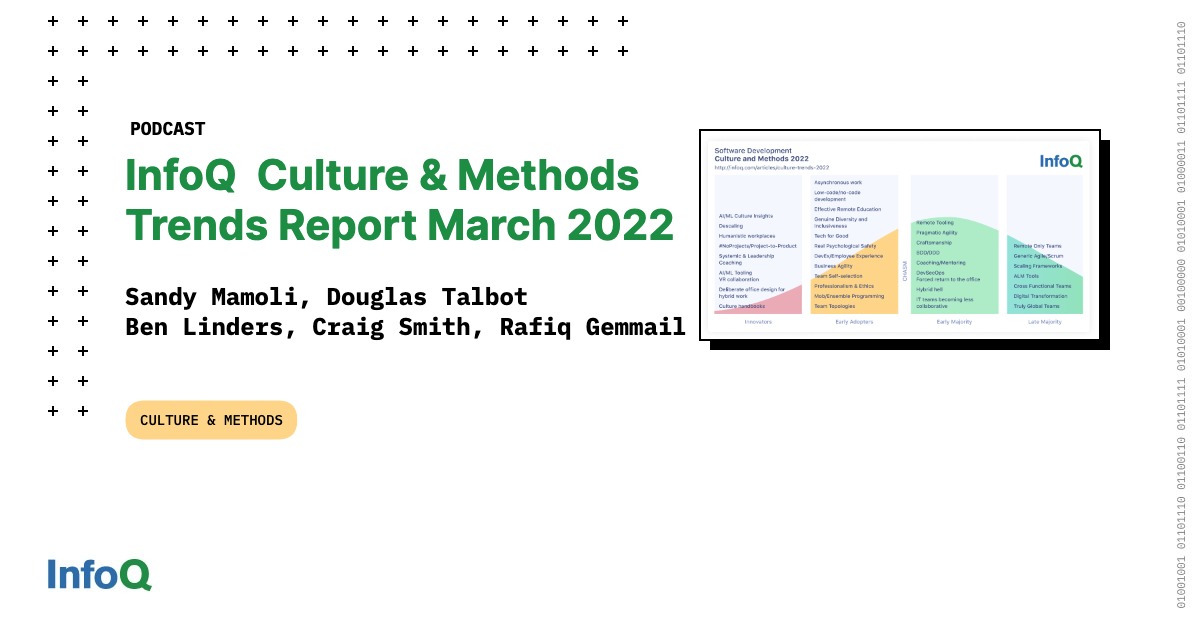
InfoQ Culture & Methods Trends Report March 2022 Podcast

In this podcast the InfoQ Culture & Methods editors, along with special guest Sandy Mamoli, discuss what they have seen over the last year and the trends they see going forward.

Source: InfoQ Culture & Methods Trends Report March 2022

InfoQ Culture & Methods Trends Report – March 2022

  • Hybrid work needs careful redesign and reassessment of the workplace and will be a significant challenge going forward
  • Culture matters more than ever before as people are reassessing their options around workplaces and styles
  • Team topologies and being deliberate about team formation are aspects of culture design that can support better outcomes
  • The gaps between good and bad workplaces are widening and people are voting with their feet (or video conferencing cameras)
  • Leadership styles and approaches need to evolve to support the needs of teams and individuals today
  • Paying attention to physical and mental wellness matters and can’t be treated as an afterthought
  • The podcast InfoQ Culture & Methods Trends Report – March 2022 is also available

This year’s trends report is definitely the most pessimistic we’ve seen in the last decade.  Some trends we saw last year have hit bumps and roadblocks and some early cultural successes have dropped back.

Many of the points we made in last year’s trend report are still true, and sadly there has not been a lot of movement in the topics on the left of the technology adoption curve.  2021 was a year of consolidation, massive movement of people and more pressure being put on already tired teams.

Source: InfoQ Culture & Methods Trends Report – March 2022

1Culture-2022-1648710423703

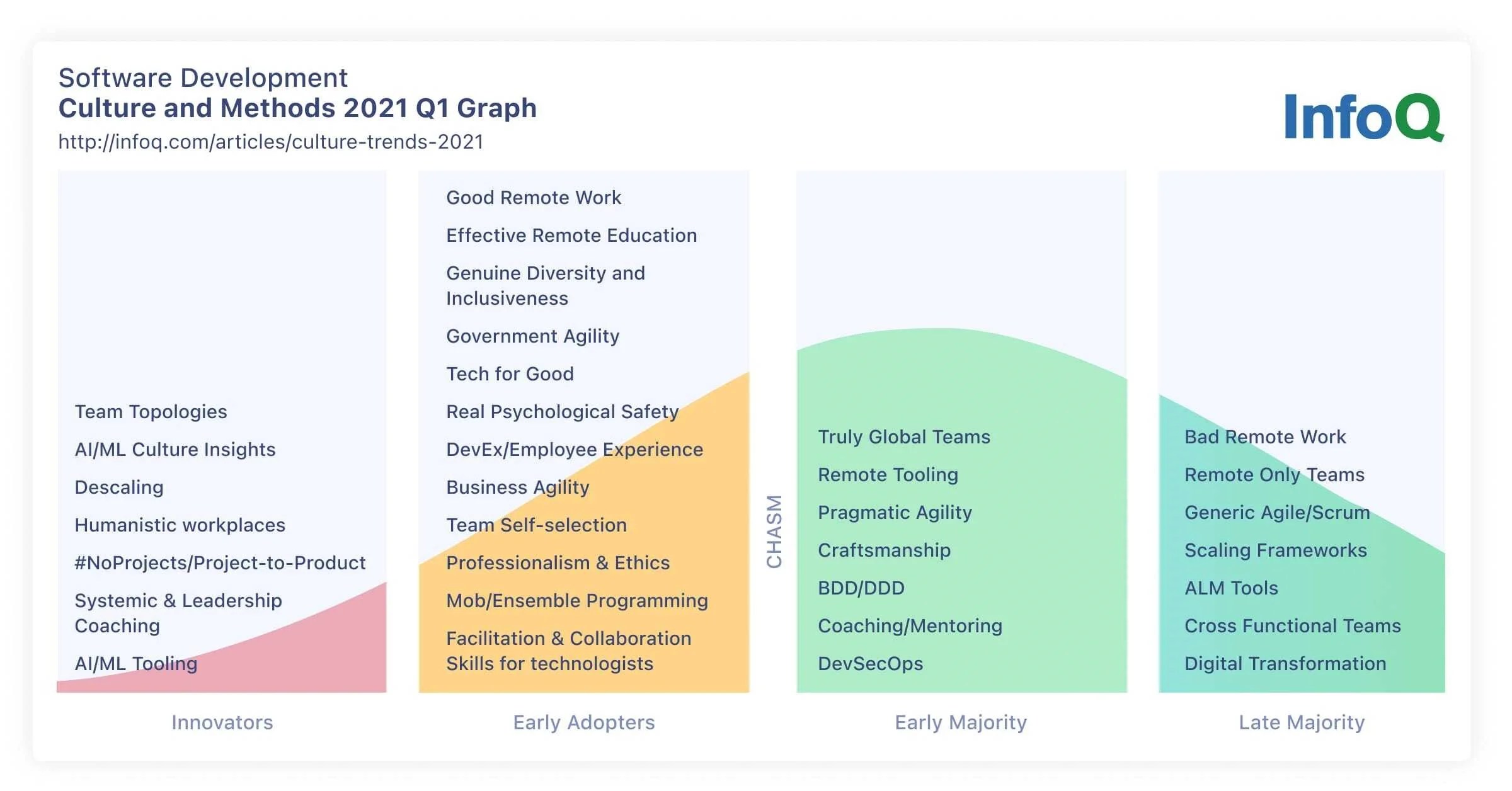
Culture & Methods Trends Report March 2021

  • COVID-19 was the biggest driver of culture change in the last year
  • There are dramatic differences between good and bad remote work cultures
  • Management practices are evolving to adapt to the new ways of working and the expectations of the workforce
  • Creating real psychological safety and focusing on employee experience is hard, but pays off in terms of engagement, motivation and outcomes
  • Ethical issues, diversity and inclusion and tech for good make a difference and need to be addressed purposefully.

COVID-19 was the largest influence of change in the culture and methods space in 2020 and the knock on effects in 2021 are driving many of the trends we see at this time.  The previous trends report was released early in the pandemic and we now have a year’s worth of content to explore how the IT world has adapted and responded. There have been many examples of great collaboration, teamwork and adapting to new ways of working along with plenty of stories of hardship, Zoom Fatigue, mental and physical health challenges and other impacts as people have adapted to working from home, managers have changed long-held beliefs about remote work and organisations have adopted new technologies to support the shift.

Source: Culture & Methods Trends Report March 2021

Engineering Culture Trends Report – March 2021 Podcast

In this podcast the Culture and Methods editorial team discuss their views on the current state and trends in the Culture and Methods area that they monitor.  The editorial team consists of Ben Linders, Craig Smith, Doug Talbot, Raf Gemmail, Shaaron Alvares and Shane Hastie. Unfortunately Shaaron was unable to join in the recording, however her perspectives are included in this and in the accompanying trends report article.

Source: Engineering Culture Trends Report – March 2021

Software Teams and Teamwork Trends Report Q1 2020

  • Remote work is suddenly the new normal due to the impact of COVID-19, and many teams are not fully ready for the change
  • The spread of agile ideas into other areas of organizations continues—business agility is becoming much more than just a buzzword
  • At the practices level, Wardley Mapping is one of the few truly new ideas that have come into this space recently. Invented by Simon Wardley in 2005, they are gaining traction because they are truly a powerful tool for making sense of complexity.
  • The depth of impact that computing technology has on society has heightened the focus on ethical behavior and the move towards creating an ethical framework for software development, as well as growing concern in the environmental impact the industry has.
  • Diversity and inclusion efforts are moving forward, with a long way still to go
  • Practices and approaches that result in more humanistic workplaces, where people can express their whole selves, are recognized as important for attracting and retaining the best people and result in more sustainably profitable organizations

Source: Software Teams and Teamwork Trends Report Q1 2020

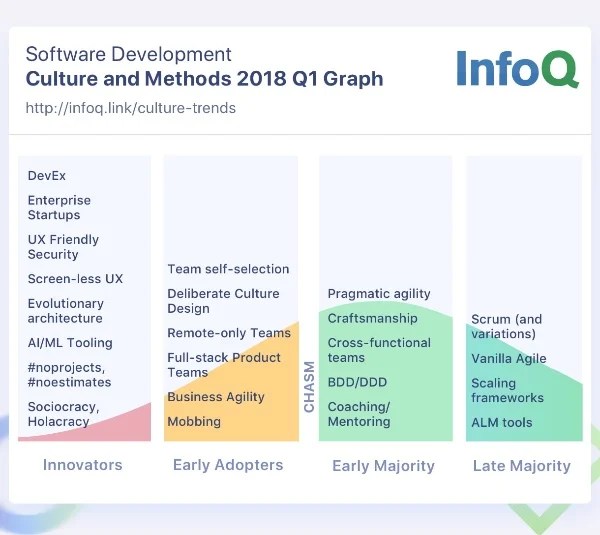
Engineering Culture and Methods InfoQ Trends Report – January 2018

At InfoQ we regularly revisit the topics we focus on based on the technology adoption curve. This article provides a view of the topics which are important to the community at the beginning of 2018.

  • There is no longer a question about should an organisation adopt an agile approach to software development – some form of agile is now the norm for software development
  • Craftsmanship is becoming more prevelant in software development 
  • Culture is recognised as a competitive advantage and an attractor for the best people and teams
  • Distributed and remote teams are becoming the norm
  • Diversity in all its forms matters today
  • Ethics in software engineering will become more and more important
  • Developer Experience and removing friction in the development process makes a difference to productivity and business outcomes

Source: Engineering Culture and Methods InfoQ Trends Report – January 2018