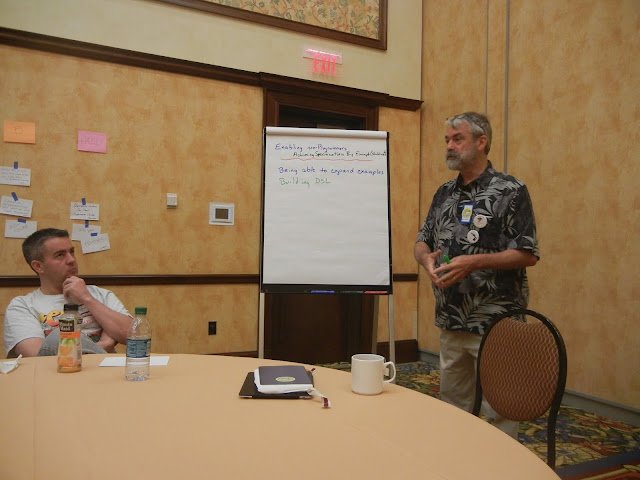
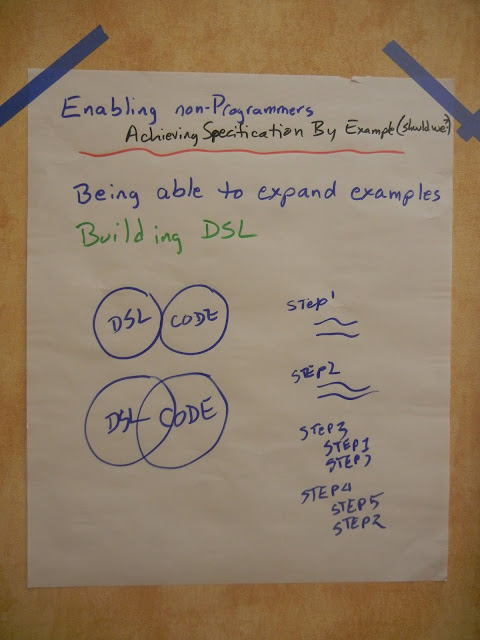
George Dinwiddie led this session which turned into a lively discussion! I had proposed what I thought was a related session on Specification By Example and had combined them, but the conversation never really had a chance of getting onto that topic!
George expects the business people to be able to read and understand the tests
non-programmers should not be writing automation, it is the programmers responsibility
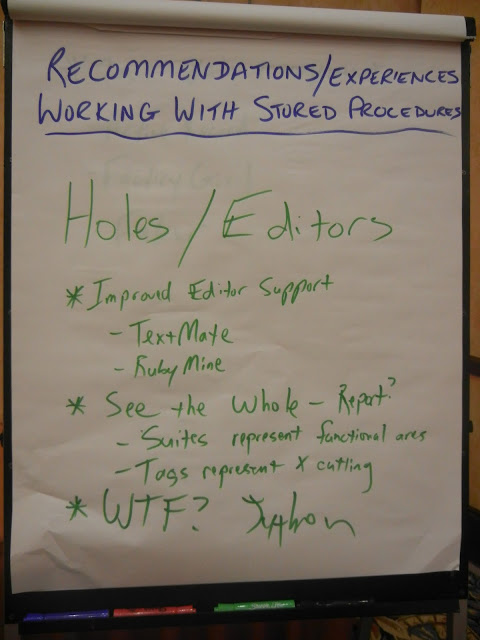
wants to be able to extract working tests into a step definition rather than needing to rewrite in Ruby (George Dinwiddie)
there is a difference between a specification and testing (Christian Hassa), this is a fundamental shift
building a DSL – talk about terminology and how we explore our domain – essential step
you don’t create a DSL, you build it
not a problem with the toolset but our training in thinking in a procedural way rather than an example way of thinking (Corey Haines
testers new to automation create large scripts because it’s their only hope in creating some sort of repetition (@chzy), it does not take a lot of effort and most business people are open to working this way
enable non-programmers by getting them to come work with us every day (Woody Zuill)
George is helping people make a transition, don’t want people to throw away what they have,
ideal is not to have step definitions call step definitions, Cucumber community is becoming a community of programmers and are moving away from this
Robot Framework is more keyword driven, more aligned to non-programmers, you can also make a mess, “it is a double edged sword” (Elisabeth Hendrickson)
testers like to test the negative cases, should they be expressed at a high level or expressed as a unit test by pairing developers and testers
if you are testers and you cannot write simple Ruby scripts, then you have no place on my team (Corey Haines), this opinion is probably shared by the Cucumber community (George disagreed…)
need to use the same design patterns in both Robot and Cucumber (@chzy)
in an environment that is test centric and BDD, Cucumber is the tool (usually environments with little to no QA), in a business centric environment where you an get the business involved Robot Framework is your tool
Corey works in environments where there is very few Cucumber specifications per scenario, backed by lots of unit tests
Cucumber came out of environments where the team is predominantly developers, hence the desire to drill down to Ruby code sooner
at a large household name company – theyexpect testers to be more technical, happening more in the industry, eliminated the role of tester due to different pay grades (@chzy)
moving traditional organizations to a collaborative way of working is hard (@chzy)
wants simple refactorings that are are a bridge from one place to another (George Dinwiddie)
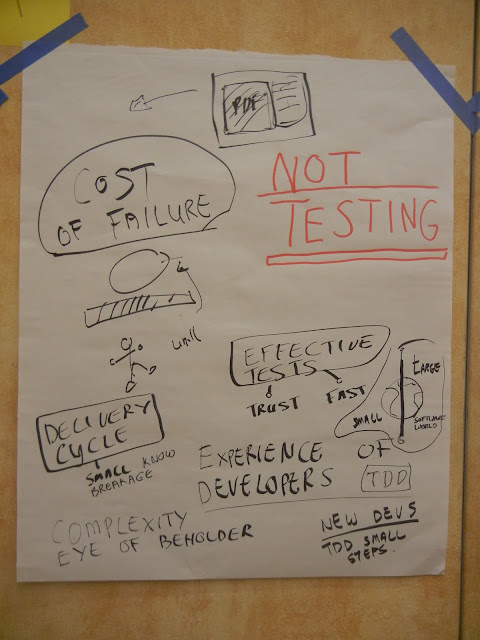
at a startup Joseph was at, tests were taking up to 8 hours to run and costs for distributed architecture was high
Forward Internet (London) – let developers do what they want – by not testing they could be faster and more interactive than their competitors – did testing in Production, a risk that sometimes things could fail – testing should not block deployment
in some situations it is just worth hacking it out, particularly in a lean startup
if it is faster to rewrite rather than maintain it, then don’t write tests (Fred George via Corey Haines)
a big question of this is the skill level of your developers – do you have the skill level to make the choice to not do it (Corey Haines), primary impact of success is the skill level of your developers
Scribd – were having trouble with test speed and found out the developers were scared of breaking the PDF (which is the heart of the business) – they separated the PDF out to speed up development (so developers weren’t worried about breaking it)
quick delivery – need the quick feedback cycle to make this work, simulate production
need effective tests – small suite of tests that are 5-10 minutes long
test what you are most scared of
Silicon Valley’s issue is hiring – Facebook is stealing developers from Google because they hire good people and enable them to just hack it out
2 software industries – small companies and large corporations, very different worlds
question everything – can only do this if you have experienced it before and understand it
Wikimedia Foundation – looking at ways crowd source testing to test infrastructure (rather than content) – more on this initiative to be announced in the near future
why is it any different to coding katas? Safer and smaller so you get more practice, practice collaboration too
organise a community like a book club
code roast – put the code up and everybody critiques it, be careful not to attach to a person!
We finished up the open space by writing what action we were taking from the day and giving them to another participant to keep us honest (mine was to write this post!)
Craig and Renee are at the Agile Australia 2012 conference speaker breakfast where they discuss the workshop day, the upcoming conference and their respective talks and a Lean Startup story about monkeys and bananas.
So there have been a lot of posts out there about Moneyball and how it directly relates to Agile and the Lean Startup. However, I finally got around to watching the move tonight (thanks to my colleague Renee Troughton for lending me the Blu Ray) and had to note down my own thoughts. There are so many good quotes and scenes from the movie, but here are just a couple of standouts (warning, some folks may consider these to be spoilers if you have not seen the movie!)
Right at the start of the movie Billy Beane is talking to the team owner about needing more money (sounds like the start of any typical traditional project to me!)
Billy: I can’t compete against a hundred and twenty million payroll with thirty eight million dollars. Schott: We’re not gonna compete with these teams that have big budgets. We’re gonna work with the constraints that we have and you’re gonna get out and do the best job that you can recruiting new players. We’re not gonna pay seventeen million dollars a year to players.
And a little later in the scene, Billy sets his goal.
Billy: That’s my bar. My bar is here. My bar is to take this team to the championship.
At the scout’s meeting, their discussion is all about appearances rather than understanding and building a team.
Scout: Ugly girl friend means no confidence.
In that same meeting, I really enjoyed the scene where Billy is in the position of a coach/facilitator and keeps asking them if they understand the problem!
Grady: We’re trying to solve a problem here. Billy: Not like this you’re not. You’re not even looking at the problem. Grady: We’re very aware of the problem. Billy: Okay, good. What’s the problem? Grady: Okay, Billy. We all understand what the problem is. We have to replace… Billy: Good. What’s the problem? Grady: The problem is we have to replace three key players. Billy: No. What’s the problem? Poloni: Same as it’s ever been. We’ve gotta replace these guys with what we have existing. Billy: No! What’s the problem, Barry? Barry: We need three eight home runs, a hundred twenty R.B.I’s and forty seven… Billy: Aaahhh! The problem we’re trying to solve is that there are rich teams and there are poor teams, then there’s fifty feet of crap, and then there’s us. It’s an unfair game. And now we’re being gutted, organ donors for the rich. Boston has taken our kidney’s, Yankees takin’ our heart and you guys are sittin’ around talkin’ the same old good body nonsense, like we’re selling deeds, like we’re looking for Fabio. We got to think differently!
A little later in that scene, Billy is really trying to make the committee think differently, but they are just thinking in the same old ways.
Billy: If we try to play like the Yankees in here, we will lose to the Yankees out there Grady: Boy, that sounds like fortune cookie wisdom to me, Billy. Billy: No, that’s just logic.
I really liked the scene where Billy is talking with Art about his contract. The final line of the conversation reminded me of many wasted meetings.
Billy: Good meeting. Everytime we talk, I’m reinvigorated by my love of the game.
And then there are always the nay-sayers and (in the case of Grady) those who will always try to bring your approach down.
Announcer: Do you see this as a decimation of the whole team? Grady: I think that he bought a ticket on the Titanic. Announcer: Oh, boy! He’s tried to come up with a new approach, my hat’s off to him. It won’t work.
The discussion between Billy and Peter about cutting players was a good reminder of being honest and transparent.
Billy: They’re professional ball players. Just be straight with them. No fluff, just facts. ‘Pete, I gotta let you go. Jack’s office will handle the details.’ Peter: That’s it? Billy: Would you rather get a bullet to the head, or fire to the chest or bleed to death? Peter: Are those my only two options?
There was an interesting little scene regarding soda, that is a good reminder that sometimes you can be penny smart but pound foolish (the little things are sometimes what keeps individuals and teams motivated).
Justice: And how come soda is a dollar in the club house? Cause I’ve never seen it like that. Peter: Billy likes to keep the money on the field. Justice: Soda money? Really? Where on the field is the dollar I’m paying for soda?
The scene where Billy shakes up the team by firing some of his all-stars was the turning point that shows that sometimes your superstars are hiding the real talent (and sometimes you need to do something extreme to make a change). Art is the classic Project Manager in this scene.
Art: Yeah, I don’t wanna go through team rounds, Billy. The line up card is mine. And that’s all, okay? Billy: The line up card is definitely yours, I’m just saying you can’t start Pena first. Art: Well, I am starting him at first. Billy: I don’t think so, he plays for Detroit now.
There are some good inspirational pieces in the film (like when Billy asks Justice to step up and be a leader for the younger guys). This quote is my favourite though.
Billy: Everybody, listen up! You may not look like a winning team, but you are one. So, play like one tonight.
The big speech when Billy is at the Red Sox resonates with anybody who has tried to implement Agile in a team before.
For forty one million, you built a playoff team. You lost Damon, Giambi, Isringhausen, Pena and you won more games without them than you did with them. You won the exact same number of games that the Yankee’s won, but the Yankee’s spent 1.4 million per win and you paid 260 thousand. I know you’ve taken it in the teeth out there, but the first guy through the wall. It always gets bloody, always. It’s the threat and not just the way of doing business, but in their minds it’s threatening the game. But really what it’s threatening is their livelihoods, it’s threatening their jobs, it’s threatening the way that they do things. And every time that happens, whether it’s the government or a way of doing business or whatever it is, the people are holding the reins, have their hands on the switch. They will bet you’re crazy. I mean, anybody who’s not building a team right and rebuilding it using your model, they’re dinosaurs. They’ll be sittin’ on their ass on the sofa in October, watching the Boston Red Sox win the world series.
Near the end, when Peter shows Billy the video about the guy hitting the home run, they starting mentioning metaphors (I was so thinking about the metaphor in XP at that point!)
Also, the Lenka song “The Show” made me think about why as Agile coaches we get up in the morning and do this (plus good to see Australian music in the movie!)
I am just a little lost in the moment
I’m so scared but I don’t show it
I can’t figure it out
It’s bringing me down I know
I’ve got to let it go
And just enjoy the show
For those who haven’t seen the movie, it is well worth the time spent. I hadn’t realised Aaron Sorkin had worked on the screenplay, so for that alone it had to be good!
Craig, Tony and Renee talk about the news Scrum Inc style, discuss the coolness of Lego for reporting, chat about Net-Map and discuss the state of IBM.
I am a huge fan of the Lean Startup movement, so it was a thrill to hear directly from Eric Ries. His talk mirrored others of his that can be found all over the web and the content followed much of what is available in the book, but it was inspiring and awesome nonetheless.
This is a copy of a similar presentation from another conference.
Here are some of my notes from the talk.
you can now rent the means of production and compete with big players
join the global conversation at #leanstartup
this is the boring part of entrepreneurship
Ghostbusters is the original movie on entrepreneurship
startup = experiment
we live in a time where we can build anything we can imagine – need to ask not can it be built but should it be built…
entrepreneurship is management
most products Eric has built have failed!
Frederick Winslow Taylor stated things that are obvious now yet had to be invented then – work needs to be done as efficiently as possible and breaking work into tasks
all of the tools of general management are based on planning and forecasting – but making an accurate forecast relies on a long operating history – need a new entrepreneurial toolkit because the world is filled with uncertainty
the pivot – successful entrepreneurs did not have a better idea, they take the leanings and change the direction without changing the vision
runway should not be amount of money remaining but amount of pivots remaining
achieving failure is successfully executing a bad plan – this is like getting good fuel mileage when driving a car off a cliff
Agile only works well if you know who the customer is
failure is the great equaliser of quality
“we learned something important” is an excuse, need to learn early
ask what experiment am I trying to run, and what learning can I take from that
build > measure > learn loop – minimise time through the loop
measurement will slow you down but optimise the part to optimise the whole
drive down the batch size to one day – continuous deployment – many features take longer to prioritise than to build
The Toyota Way says foundation is long term thinking, the startup way says foundation is accountability
brink of success is indistinguishable from goofing off – need innovation accounting
business plans are rarely achieved – achieving failure – leap of faith assumptions need to called out
build a minimum viable product, iterate experiments and look for upward trends, pivot when returns are diminishing
better to have bad news that’s true than good news that’s made up
pivot meeting should be a milestone in its own right, need good information to make a good decision – micro scale experiments that help make future decisions
lean startup is still early adopter stage
Dr Werner Vogels – The Lean Cloud
Dr. Werner Vogels is the CTO of Amazon.com and opened the startup event. Here are some notes from his session.
are all the lessons US lessons? No, early on some cultures said this would not work, particularly admitting failure, the grass is not greener in Silicon Valley, understand the underlying principles, figure out how to translate strengths and build on the Lean startup principles
there is a new book by Jeffrey Liker who wrote The Toyota Way (The Toyota Way to Lean Leadership) – Toyota has translated the approach to as many plants in the USA
need to communicate and connect with your employees – we are still solving simple problems
good thing about having a small amount of customers is that when you screw up you can apologise… personally
Within this podcast we learn what exactly a Lean Start-up is and how it isn’t just for new entrepreneurs.
In addition to the Lean Start-up presentation Josh also did a fantastic presentation on the Limited Red Society which focuses on using metrics and visualisation of these to behaviourally change a developer so that their tests pass sooner and more often with less compilation errors.
Other than being an early pioneer in eXtreme Programming, he is also the author of the best-selling Refactoring to Patterns book and provides Agile training from an amazing technical depth of experience.
Craig, Tony and Renee talk about Lean Startups, Tony’s Agile training in India and great places to work, discuss Quotable Kanban and solve a listener problem, all in 50 minutes!
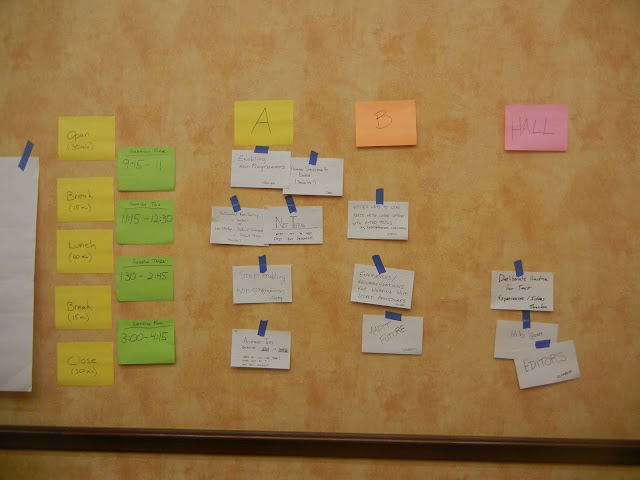
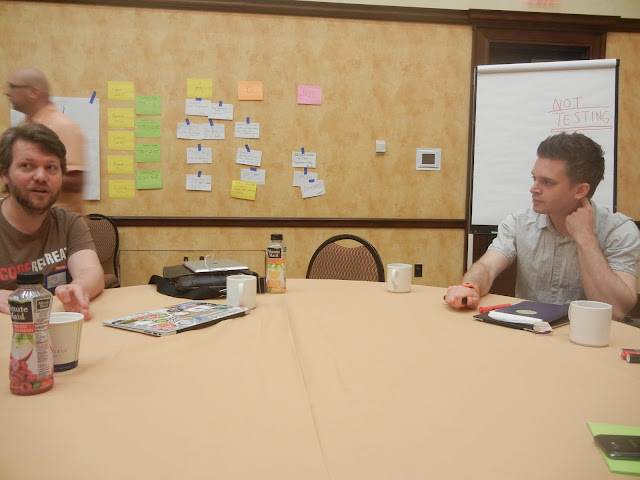
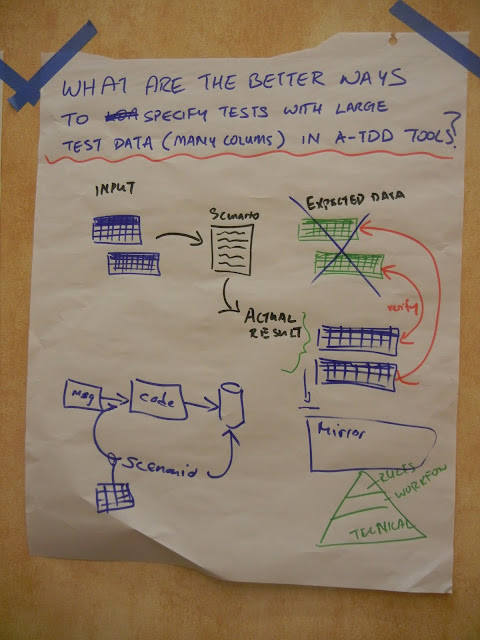
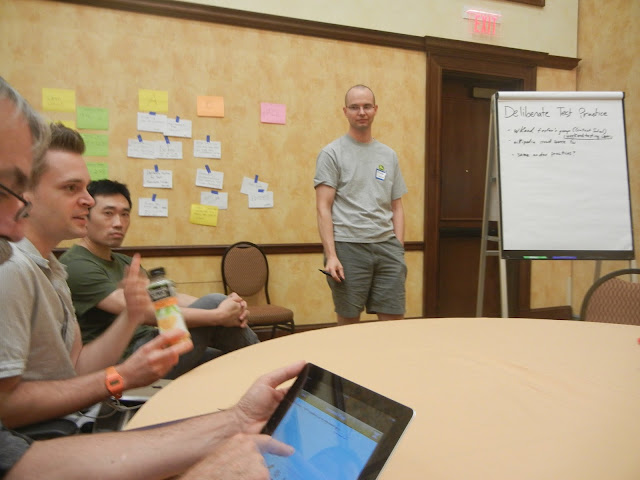
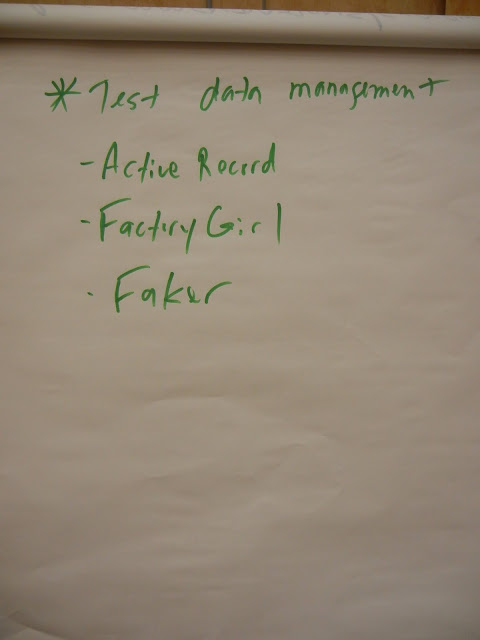
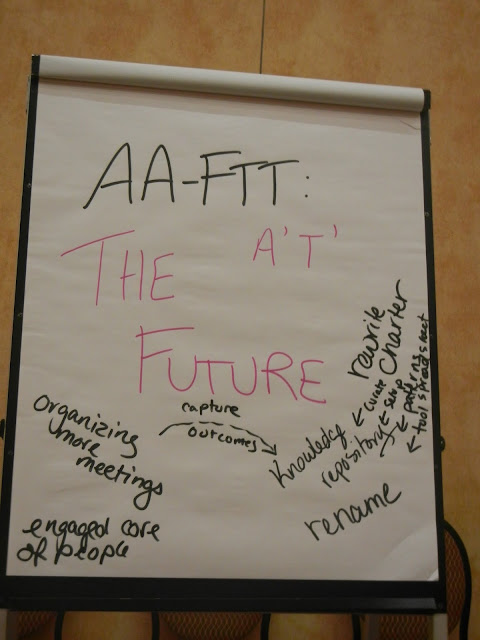
 The Agile Alliance Functional Testing Tools Workshop (AAFTT), was one again held this year the day before the Agile 2012 conference in Dallas. Despite there being only a small group there this year, the discussion was still open and free flowing under the facilitation of Matt Barcomb and the organisation of Joseph Wilk and Elisabeth Hendrickson.

















You must be logged in to post a comment.