Agile 2011 Day 1 Review

Agile 2011It was great enthusiasm that I set off to Salt Lake City last month for Agile 2011. In the lead up I was a reviewer on two stages (Testing & Quality Assurance and Working with Customers), plus I was lucky enough (and apparently the only submitter) to have all three of my original submissions accepted (although conference rules, for good reason, restrict speakers to two sessions). Whilst its a been a month since the conference (I took some time afterwards to spend time on both the east and west coast of the USA), I wanted to ensure that I posted my notes.

Here are the notes from the sessions that I attended on day one.

The Product Partnership: Using Structured Conversations to Deliver Value

Mary Gorman and Ellen Gottesdiener led this tutorial. They started by taking about requirements by collaboration and leading a discussion on things that hinder and help.

From Agile2011

Things that hinder: access to the right people, thinking about the solution rather than what needs to be done, multitasking, people not listening, customer not clear of needs, backlog too big, stories too big, missing product owner

From Agile2011

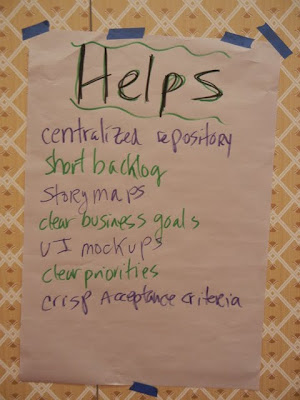
Things that help: centralised repository, short backlog, story maps, clear business goals, UI mockups part of the story, clear priorities, crisp acceptance criteria
From Agile2011

To set the stage we need:

  • a sponsor, product owner / champion, customer, technology
  • a shared understanding of vision, much like an infinity loop we: discover –> prepare –> deliver
From Agile2011
From Agile2011

They then went on to speak about value:

  • conflicting voices for value – not just from the customer but technology value, we need to listen to all the voices
  • evaluate requirements – value, risk (such as technology risk, team risk, outsourcing risk) and dependencies (dependent on other teams or external vendors and requirements and dependencies where value violates the way we would like to build the system)
  • benefit – IRACIS (increase revenue, avoid cost, improve service) needs to be balanced with cost, time and delivery
  • table stakes – the things we must deliver to stay in business
  • differentiators – point of difference in the marketplace
  • up sell revenue potential
  • foundation for long term savings
  • provides revenue for future
  • frequency of use
  • automate labour intensive tasks
  • no viable manual workaround
  • reduces pain for end-users
From Agile2011

This led to a discussion about backlog:

  • we want to build the most valuable things first
  • two states – credible (it has some kind of value) or buildable (it has been prepared and is sliced, groomed or right size as well as understood well enough to estimate, test and document)
  • incorporate UX into preparation, collaborated workshops
  • slice for value – starts with a glean in someone’s eye, then it gets bigger because we have a bunch of options, so we need to fit based on value to contract the list
From Agile2011

And finally onto requirements:

  • product provides value to users – who will receive value from the product
  • what actions need to be performed – what are set options
  • what is the data (noun) and the type and state of data
  • what are the constraints – policies or controls that need to adhered to, business rules

The example for this tutorial was getting to the Agile 2011 conference. We first ask the question: what do we value.

From Agile2011
    • customer value – convenient parking, staying in conference hotel, cheap flights, etc…
    • business value – people stay at conference hotel, one stop shopping on the website to save aggravation for Agile Alliance as well as attendees
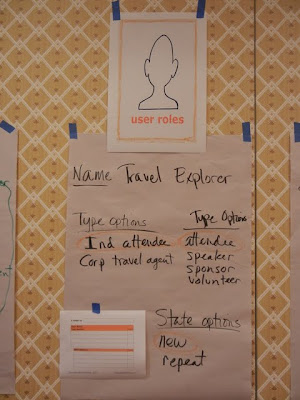
    • user roles – travel explorer – individual attendees (speakers, sponsors, volunteers, attendees) and corporate travel agencies for group travel
From Agile2011
    • actions – hotel information, distance to the venue from home, distance from other hotels
From Agile2011
    • data – link to hotel (official hotel plus local hotels), Salt Lake City information
From Agile2011
    • control options – the business rules, such as when you need register by, etc…
From Agile2011
So we start with the requirement:
I need to: register
User role
  Type options: member*, non-member, group, academic
  State options: active*, inactive
From Agile2011

Then the actions:

Action options
  learn
  pay
  confirm
  communicate
  cancel / transfer
From Agile2011

Then the data:

Data: Fee
  Type options: regular, early bird, super early bird
  State options: available, sold out
Data: Payment
  Type options: credit cards, payment order, check
  State options: paid, pending, not paid

We may also visualize this as a data model or a state diagram

From Agile2011

We then need to look at the business rules and prioritise them.

From Agile2011

Once this is complete we can now we slice for value and write a story. This needs to be the silver bullet / tracer bullet, then you can break down from there. At this point you can write the stories and throw the sheets away. This all leads to:

As a... I need... so I (value)

Requirements leads to examples which leads to tests. We can now link this to given when then:

 Given: pre-condition (state), fixed data
 When: action, business rules, input data
 Then: output data, post condition (state)

It is recommend that you come to these workshops with some pre-planning but be under the agreement that they are draft and often wrong. These could be release or iteration planning workshops.

Now the forgotten heroes, the non-functional requirements:

    • design and implementation constraints – the givens, the parts of your technical infrastructure that are dictated or restricted – worth pausing and discussing if there are any options
From Agile2011
    • interfaces – human, other systems and device interfaces such as messages (you could use a context diagram to illustrate this) – with the diagram you can start discussing the options / choices / possibilities
From Agile2011
    • quality attributes – things like speed, stability, uptime, security, scalability, usability, extensibility, etc…, need to be testable and SMART (specific, measurable, attainable, realistic, time-based) – eg. recover from user error in x clicks, x time
From Agile2011

You can do this at the big view (business process, features, MMF, scenarios), pre-view (user stories, user story maps where you lay out stories left to right, scenarios) or the now view (buildable, scenarios). The granularity will change.

From Agile2011

Plans in an array matrix – the anchor is the action dimension
From Agile2011

Need to have a structured conversation to communicate effectively. Face to face is the most effective and get a shared understanding of the highest value.

Overall, this was an enjoyable session. I really liked the templates for mapping out the requirements (despite the fact that these were essentially just aids for the workshop) as they helped focus the conversation and gave our group something to focus on. Mary and Ellen are currently writing a book based around this content, so I look forward to seeing that in the future.

Coaching Success: Getting People to Take Responsibility & Demonstrate Ownership

Christopher Avery (creator of the Leadership Gift and author of The Early Admissions Game: Joining the Elite, which apparently is 10 years old and still in print) led this extremely packed session, the essence is contained in this publication available here (as well as here).

From Agile2011

We started the workshop by competing in a spaghetti challenge (based on the Marshmallow Challenge) which consisted of the materials of just 10 pieces of spaghetti and a  line of tape. The team I was working with constructed a tower of 35 inches, which ended up being the second tallest in the room.

From Agile2011

There is a pattern in our mind that kicks in every time something goes wrong – creates angst and anxiety – responsibility process – a descriptive model:

  • QUIT – the pressure of responsibility and obligation can lead us to quit, an avoidance move, a lack of completion, active disengagement
  • RESPONSIBILITY – call yourself on obligation so you start looking for solutions – start saying “I get to go to this stupid meeting”, means you have a choice – we were taught that doing stuff we have to do makes us responsible
  • OBLIGATION – I have to go to his stupid meeting have to but don’t want to – leads to resentment
  • SHAME – how could I do this, how could I be so stupid – laying blame on self – premise is the problem, you can’t learn
  • JUSTIFY – it was raining, I dropped my keys – story makes it just – “that’s just the way it is around here…”
  • LAY BLAME – who took my keys? – not a solving position of mind
  • DENIAL

3 keys – descriptive model

  • INTENTION – wanting to get something done, get to RESPONSIBILITY around every problem in your life
  • AWARENESS – be aware of which level you are in
  • CONFRONT – ability to face, taking yourself to the edge of your comfort zone, comfort zone = current capability, confront = expanding capability – every person you know was once a stranger

Example coping mechanisms are: learn to live with it, it worked on my machine, they just don’t get it, it’s the vendors fault, it’s too hard, you’ve been here long enough to know that’s not going to happen, murphys law, we did exactly what they asked for, …

We then did a “Be With” exercise, which was essentially sitting knee to knee with the person next to you, in complete silence,  for 30 seconds, to feel the others anxiety. Ultimately, it’s not the other person that makes you feel bad, it is yourself.

Confront is the angst of confronting yourself. If you want to change something you need to poke it, and observe the change.

Accountability Responsibility:

  • accountability is the number one tool of management – it’s the way we manage commitments between two parties – its outside of us because it is us and someone else
  • responsibility is about how we respond – internal to us, and different for all of us
  • what people are signed up for is greater than what they are responsible for
  • what people are responsible for is greater than what they are accountable for <– We want to be here
  • they are both equal

Where’s the bottleneck?

  • what if you had to reproduce the code, if you had the same team and resources?
  • what percentage would be more efficient the second time?
  • modal is 70%. You would be better because you have solved the problem before. Learning takes time. Essence of agility is to learn and take feedback.

There is lots of feedback in agile practices such as retrospectives, showcases, standups, etc… If you are not going to do anything about it, stop investing in the feedback loop. The fastest way to learn is to take ownership.

Fastest way to elevate responsibility in a group is demonstrate it yourself. If you are saying people around you are not displaying responsibility, then you are just laying blame.

Exercise coaching responsibility. The responsibility process only works when it is self applied! You need to teach it so others can self apply it. Counter not being good enough yet to teach this yet:

  1. Give yourself forgiveness, forgive yourself for being human
  2. Teach this with a light tone. Make yourself the brunt of all the jokes that are below the line
  3. Don’t go into agreement (“but I do have to go into that stupid meeting”) – don’t confuse the facts with the mental position – take time, breathe, count 10 seconds and answer – validates they raised a good question and allows you to respond – ask if you can push back on them a little bit, and ask them to identify where they are on the chart
  4. Make sure you support – need to forgive yourself, let go and move onto a better future

Taking responsibility is owning your power and ability to create, choose and attract.

Responsibility is the design space. What do we want from this? Be clear with what you want and be clear about the consequences. Responsibility gives you power but also potential consequences.

There is a difference between choosing something and avoiding something.

As a coach you get to intervene in situations, so you need to act from a position of responsibility and check where you are coming from (move through the model as quick as you can). Ask yourself if your message is clear and does not sound like blame.

Advice is seldom effective so stop giving advice. You are transferring responsibility from them to you. If it doesn’t work they perceive it as being your fault. Instead:

  1. Resist giving advice. Tell me what you have tried, tell me what you haven’t tried
  2. If you must give advice, give three alternatives so they have to choose, putting responsibility on them. “If I were in your shoes I might consider a…, b…, c… What do you think about those?” One coaching company advises 10 alternatives, so you really think about the responsibility.

Finally, play the “Catch Sinner” game to learn the process:

  • make a score card
  • choose a word for today
  • make 2 columns – “get off of it” and “it got out”
  • throughout the day, everytime you catch yourself in a position of “blame” mark your chart
  • 10 points for the left and 1 point for the right column
  • build tremendous awareness for each word at least for one day

There are a bunch of resources at Christopher’s website, in particular he encouraged us to get a copy of the teaching poster and empowered us to teach the process to our peers.

Overall, I really enjoyed this session, as I had heard good reports from this session when it was help in 2009, and this year it was listed as one of the most popular sessions. The responsibility process is something I would really like to work on personally.

The Agile Manifesto 10th Anniversary Reunion: The Big Park Bench

This was one of the highlights of the conference where 15 of the 17 original authors of the Agile Manifesto got together on a big park bench to discuss the writing of the manifesto.

From Agile2011

There were heaps for great stories but here are some of the snippets I took away:

  • started with XP Immersion
  • at the XP Leadership meeting, rejected idea of creating a group
  • Bob Martin and Martin Fowler sketched out an idea for the Lightweight Methods conference
  • Jim Highsmith noted that there us nothing about it that he would change and would not get back together with these people to do it!
  • Ward Cunningham would change the colour balance of the background image
  • Brian Marick noted that individuals and interactions can often be a beat up for people who appreciate tools
  • Jim Highsmith commented when asked about the next 10 years that agilists don’t predict!
  • they never expected that something written in a couple of afternoons would be this big
  • Brian Marick recalled that the stated objective of the meeting was a manifesto and it seemed miraculous that they left with a good framework . Bob Martin was just surprised that he has been to one meeting that worked!
  • Martin Fowler did not want to call it agile, he wanted a wackier name
  • Agile Manifesto nailed it as a baseline – they might have added “we really mean it” or “we are not kidding”!
  • when you gel with a team you get what can be summed up in 3 words: high quality work
  • great teams change people lives. “The manifesto changed our lives, and probably yours too”
  • many people who may have survived under waterfall may not survive much longer under agile, as it is flushing out bad practices
  • other potential names for agile were: adaptive, hummingbird, lean (used already), PPP, a bunch of acronyms, did not want a word they would have to wear pink tights and a tutu to explain!
  • Agile was a coincidence – people following lean in the 1990’s were saying agile is the future, which was good because agile has a meaning in the business world
  • the most argued item on the manifesto – iteration timeframe, executes terminology
  • the principles were harder to arrive at
  • biggest disappointment – everyone wants to be agile but too few people want to do it (when they wrote it they really meant it), the scrumbut
  • biggest success – uses outside of software (for example Pragmatic Programmer publishing), wanted teams to be able work freely in a way they wanted to work
  • need a revolution in middle management and need a similar framework for agility
  • Agile is not the “not-waterfall” – it’s about teams and delivering software
  • Agile stands as a beacon of hope, for it to disappear would mean the evil empire has won
  • in software, we still need to ask how do we do a better job?
  • an Agile process of inspect and adapt is what makes lean companies great
  • Jim Highsmith particularly called out Jeff Smith, the CEO of Suncorp Business Services as being someone who got promoted from CIO to CEO through the success of Agile
  • consider lean inside the same heritage as agile
From Agile2011
From Agile2011
From Agile2011

A reunion site has been setup in conjunction with this event.

Podcast

Finally, I recorded a short audio podcast for The Agile Revolution wrapping up Day 1 of the conference.

Agile Australia 2011 Day 1 Review

Agile Australia 2011Agile Australia 2011 was held for its third year last week at the Hilton in Sydney. Once again I was honoured to be offered an opportunity to present, be an MC for speaker sessions on both days, moderate a panel discussion and run the end of conference retrospective. The conference attracted 675 attendees and the buzz over the two days indicated to me that the conference was a huge success.

For the second year, it was a great pleasure to be one of the conference advisors. As the conference was brought forward to June, there was only six months to prepare between conferences and lots of suggestions and improvements to implement from previous years. A lot of review, debate and discussion went into putting the program together and ensuing there was a good mix of speakers, variety of topics and sessions for different levels of expertise. More effort was also put into shepherding speakers. A huge thank you needs to go to Rachel Slattery and Zhien-U Teoh from Slattery IT for their commitment to the conference as well as my fellow conference advisors Phil Abernathy, Adam Boas, Keith Dodds, Martin Kearns, Dave Thomas and Nigel Dalton.

The following are my notes from the sessions I attended on the first day.

Keynote: On Beyond Agile – The New Face of Software Engineering

Alistair Cockburn delivered this keynote, the slides are available here.

From Agile Australia 2011
  • agile software development is for wimps
  • cooperative game – invention, communication and decision making
  • projects are in a position, look for strategies to move our position, no fixed formula for winning the game (competitors and the economy are some of the enemies), only three moves to invent, communicate and decide
  • communication – whiteboard discussion provides stickiness over time (can just point back to conversation) as well as proximity
  • need about 3 minutes of video to enhance the distributed conversation, becomes archived documentation to remember user point of view or architect design decisions
  • craft – a lot has changed, software development changes every 5-10 years and you need to keep up
  • people learn skills in 3 stages – shu, ha and ri
  • work in progress is decisions that have been made but have not been shipped and delivered
  • like lean we we want multiple deliveries per day – continuous integration has evolved to continuous delivery
  • in decision making, look for the bottlenecks, the person with the full inbox is the person limiting the work in progress of the whole organisation
  • knowledge acquisition – real moment of learning often happens at the end when the surprise factor occurs when we deliver work, suggest that at the beginning of a project deliver a knowledge curve ahead of the cost curve (a number of small experiments)
  • agile says deliver highest level of business value first but projects tend to always deal with the risks first – learn about your business risk (should we build it), social risk (do we have the right people), technical risk (API’s, performance, architecture), cost/schedule risk (gain knowledge about the solidity of the estimates) – you need to decide whether to deliver business values or knock off some of these risks
  • need to identify the tail to determine whether we deliver business value early or add more features later (Apple are good at this, for example shipping an iPad without 3G initially)
  • self awareness – the team is self aware when the team can talk about the team and where they are

Keynote – Is Business Ready for Agile

Rob Thomsett delivered this keynote, his slides are available here. He advised that he was going to run his talk in two sprints and check the heart beat halfway

From Agile Australia 2011
  • agile is a church of all people – the newbies through to the true believers and a few drooling old people
  • agile is not new – been going for 40 years
  • is business ready for agile? – yes and no – every company in the world is ready for agile, they just don’t know it – how do we develop agile into a broader organisational paradigm
  • we work on a set of models that were developed when the world was relatively stable
  • the average window of stability for an organisation is about 3 months, change is normal and everything changes
  • old business techniques have reached their use by date (Gary Hamel – Management 2.0)
  • 100% of C-level executives believe that project management is too bureaucratic, projects take too long, business cases are poorly developed, transparency is adequate, they expect to be ambushed, steering committees are a waste of time, reports are not accurate
  • in 1968/69 NATO held a conference to address a perceived crisis in software engineering – sound familiar?
  • software is not engineering, wrong paradigm, it is a craft
  • the closest to what we do is not making buildings but making movies
  • summary: we took the wrong model, flogged it to death so let’s throw it out
  • agile is a cultural and disruptive journey – first question to ask is are you up for the cultural challenge, for every company that says no there is one that says yes
  • business approach needs to pass the simple and transparent test – most powerful test to clean up broken processes
  • go back to work and annoy people by asking people if we can make it simpler
  • cultural values are openness, honesty, courage, trust and money
  • the people at the top are the easiest folks to get on board with agile
  • most people link budgeting to estimating – agile demands we move money around more quickly
  • sponsors must get dirty – they must be part of the process because they own it
  • PMO should exist for resourcing, not reporting

Panel – The Changing Role of the CIO

Beverley Head moderated this panel with Jeff Smith from Suncorp, Steve Coles from Allianz, Daniel Oertli from REA Group and John Sullivan from Jetstar.

From Agile Australia 2011
  • key is to turn decision making over to employees and leaders need to become coaches and create a great environment
  • The Corner Office by Adam Bryant gives advice for success – passionate curiosity, battle hardened confidence, team smarts, simplicity, fearlessness
  • role is to understand where the company is going and deliver things for them to succeed
  • relax the old techniques like governance that gave a veneer of confidence
  • need to understand and remove the barriers by becoming an active listener
  • fundamentals like attract and retain the best have not changed
  • learn the business in which you operate and realise the definition of leadership has changed (don’t be afraid to higher smarter people than you)
  • need clarity of purpose, avoid constraint of thought and don’t filter based on your experience
  • resistance at the frozen layer – middle managers are typically the blockers so need to change the communication structure (for example, using Yammer for communication to give everyone an equal voice)
  • distributed teams always need a local decision point like an iteration manager
  • leaders need to eliminate information handlers
  • offshoring value proposition – you need to decide if your assets are a strategic advantage, do not offshore things that are volatile or if the project is too big to handle yourself (which essentially means you can’t explain it to someone else), offshoring is good because it keeps us on our toes to be competitive and continuously improve
  • need to look at outsourcing from a productivity point of view and not just a cost point of view (we are not buying pencils)
  • life long learning for developers – people have to follow their own course, inject talent and different thinking, look back each year and think about what you added to your bag of tricks
  • most people are capable of learning new skills, that’s the beauty of human beings
  • what does quality mean – quality is something that is fit for purpose and testable and maintainable, quality is everything
  • pushing agile into the business – need to agree on one way of working, once you are successful people want to jump on the bandwagon

Agile Architecture & Design

I had the privilege to introduce Neal Ford for this presentation, and his slides are available here. As I had seen many parts of this presentation previously, I did not take many notes as they can be found across other posts on this blog.

From Agile Australia 2011
  • in the software world we deal with known unknowns
  • spikes are your friends, purely informational gathering
  • ckjm – tool for reporting complexity and coupling
  • don’t pay for technical debt that you may never justify

Key Metrics for an Agile Organisation

It was my pleasure to introduce Craig Langenfeld from Rally Software to deliver this presentation (originally scheduled to be presented by Mark Ortega). The slides are available here.

From Agile Australia 2011
  • cumulative flow – look at the top of the line to see what is the scope and how has it changed (total features), then ask if the team limits their work in progress by looking at the time between the boundary of in progress swim lanes, finally look at the lead times and how long it will take to deliver a feature
  • work in progress limits allow the team to move through work more effectively
  • lead and cycle time report – allows you to see where your bottlenecks are
  • stop focussing on the workers and focus on the work product – so rather than lines of code look at the the value delivered
  • productivity – understand your teams velocity, throughout mapping stories that were completed and carried over
  • earned value – useful to measure how much value we are delivering (the difference in agile is we are actually delivering the value)
  • predictability – answering the question of when we will be done – throughput chart can show you if a team is getting more predictable over time, burn up is used to show predictability of meeting scope, release burndown to show meeting a date and demonstrate additional scope being added
  • use cumulative flow to track the cone of uncertainty
  • quality – defect trends and counts, most code altered, number of changes, etc…
  • net promoter score for tracking customer satisfaction and if it is increasing
  • get customers to vote on what aspects of the product they like and don’t like
  • for cloud computing track the features that are actually used

Leading by Serving

Simon Bristow delivered this presentation, his slides are available here.

From Agile Australia 2011
  • a perfect team is one that can do anything, in control, do anything thrown at them
  • lots of teams act in an agile manner, the leader makes the difference
  • Robert Greenleaf – The Servant As Leader – others highest priority needs are being served first
  • bridge the gap – gaps when making a decision which is the unknowns, bridges the gap to the future by seeing the unseeable
  • one action at a time
  • forcing a decision on someone will engender resistance, some you must persuade – need to listen to connect at the grass roots level
  • withdraw and acceptance – step back from the team to allow them to look after themselves and accept that the team know best as they are the subject matter experts and will get the job done
  • facilitate community – need to build
  • lead using art not science – if you turn to science in agile you will turn to process

Soldering Irons, Consumer Devices and Hardware Manufacturing in the world of Agile Software

Dean Netherton and Neil Brydon for DiUS delivered this talk which was one of the highlights of the conference for me. The slides are available here.

From Agile Australia 2011
  • DiUS working on a fire danger smart meter and technology for charging electric cars
  • how do you demonstrate value when haven’t built the device?
  • had to work around the vendor for the smart meter because they had a traditional process for building the device – aligned project plans around hardware drops and had to simulate the hardware in many cases
  • used wireframes to drive design but had to spend longer on design to ensure it was right – for example, can’t add a bigger battery later
  • first drop was an off the shelf component board to kick start the software
  • second drop was a bare board that was the basic board without the LCD
  • third drop was the plastics without the screen as the component had not arrived so replaced with paper
  • challenge on how to articulate stories – had to break stories own technically
  • used Cucumber to test as there was an embedded USB port on the board – helped embedded engineers assist the Ruby engineers understand how the device worked
  • did continuous integration by plugging a device into the build server, had an issue about flashing the device when the code changes
  • hardware engineers slightly change the design with each revision which had affects on software design as well as having hardware for continuous integration
  • built own hardware prototypes and used local suppliers to cut down lead times (China cheaper but added 6-7 weeks to the lead time)
  • used mocking to show users the idea ahead of hardware being available
  • planned for multiple hardware revisions to allow for late decisions
  • these days you can send a 3D model to a design house and they can pop out a prototype, design exercise ensures that screws line up, etc
  • no excuses for automated testing, in the past it was not embraced in hardware, can test the integration layer without the need for hardware
  • no benefit in running tests for the hardware design as you only get a handful of drops
  • use automated test to ensure buttons and light work, good when you get new hardware and good for checking faults on the production line
  • had to learn about the hardware stack early on which challenged whether value was being added
  • firmware development not integrated onto the story wall
  • technical tasks are OK but really understand what done is
  • luckily the stakeholders were quite technical

Putting It All Together – Agile Transformation and Development Tooling

Philip Chan from IBM delivered this presentation, his slides are available here. I failed to see a lot of agile in this talk personally.

  • established teams – communication difficult across timezones but tools make it easy, different tools used in different teams,
  • IBM agile process – 2 week iterations, 2 day inter sprint break every 4 weeks, develop for first 6 days followed by 2.5 days for bug fixing, do acceptance testing for first 6 days and 2.5 days of exploratory testing, showcase on day 9
  • test management very waterfall for audit purposes
  • using automated tests and continuous integration to assist global team optimise processes

Panel – Continuous Delivery

Evan Bottcher, Neal Ford and Martin Fowler from ThoughtWorks were on this panel.

From Agile Australia 2011
  • continuous integration – everyone in the team integrates with the mainline at least once a day
  • continuous delivery is taking the same approach as continuous integration and apply it to the last mile – decision to deploy should be business only with no technical barriers
  • continuous deployment is continually delivering on a regular basis – continuous delivery enables this if you want it
  • rare to find a company that is pulling in the same direction, so you need to automate in pockets and add manual checkpoints and then you can look for ways to automate them
  • risks – need to bring pain forward, which was the tenet of XP, not doing it is much more risky, there is pain and effort to setup, you need to look for a leverage point in your production systems to justify
  • if you do something rarely you don’t get practice, by doing it more often you improve which actually results in a process that is more auditable and gives you more confidence
  • is a good approach to shorten feedback loops, also allows you to give confidence to the business on delivery timelines
  • packaged software makes continuous delivery hard, important to look at the automation of the configuration as well as automated tests, looking for fast feedback to give confidence in delivery
  • need to push software vendors to make things more deliverable (this was a rant by Martin Fowler, that I tend to agree with)
  • make database changes with the same fundamentals – break them down into small changes and combine schema changes with the data migration and string them together into a package, tools have got more specific like dbdeploy and Liquibase support this and Ruby on Rails just supports this out of the box
  • DBA’s are the final frontier because they like to fiddle with scripts, need to bring them in or deal with smaller changes
  • testers tied to manual processing – need to separate the low and high value testing work, fear that they will be replaced by a small shell script, will make their job vastly easier, need to get buy in by demonstration
  • difficulty is always the human element – testers are moved from the backend to the front end of the process, specification by example at the front now, need to look at incentives and make them common between developers and testers
  • key is a business decision of when to delay so you can deal with business change, training, etc…
  • people are now used to the fact that websites or apps on their phones are continuously changing
  • gives the option to deploy to different types of users when they need it
  • Go was built with continuous delivery in mind, version control systems are critical because everything needs to be in there, automated testing tools are also critical, continuous integration servers can help if they have an extra build pipelines
  • Puppet and Chef both allow you to script your environments
  • need to place people in teams who believe things are possible

Other Stuff

At the end of a very long day, it was good to network with attendees at the ThoughtWorks open office.

Also, I have to send congratulations to my colleague Adrian Smith from Ennova on his talk Agile for Startups which I hear was very well received (I have attended previous incarnations of this talk).

Agile Academy Innaugral Meetup

MeetupAgile AcademyI attended the first meetup of the Agile Academy tonight to hear Jeff Smith (CIO of Suncorp) share his story of the agile journey.

Here are my takeaways:

  • students have passion, conviction & coherence of thought but it is not necessarily youth that gives them this it is more an acessible learning environment
  • the premise behind agile is simplicity
  • the job of a leader is not to motivate people, it is to inspire them, your staff should come to work with a passion
  • there was not much in the way of agile training out there, so decided to develop within and then share with the community
  • intention is to get others to contribute to the Agile Academy, to make it better and fill the gaps
  • have learnt there is value in coaches
  • good leadership is scarce

Key success factors according to Jeff:

  • use passion and ideas not threats and bureacracy
  • tell a narrative of who you are and what want to become
  • entrepeneurship is not for the few
  • need resistance and humility, have courage to change our mind (never give up the right to be wrong) and proviude an environment for this to happen
  • create a good listening organisation, you have to ask!
  • change almost never fails when it is too early
  • connect and challenge people for the collective wisdom – the one thing youy can’t copy is culture
  • aim for success not perfection
  • do what you believe in and paint a good picture of it (then people will follow)

From the Q&A sessions:

  • needed a simple way to describe agile to the business and the board, painted a picture and a simple message. Need to train the business and seed successes in different places and put a support structure behind it. You also need the courage to stop projects.
  • “…better to piss people off in the beginning than try and make them happy in the end”
  • listen to the leaders (they are not necessarily at the top)
  • you need to balance people, technology and processes
  • the challanege for the first year was to change peoples belief processes, now Suncorp need to mature
  • Scrum can be used anywhere in the organisation (it was used to roll out eLearning by the HR area)
  • a project over 6-7 months means that you visibility of what you are trying to achieve
  • the less people on a project the better it works
  • have to accept what you have and not use that as an excuse for not inventing
  • decided the best approach was to aggregate people by business people skill, by technical skill and then by city (as opposed to one centralised testing centre for example)
  • the entire team needs to be part of a connected ecosystem