Craig is at YOW! Conference and catches up with Anne-Marie Charrett who is well known in the testing community as a trainer, coach and consultant but also for her support of the community:
Lisa Crispin and Janet Gregory talk about how they came to collaborate on the “Agile Testing” books, the testing skillset and approaches to learning, and new and interesting approaches to testing.
A couple of years ago I received an awesome opportunity to attend James Bach deliver his Rapid Software Testing course in Adelaide. At the time I was working with Sharon Robson from Software Education to help re-develop the Agile Testing course for the Agile Academy, and she thought it might be good for us to sit in the back. The two day course was awesome (one of the best courses I have ever attended), although the animated debate between James and Sharon over breakfast in relation to ISTQB is one I will never forget either.
One of the great things about the course is that the notes are freely available from the Statisfice site (slides and appendices). Although it is the insight and passion from James that makes the course extremely worthwhile. Unfortunately I did not earn my “testing stars” from James from this course, but I did learn a lot. I recently dug out my notes from the course and here they are below.
the secret – “watch people test” – then follow the patterns
traditionally testers muddled through, as you got more experienced you just muddled better
there is lots of practices yet to be written about
James is “walking through an orchard rip with apples”
“nobody expects a tester to be right about anything” – we are in the evidence and inference business
tester tip – did you do “booja booja” testing? Your answer should be “not by that name”
you test under uncertainity and time pressure – if not you are about to be laid off!, organisations keep testers at minimum number
heuristics – essential to rapid testing, eg. walking into a foreign building – “I’ll know it when I see it”
“creep and leap” – leap is the most outrageous test you can do, creep is to gently shatter the pattern in your mind – creep and leap may fail because you don’t leap far enough or you don’t creep enough
minimum number of cases has no meaning – infinite – no light flashes when you have finished testing / understand the pattern
pattern in the test cases is just the pattern in the test cases, not the program
need to leap beyond imagination
rapid testing is not about techniques – a way of thinking, a set of skills
what do testers do? – they are the “headlights of a project”, don’t need testers in the daylight (no risks)
testers don’t ensure quality of a product, they report the quality of the product
key definitions: quality is value to some person (who matters), a bug is anything about the product that threatens its value
testers represent the people whos opinion matters
defect is a bad word legally; not sure it is a defect when you find it, assumes more than you know (emotional word: bug, issue, incident)
testing and questioning are the same thing
there is a motivating question behind each test (if not, a zombie walk)
first principle – know your mission – allows you to test what matters, gets you more focussed
we are chasing risk
quality criteria – what is important, who are users
curse of expertise – people who know a lot, don’t always see a lot (why you need developers and testers)
need an oracle / result – otherwise you are just touring (an oracle is a principle or mechanism by which you find a problem)
rapid test teams should be a team of superheroes – what is your super power? Seek test teams that have variety
critical thinking – “huh”, “really”, “so” – say these words and you are on the road to critical thinking, you have to make assumptions to get work done
“huh” = what exactly does that mean?
“really” = what are the facts, how do we know it is true?
“so” = does any of this really matter, who cares?
safety language – this desk “appears” brown, have “not yet seen” a number 127 work, when you see this language your brain keeps thinking about the problem (interim conclusion only)
if you have stopped questioning you have stopped testing (and turned yourself into a test tool)
video tape your tests – take notes at timestamps, good for audit when you need that
ask a question without asking a question – make a statement / fact and wait for a reaction
model it differently – look at it in a different way
need to have the ability to slow down your thinking and go step-by-step and explain/examine your steps and inferences
exploratory testing is about trying to de-focus – seeing things in a different way
there is no instruction you can write down that won’t require some judgement from a human
irresponsible to answer a question without knowing some context – allows you to establish a risk landscape
James remembers his testing approach as a heuristic – CIDTESTDSFDPDTCRUSSPICSTMPLFDSFSCURA (his notes go on to explain this one!)
when you hear “high level”, substitute “not really”
HICCUPS(F) heuristic, a set of patterns all testers seem can be an answer to justify why something might be: History (something has changed), Image (OK, but something makes us looks stupid), Comparable products (like another system), Claims (said in a meeting, hallway), User’s expectations (do you understand users), Product (consistency), Purpose (why and what is it trying to accomplish), Statutes (something legal), Familiarity (a familiar feeling)
Oracles – calculator (ON 2 + 2 =4; not heuristic, answer won’t be 5, burst into flames, number won’t disappear), Word saving files (came up with 37 alternatives), Notepad (this application can break, Microsoft suggested it was not a bug)
Ask for testability – give me controllability (command line version and visibility, text version of display), when developers say no send email so you have documented evidence on why didn’t or it takes so long to test
ask “is there a reason I have been brought into test this?”
ad-hoc / exploratory does not equal sloppy
testing is not the mechanical act but the questioning process, only people who have a goal of 100% automated testing are people who hate to test, don’t hear about automated programming (what about compiling?)
everybody does exploratory testing – creating scripts, when a script breaks, learning after a script runs, doing a script in a different way
exploratory testing acts on itself
“HP Mercury is in the business of avoiding blame”
script – to get the most out of an extremely expensive test cycle, for interactive calculations, auditable processes
mix scripting and exploration – what can we do in advance and what can we do as we go, James always starts at exploratory and moves back towards scripting
use a testing dashboard – break down by key components in the system, all management cares about is a schedule threat so get to the point, count the number of test sessions (uninterrupted block of testing time – 90 minutes) as management understand this (session test management), the key is simplicity, what does management usually ask for / need (usually a different measure), counts give the wrong impression, numbers out of context, number of test cases is useless, use coverage (0 = nothing, 1 = assessed, 2 = minimum only, 3 = level we are happy to ship) and status (green = no suspected problems, yellow = testers suspect problem, red = everybody nervous)
equivalence partitioning – you treat differences as if they are the same, models of technology allow us to understand risk (eg. dead pixels on a button), critical tester skill to slow your thinking down (is that a button?)
galumphing – doing something in an intential, over exuberant way (eg. skipping down the street), some inexpensive galumphing can be be beneficial, takes advantages of accidents to help you test better
many people are hired to fake testing – not to find bugs but to point fingers (“we hired testers”)
good testers build credibility
testers question beliefs (we are not in the belief business) – cannot believe anything that the developers tell you
lots of people can test – like surgery in the 14th century
reality steamroller method – maximise expenses from the value that they are going to have – record decisions, do your best to help out, let go of the result, write emails to get your hands clean (helpful, timestamp documented)
get all of the documentation and create a testing playbook – diagrams, tables, test strategy
calendar exercise – visualise your test coverage whenever you can, plot times on a grid, bar chart, wheel
choose a number between 1 and 20 – 17, 7, 3 – 20 is the least popular – what about pi, floating points – choose because they look less random
bugs with data types (eg. string in JavaScript) and bugs in tables and labels not found by boundary tests – this is when you need to run inexpensive random testing
anti-random testing – heuristic – every molecule trying to get away from the other molecule – as every test is trying to do something different
finding bugs – testing exhaustively, focus on the right risk, indulge curiosity, use a defocussing strategy
curiosity – urge to learn something you don’t need to know
good usability checklist (medical devices) – ISO 60601-1-4
base testing on activities (what a user does) rather than on test cases
playbook – table – goal, key, idea, motivation, coverage, etc… – is just a list of ideas
you can’t check an always – but you can test aggressively for confidence
stopping heuristic – piñata heuristic (when you have enough candy), cost vs value (when cost exceeds value), convention (what is expected of you), loss of mission, ship
basic boundary is testing is not one over / one under –> fairy tale boundary testing

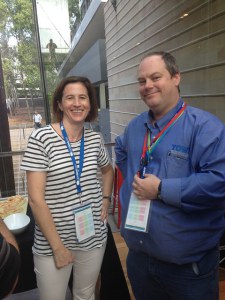 Craig is at YOW! Conference and catches up with Anne-Marie Charrett who is well known in the testing community as a trainer, coach and consultant but also for her support of the community:


 Craig Smith
You must be logged in to post a comment.