Today ‘agile’ is no longer just a buzzword. From building spacecraft to manufacturing, some of the most complex and largest organisations in the world are using agile ways of working to deliver better outcomes, respond to change, improve quality, foster more productive and happier teams, and reduce risk.
This hands-on and interactive session is aimed at helping public sector organisations build capability to support agile ways of working, from policy development through to service design and delivery.
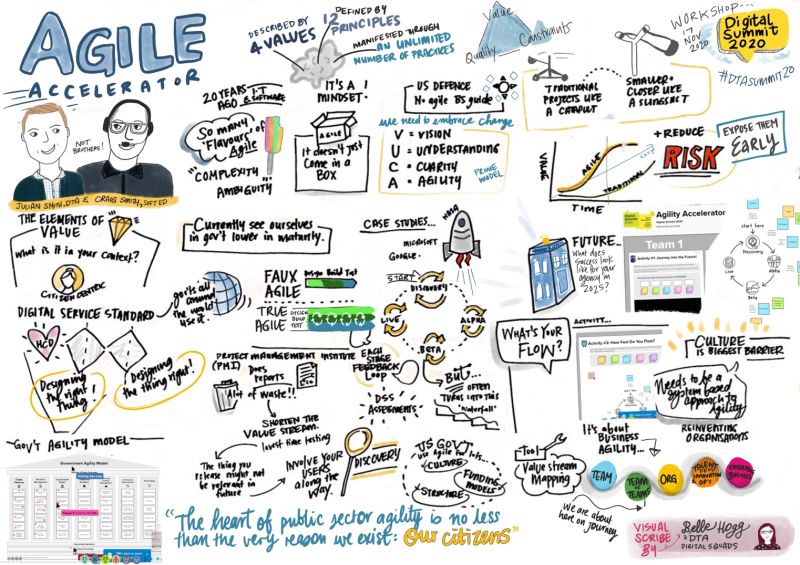
Belle Hogg from the DTA did an amazing job of capturing a visual scribe of the workshop and managed to capture my headset, glasses and lack of hair a little too well!
Communities of practice are about building knowledge, giving people support networks they need to give them the confidence to do their jobs well and making that practice better and as good as it can be
Most communities of practice are organic but they tend to be closed and often lack direction
At the recent YOW! Night in Brisbane (as well and Sydney and Melbourne), Lindsay Holmwood (the Head of Technology at the DTA) presented “Breaking the Cylinders of Excellence”. It was a rare experience to hear the story of how the DTA is using cutting edge development practices to help the government catch up with, and even exceed, the public sector.
DTA – aid transformation in government, small agency
Delivery hubs in Sydney and Canberra – help identify and plug capability gaps in teams
Prototype of how government services could work gov.au/alpha
Digital Service Standard – 13 characteristics on what good looks like in government, useful in organisations as well
Cloud.gov.au – government cloud service, usage growing, continuous delivery pipeline (which is a major change for government who are used to 2 changes per year)
The unit of delivery is the team – not about individuals, but the team – borrowed from GDS
Government is slow, but government is designed to be stable, they cannot fail, they have characteristics that are resistant to change
Myth that organisations must choose between speed and reliability, high performing organisations deploy more frequently, have shorter lead times, fewer failures and recover faster, but they also have a greater profit
Want to deliver like a startup but be stable like a government
Not a lot of cross pollination between departments currently
Read the policy! – quite often the process is not mandated
Document what works and doesn’t so it becomes a repeatable pattern – ie. running a meetup inhouse, don’t tell me I can’t do it, tell me how I can run it without being thrown in jail!
Stick with technologies the government is comfortable with if you are changing the delivery engine
Security matters – prevention is a battle you will always lose, detection is your best defence – aggregate and log in one place, identify threat signatures, etc
Embed security people on big services so it is part of the architecture
Proactive testing between different governments around the world on similar platforms
Simplest security breaches make the most mess – infected excel macros, leaving free USB keys in the foyer that are malware infected
Need to put user needs first – alpha mockup using tools like Jeckyll, then beta then live
Lots of people strictly interpret the design and delivery guides – they are guides not rules!
Create a longer runway by pulling tech forward – turn down the volume of design, turn up the volume of tech
If it hurts, do it more often!
Fixed cost delivery with agile is a thing, agile is a way to de-risk in the government
Don’t put manual testing on the critical deployment path – have special skills on hand for accessibility, performance and security


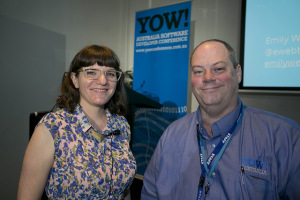


 Craig Smith
You must be logged in to post a comment.