Engineering Culture Trends Report – March 2021 Podcast

In this podcast the Culture and Methods editorial team discuss their views on the current state and trends in the Culture and Methods area that they monitor.  The editorial team consists of Ben Linders, Craig Smith, Doug Talbot, Raf Gemmail, Shaaron Alvares and Shane Hastie. Unfortunately Shaaron was unable to join in the recording, however her perspectives are included in this and in the accompanying trends report article.
Source: Engineering Culture Trends Report – March 2021

Episode 190: Talking Agile Live From The Man Cave with Serge Beaumont

The Agile Revolution's avatarThe Agile Revolution Podcast

Renee, Craig and Tony are together to chat with Serge Beaumont, Principal Agile Coach at Xebia, live from his man cave and despite showing their lack of mathematical skills in relation to dice they chat about:

  • In relation to culture, if the human connections are there you can handle just about anything
  • A foundational cultural aspect at Xebia is that they implemented Xebia Knowledge Exchange (XKE) – every second Tuesday the team has dinner and then has a mini-conference of about 20 streams
  • Xebia were at the foundation of the ING Agile transformation
  • Gloomhaven
  • Rode PodMic
  • You need leadership that truly believes in culture as a powerful thing
  • Renee does story maps like trees and Serge prefers to ensure that he finds his epic on the horizontal slice rather than using the activities on the vertical backbone, building towards an MVP
  • All backlogs should be tree structures
  • An…

View original post 133 more words

Episode 159: What Colour Agile Would You Like Today with Nigel Dalton

The Agile Revolution's avatarThe Agile Revolution Podcast

Craig is at YOW! Hong Kong and is sitting with Nigel Dalton, Chief Inventor at REA Group and the Australian “Godfather of Agile” and they reminisce about:

View original post 529 more words

Culture & Methods – the State of Practice in 2019

The latest Culture and Methods Topic Graph shows the topics that the editorial team feels are gaining traction and should be explored at the beginning of 2019.

  • Several new ideas came into view in 2018, but few from the previous year have managed to jump the chasm to Early Majority adoption.
  • Many organizations are embarking on “Digital Transformations”, often the same ones who have undergone two or three “Agile Transformations” in the past without seeing the promised benefits. We believe that this is because the adoption is often implemented “to pay lip-service” to the idea, and is shallow rather than truly transformational.
  • Pragmatic approaches that mesh ideas from agile, DevOps, Machine Learning and Artificial Intelligence are appearing, and the methodology brand wars are diminishing.
  • “Shift Left Security” is slowly becoming the norm – DevSecOps and variations are bringing compliance and security into the product team rather than seeing these as independent specializations.
  • Organization and culture design continue to be two important pillars for achieving more effective outcomes.  The new models such as Teal Organisations, Sociocracy (and S3), Holacracy are starting to gain more traction but still have a long way to go.

Source: Culture & Methods – the State of Practice in 2019

Episode 155: Continuous Delivery Culture at Pushpay with Ian Randall

The Agile Revolution's avatarThe Agile Revolution Podcast

Craig is at YOW! West in Perth and sits down with Ian Randall, Engineering Lead at Pushpay and co-organiser of the Codemania conference in New Zealand and they chat about:

  • The size of the New Zealand banking system and small number of banks makes it very easy to innovate in the payments space
  • YOW! West talk “From Inception to Production – A Continuous Delivery Story
  • The more times you the do the things that are hard and hurt, opens up the opportunities for automation
  • Blameless Retrospective (John Allspaw, Etsy, 2012) – promise that there will be no retribution or consequence for decisions that anybody made during an incident, they made the best decisions that they knew at the time, they were operating in a system that allowed you to make that system in the moment – therefore means that people are not afraid to make decisions because…

View original post 68 more words

Episode 149: Continuous Delivery with Dave Farley

The Agile Revolution's avatarThe Agile Revolution Podcast

Craig, Tony and honorary Revolutionist Pete Sellars are at YOW! Conference and sit down with Dave Farley, co-author of “Continuous Delivery” and they chat about the following

  • There are anti-patterns with doing XP at scale, continuous delivery was born from the learnings from that
  • Continuous delivery is just extending continuous integration to more of the software development practice (and continuous integration requires test driven development)
  • Continuous delivery works because it is the application of the scientific method to software development
  • If you work in an iterative, imperative, experimental way and you take continuous learning seriously and take cycle time as a serious measurement you will naturally drive out agile, lean, systems theory and DevOps
  • YOW! 2016 presentation “The Rationale for Continuous Delivery
  • Most common two ways to introduce continuous delivery to your organisation – need to get cover from senior management to make change or…

View original post 250 more words

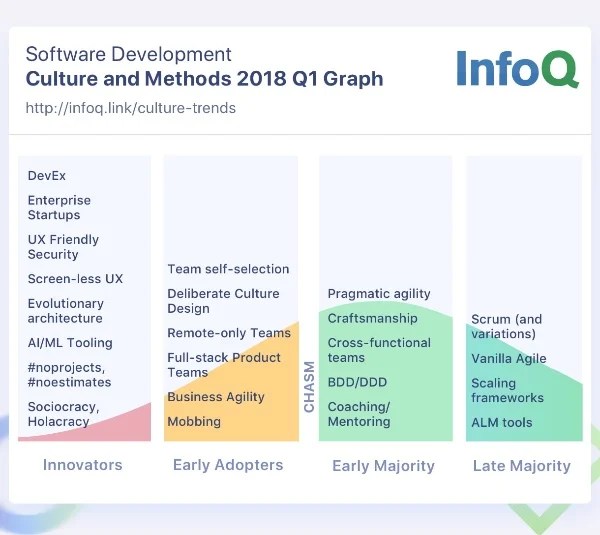
Engineering Culture and Methods InfoQ Trends Report – January 2018

At InfoQ we regularly revisit the topics we focus on based on the technology adoption curve. This article provides a view of the topics which are important to the community at the beginning of 2018.

  • There is no longer a question about should an organisation adopt an agile approach to software development – some form of agile is now the norm for software development
  • Craftsmanship is becoming more prevelant in software development 
  • Culture is recognised as a competitive advantage and an attractor for the best people and teams
  • Distributed and remote teams are becoming the norm
  • Diversity in all its forms matters today
  • Ethics in software engineering will become more and more important
  • Developer Experience and removing friction in the development process makes a difference to productivity and business outcomes

Source: Engineering Culture and Methods InfoQ Trends Report – January 2018

Episode 133: Rules Are For Pussies!

The Agile Revolution's avatarThe Agile Revolution Podcast

Craig and Renee are both in Sydney and catch up around the kitchen table to discuss a bunch of things happening in the Agile universe:

View original post 192 more words

Episode 122: Learning to Learn with Aino Vonge Corry

The Agile Revolution's avatarThe Agile Revolution Podcast

ainoCraig is at YOW! Conference and catches up with Aino Vonge Corry who is one of our very few repeat guests on the Agile Revolution. She describes herself as someone who puts speakers on stage, makes developers communicate and messes with the heads of students!

  • Part of the YOW! conference organising committee
  • Important to find examples that relate to all of the students in the class (not just a subset)
  • Microservice lectures – no more than 15 minutes lecture and then a learning activity
  • If there is interactivity then there is a reason to turn up to a live lecture
  • YOW! 2015 talk “A Comment on How We Learn
  • Need to respect and acknowledge that other people take in knowledge at different paces, this is important in activities that we give people time to think
  • People need to relate ideas to the things they are doing now to take…

View original post 191 more words

Episode 112: Inside Spotify with Anders Ivarsson

The Agile Revolution's avatarThe Agile Revolution Podcast

AndersRenee and Craig are at the Agile Australia conference and talk to Anders Ivarsson, an organisational coach at Spotify, and learn some of approaches that make Spotify tick:

  • Agile Australia talk “Autonomy and Leadership at Spotify” and workshop “Organisational Improvement: Design-inspired Problem Solving”
  • Agile Coaches spend time with squads versus a new role of organisational coach that looks at the culture, ways of working, vision and systemic wastes
  • Spotify is not a model
  • Original Spotify scaling paper, never imagined the spread or the impact
  • Spotify have shared a lot of the things that have worked well, but they do also have challenges as well – one is alignment across teams as the organisation gets bigger so they have been working on visualisation and prioritisation
  • Spotify Culture videos (Part 1 and Part 2)
  • use microservices to ensure that the organisation can work in the…

View original post 93 more words