Recently the Agile Academy decided to get out of running community meetups and hand them back to the community. At the same time, Adrian Smith and I had been talking about the lack of meetup groups in Brisbane. As a result, we took over the established group that existed and created the Brisbane Agile and Lean User Group.
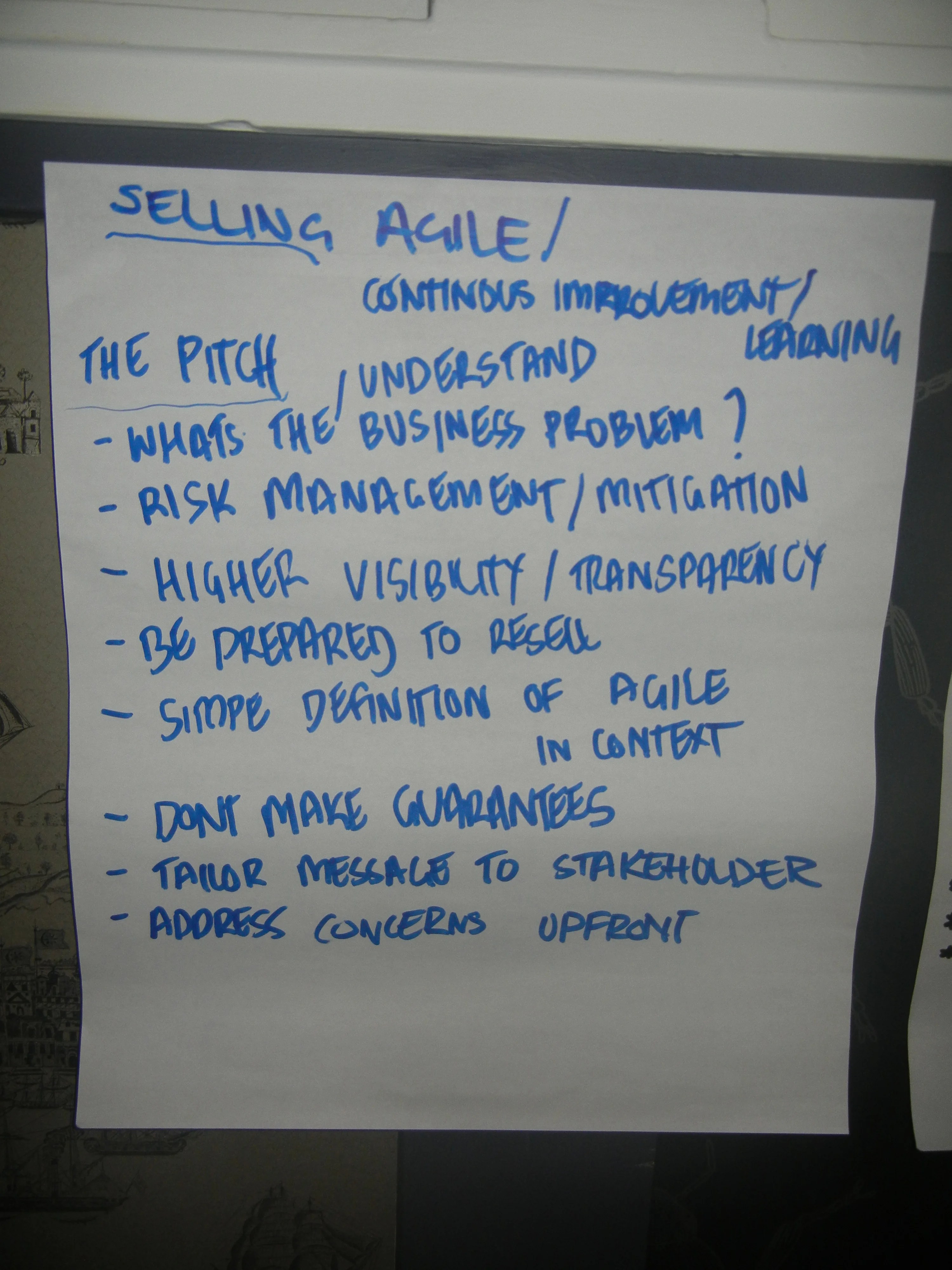
We held our first meeting last week at the Villager Hotel who kindly sponsored the venue and some nibbles. We had about 30 attendees turn up to listen to a discussion about OpenMRS as well as having some group discussions on distributed Agile and selling Agile.
For our first meetup (under our new identity), we are going to run some lightning talks in an open space format. With a number of members having just attended Agile Australia and a long time since our last meetup, we are looking for members to share their stories.
For those that attended Agile Australia, there was a calll to action to support the OpenMRS project (http://openmrs.org/). With groups already kicked off in Melbourne and Sydney it would be great to canvas interest for a similar group in Brisbane.
If you are interested in giving a Lightning Talk please contact us and propose a topic. Alternatively, feel free to speak with us on the night as we setup the agenda.
We are also looking for suggestions on where and where to best host our meetup as well as looking for upcoming topics that the group is interested in hearing or speaking about.
After an overview of the new group and some discussion on potential upcoming topics, Michael Harrison led a discussion with Cathie Hagen on OpenMRS:
We then broke into two groups to talk about Distributed Agile:
The day before the Agile Australia 2012 conference in Melbourne was workshop day, and I presented a couple of sessions as well as sitting in on others. There was a good mix of local talent delivering workshops this year. One of my hopes for next year is to make them inclusive of the conference proper somehow, so more people can benefit from and experience them.
First Steps With Agile
On behalf of the Agile Academy, Rene Chappel and I presented First Steps in Agile to a large enthusiastic class (in fact, the class was four times larger than we were expecting and much larger than the numbers I have had in similar classes for the last few years).
New to Agile and wondering where to start or want to know what all the fuss is about? This workshop will start you on your journey and help you become familiar with the core values and principles of Agile. You will gain an understanding of what is meant by the term ‘Agile’ and learn about some of the key practices and processes of an Agile approach (while having some fun along the way!)
I had one session free and sat in on this session delivered by Jason Yip. The workshop exercises presented scenarios and encouraged participants to practice speaking aloud their process to solving the scenario.
novices understand the formulas but not what is happening
superficial (understand the formula), semantic understanding (understand what is going on), qualitative understanding (know instinctively what is true)
“Think like a Commander” – US Army exercise to expose and correct weaknesses
learning is not a comfortable experience, it is an experience of confusion
sits between classroom study (learning basic concepts) and a full scale simulation (you use your strengths to achieve an aim)
Last year, I attended a 5 day intensive lean course led by the folks at Lean Quest. The course helped cement a lot of my understanding around Lean and here are some of my takeaways from the course:
Culture
the way we execute is the culture we have
culture is how we go about solving problems, the way we do our work every day
organisations tend to fix problems by: avoiding and defelcting blame, adding resources, calling in external resources, organisation restructures, adding new technology and adding a new layer of management
the foundations are our core values and principles as well as our beliefs and assumptions. We can see and observe the norms and behaviours and artifacts. You need to focus on the bottom and the top will take care of itself
“you can only see what you can see, you can’t see what’s inside”
leaders doing things different will change the culture, need to create an environment where everyone can be successful
catastrophes are made up of little problems that are allowed to slide by – it takes 7 problems to happen simultaneously for a plane to crash
lean has 3 core values – customer first (start with the customer and optimise the process for the next process), respect for people (engage and enable people, value people over process) and continuous improvement (a thirst for perfection, fix your own work / area)
true north – don’t need to get to perfection, but continually heading there
lean principles – standardised work, just in time, problem solving, built in quality, visual techniques, culture
break the process – by increasing the measure, will expose more problems
Capability 1: Design and Operate Work to Reveal Problems
every problem is an opportunity
failure is word that people feel uncomfortable with
fail quick and often versus do it right the first time
reveal problems for the level you control – need to be able to measure this
quality starts with the customer (ask them)
add quality to the discussion, add value to the conversation
quality check at the end, adds no value to the customer
pathways break down with the connections between them
use visual queues, they are all over the place – red line to get to emergency in a hospital, lines in a carpark
work is three categories – value added work (something a customer is prepared to pay for – 3% – 4% on average, if you changing fit, form or function you are adding value), incidental work (needs to be done but the customer does not care) and waste (unnecessary activities in the process)
continuous improvement to reduce waste and incidental work in a process
7 wastes – inventory, motion (of the person), material movement (of the product), rework, over processing, waiting, over-production (the worst waste because it hides the other wastes)
we want problems to surface so we can see them and fix them
Capability 2: Contain and Solve Problems Close in Person, Place and Time
if you reward fire fighters, you get arsonists…
we don’t teach people how to solve problems very well
everytime you problem solve you are making a little more time for yourself
a problem is a gap between the expectation and the current state, the key is to set the standard , if you don’t have a standard you don’t have a gap
keep lowering the water level and/or raising the standard
start with where you are today and measure variation to the standard
PDCA – Plan, Do, Check, Act (Deming wheel)
7 step problem solving process (1. define the problem, 2. grasp the situation, 3. plan, 4. do, 5. check, 6. act, 7. conclusions and lessons learned)
A3 – used to document the journey in the most concise form possible
project charter – an improvement project that is a break from operations
use a SIPOC+M to grasp the situation or to assess the future state, want to create a SIPOC+M for the repeatable steps (there should not be 100’s of these)
SOP – Standard Operating Procedure – leverage SIPOC+M and process flow diagrams
use a standard A3 format for reading and reviewing efficiency
leaders need to understand the job – need to study it and be able to improve it
Capability 4: Leaders Coach and Develop the Previous Capabilities
traditional organisations manage people and results, high performing organisations manage processes
Craig and Renee are at the Agile Australia 2012 conference speaker breakfast where they discuss the workshop day, the upcoming conference and their respective talks and a Lean Startup story about monkeys and bananas.
Agile adoption in Australia and across the world is now becoming more mainstream and, as a community, we are struggling to address the issue of how to take experienced Agile practitioners to the next level, while still supporting those who are beginning their journey. With the “agile” word getting so overloaded, the challenge is to continually innovate without assigning labels or losing focus on our prime objective – to deliver!
Join Craig Smith with Nigel Dalton, Simon Bristow and David Joyce (on the couch) as they explore different viewpoints on all things Agile – then, now and future!
Some of the comments on Twitter included:
@jchyip: #adapt discussion is similar to our Agile cult discussion at this morning’s Lean Coffee. #agileaus
@carolineggordon: Issueing a challenge to the women in the audience at the panel, I want to see one of us up there next year #agileaus — #deliver
@stephlouisesays: Always look forward to hearing @smithcdau at #agileaus -didn’t disappoint! Valuable messages and images that make you think (and giggle!)
@lukasm: Great start to #agileaus Inspiring talk by Dr Fiona Wood followed by a thought provoking panel on where agile is, has been, and going.
The Agile Coach is a critical role in helping leaders, teams or individuals understand, adopt and improve Agile methods and practice. Additionally, an Agile Coach helps people rethink and change the way they go about their work. For a individual to be effective in a coaching role, they must poses a wide range of skills and experience. In this workshop we will explore Agile coaching skills in the context of a competency framework and provide participants with lessons from real-world coaching experience. The workshop will provide an opportunity for participants to learn about coaching, identify areas of Agile development and to broaden skills through hands-on group and individual exercises and games.
You will:
» Understand role of an Agile coach and the typical development pathways
» Identify personal areas of strength/weakness in relation to a broad range of Agile and related skills
» Learn situational specific coaching techniques for common Agile dysfunctions
» Understand the use of maturity models in helping teams learn and adapt to Agile
» Understand organisational and role specific Agile challenges
» Learn how to adapt Agile practices to suit team specific challenges
“The aim for any company is for everybody to gain – shareholders, employees, suppliers, customers, community, the environment – over the long term” – Deming
The myth "if you can’t measure it, you can't improve it" is easy to bust. Babies learn to walk without metrics.
I first started using Yammer back in 2009 after hearing about it winning TechCrunch50, and was user number 1 on our company domain (now we have thousands of users). Its been interesting to see the organic growth from the first time I used it (I had nobody to talk to), to a community of early adopters (who treated it like a corporate Twitter) to its usage now as an important communication channel and groupware solution.
My colleague and friend Teale Shapcott arranged the guys at Yammer to come into our organisation last week to give a bunch of people an informal train the trainer session on “Yammer – Getting Started with Groups”. Steve Hopkins and Ross Hill conducted the session, and here are my notes:
Metcalfe’s Law essentially confirms that things get more useful the more people you have in the group
the problem with email is that if you send an email to 12 people, you get 12 responses!
a Yammer group is an way to replace email in a team (basically an easy way to setup a distribution list)
Yammer are currently launching new things to the site every week
Yammer recently acquired oneDrum. Essentially what this will do is put a Yammer folder on your desktop for Office integration, as well as being able to follow files and get updates when things change.
The point of the training was to help get people using Yammer for collaboration. A good exercise to start is get people to log into Yammer (set up a private group for training) and get people to say hi. Next get people to enter what they are currently working on and then get everybody to respond on others posts to get people familiar with the value of the tool.
Pages are a new feature:
pages are a good way to collaborate and brainstorm on ideas
pages can have 10 editors maximum at the same time. It will auto save. When you publish it will notify all the followers that there is a new draft. You can revert back to old versions
pages are useful for meetings, use an iPad and throw the notes or actions up on a page, you can link actions to people or files as well
coming soon is the ability to mark a page as official
documents don’t need to be run by any person specifically, they are now crowd sourced
groups are like rooms in a house
One thing that is new that I did not know about is that you can now use the share feature to share a message across groups (you used to have to duplicate the message).
In the session, one of the other participants shared their approach to getting their team to use Yammer:
they created a new private collaboration group
it took a conscious effort to use yammer by getting the leader to share things on Yammer, this took a few months
they have seen a massive reduction in email but communicating a lot more
they also created a larger department group as well
gains comfort for people using a team group rather than the All Company feed or a public group
takes time to get the comfort up and you have to make enemies
people for the most part are learning something new
you need leadership and you need to take a hard line about just using Yammer
use followed conversations mode, set their preferences to only follow groups that I follow as it removes the noise – everything you see should be relevant, you also need to clean up the feed and email notifications settings for them
update the information tab and use it for information and quick links
needed to be hardcore and had to keep asking “are you logged into Yammer” in order to cement the habit
direct people to engage with your content, rather than just posting something
use announcements to get everybody in the group
get people to follow a hash tag for things like events
Generation Y folks are good advocates to get on side
As a second exercise, we then created a page and collaborated on out own checklist of an approach and tips to setting up a group. Many of the participants (who I assume were not familiar with wikis or collaborative tools like Google Docs were in awe of seeing people collaborating at the same time).
When introducing groups, you are bound to get resistance, so the Yammer has a bunch of great case studies that cover lots of different team types.
Another use, relating this back to Agile, is one team were using it for showcases by doing a live webcast and getting people to comment on Yammer (also the posting the video to Yammer so people could talk about it later as well). In the vain of standup, another organisation would, on a Monday, start a post on what are you working on this week. There are lots of potential usages for the features of Yammer for distributed teams. Another suggestion was to organise in everyones calendar a YamJam to discuss something on Yammer a a certain time.
Finally, there are a lot of Australian companies using Yammer, and the following videos are worth a look.
So there have been a lot of posts out there about Moneyball and how it directly relates to Agile and the Lean Startup. However, I finally got around to watching the move tonight (thanks to my colleague Renee Troughton for lending me the Blu Ray) and had to note down my own thoughts. There are so many good quotes and scenes from the movie, but here are just a couple of standouts (warning, some folks may consider these to be spoilers if you have not seen the movie!)
Right at the start of the movie Billy Beane is talking to the team owner about needing more money (sounds like the start of any typical traditional project to me!)
Billy: I can’t compete against a hundred and twenty million payroll with thirty eight million dollars. Schott: We’re not gonna compete with these teams that have big budgets. We’re gonna work with the constraints that we have and you’re gonna get out and do the best job that you can recruiting new players. We’re not gonna pay seventeen million dollars a year to players.
And a little later in the scene, Billy sets his goal.
Billy: That’s my bar. My bar is here. My bar is to take this team to the championship.
At the scout’s meeting, their discussion is all about appearances rather than understanding and building a team.
Scout: Ugly girl friend means no confidence.
In that same meeting, I really enjoyed the scene where Billy is in the position of a coach/facilitator and keeps asking them if they understand the problem!
Grady: We’re trying to solve a problem here. Billy: Not like this you’re not. You’re not even looking at the problem. Grady: We’re very aware of the problem. Billy: Okay, good. What’s the problem? Grady: Okay, Billy. We all understand what the problem is. We have to replace… Billy: Good. What’s the problem? Grady: The problem is we have to replace three key players. Billy: No. What’s the problem? Poloni: Same as it’s ever been. We’ve gotta replace these guys with what we have existing. Billy: No! What’s the problem, Barry? Barry: We need three eight home runs, a hundred twenty R.B.I’s and forty seven… Billy: Aaahhh! The problem we’re trying to solve is that there are rich teams and there are poor teams, then there’s fifty feet of crap, and then there’s us. It’s an unfair game. And now we’re being gutted, organ donors for the rich. Boston has taken our kidney’s, Yankees takin’ our heart and you guys are sittin’ around talkin’ the same old good body nonsense, like we’re selling deeds, like we’re looking for Fabio. We got to think differently!
A little later in that scene, Billy is really trying to make the committee think differently, but they are just thinking in the same old ways.
Billy: If we try to play like the Yankees in here, we will lose to the Yankees out there Grady: Boy, that sounds like fortune cookie wisdom to me, Billy. Billy: No, that’s just logic.
I really liked the scene where Billy is talking with Art about his contract. The final line of the conversation reminded me of many wasted meetings.
Billy: Good meeting. Everytime we talk, I’m reinvigorated by my love of the game.
And then there are always the nay-sayers and (in the case of Grady) those who will always try to bring your approach down.
Announcer: Do you see this as a decimation of the whole team? Grady: I think that he bought a ticket on the Titanic. Announcer: Oh, boy! He’s tried to come up with a new approach, my hat’s off to him. It won’t work.
The discussion between Billy and Peter about cutting players was a good reminder of being honest and transparent.
Billy: They’re professional ball players. Just be straight with them. No fluff, just facts. ‘Pete, I gotta let you go. Jack’s office will handle the details.’ Peter: That’s it? Billy: Would you rather get a bullet to the head, or fire to the chest or bleed to death? Peter: Are those my only two options?
There was an interesting little scene regarding soda, that is a good reminder that sometimes you can be penny smart but pound foolish (the little things are sometimes what keeps individuals and teams motivated).
Justice: And how come soda is a dollar in the club house? Cause I’ve never seen it like that. Peter: Billy likes to keep the money on the field. Justice: Soda money? Really? Where on the field is the dollar I’m paying for soda?
The scene where Billy shakes up the team by firing some of his all-stars was the turning point that shows that sometimes your superstars are hiding the real talent (and sometimes you need to do something extreme to make a change). Art is the classic Project Manager in this scene.
Art: Yeah, I don’t wanna go through team rounds, Billy. The line up card is mine. And that’s all, okay? Billy: The line up card is definitely yours, I’m just saying you can’t start Pena first. Art: Well, I am starting him at first. Billy: I don’t think so, he plays for Detroit now.
There are some good inspirational pieces in the film (like when Billy asks Justice to step up and be a leader for the younger guys). This quote is my favourite though.
Billy: Everybody, listen up! You may not look like a winning team, but you are one. So, play like one tonight.
The big speech when Billy is at the Red Sox resonates with anybody who has tried to implement Agile in a team before.
For forty one million, you built a playoff team. You lost Damon, Giambi, Isringhausen, Pena and you won more games without them than you did with them. You won the exact same number of games that the Yankee’s won, but the Yankee’s spent 1.4 million per win and you paid 260 thousand. I know you’ve taken it in the teeth out there, but the first guy through the wall. It always gets bloody, always. It’s the threat and not just the way of doing business, but in their minds it’s threatening the game. But really what it’s threatening is their livelihoods, it’s threatening their jobs, it’s threatening the way that they do things. And every time that happens, whether it’s the government or a way of doing business or whatever it is, the people are holding the reins, have their hands on the switch. They will bet you’re crazy. I mean, anybody who’s not building a team right and rebuilding it using your model, they’re dinosaurs. They’ll be sittin’ on their ass on the sofa in October, watching the Boston Red Sox win the world series.
Near the end, when Peter shows Billy the video about the guy hitting the home run, they starting mentioning metaphors (I was so thinking about the metaphor in XP at that point!)
Also, the Lenka song “The Show” made me think about why as Agile coaches we get up in the morning and do this (plus good to see Australian music in the movie!)
I am just a little lost in the moment
I’m so scared but I don’t show it
I can’t figure it out
It’s bringing me down I know
I’ve got to let it go
And just enjoy the show
For those who haven’t seen the movie, it is well worth the time spent. I hadn’t realised Aaron Sorkin had worked on the screenplay, so for that alone it had to be good!
 Recently the Agile Academy decided to get out of running community meetups and hand them back to the community. At the same time, Adrian Smith and I had been talking about the lack of meetup groups in Brisbane. As a result, we took over the established group that existed and created the Brisbane Agile and Lean User Group.







 Craig Smith
You must be logged in to post a comment.