 David Mole talks about implementing Spotify inspired squads and tribes at Trade Me, as well as the results of experiments in self-selection of teams and inspiration from the work of Daniel Pink.
Agile

Mik Kersten on Current and Future ALM Trends
Mik Kersten talks about current and future trends in ALM and the support for approaches like large scale Agile, DevOps, Docker, Big Data, functional languages and the Internet of Things.

Bas Vodde and Craig Larman on Large Scale Scrum
Bas Vodde and Craig Larman talk about Large Scale Scrum (LeSS), its origins, and the focus on simplicity, as well as the corresponding website and their new book “Large-Scale Scrum: More with LeSS”.

Adam Weisbart on Improv, Magic and Fun on Agile Teams
 Adam Weisbart talks about using improv and magic to make Agile more fun and shares a bunch of practical tools and resources that should be of interest to anybody leading or coaching an Agile team.
 Source: Adam Weisbart on Improv, Magic and Fun on Agile Teams
Episode 97: 3 Things, 3 Letters (Git, CTO, MBA) with Peter Bell

 At YOW! Conference, Craig has a chat with Peter Bell, a contract member of the GitHub training team, co-founder of CTO School and the founder of the Startup CTO Summit series and they talk about approaches to learning Git, building better CTO’s and digital literacy for MBA’s.
- YOW! 2014 talk “How To Undo Almost Anything with Git“
- Balance the appropriate batch size for communicating with your team the work you have completed versus the appropriate batch size for if you mess up you can easily go back – this is typically 2-10 lines of code to the local repository
- Most teams just need a master branch that is always releasable and all work done on feature branches that are merged into master
- training.github.com – training options and a number of great resources
- Learning Git – not easy to learn on the job, balance of basic how to use…
View original post 231 more words
Jeff Patton on User Story Mapping and Product Management
Jeff Patton talks about his book “User Story Mapping” and the background and approaches to the story mapping process as well as upcoming trends in relation to product management.
 Source: Jeff Patton on User Story Mapping and Product Management
Impact Feedback and Finding the Right Word
 When attending the Coaching Agile Teams class with Lyssa Adkins and Michael Spayd earlier in the year, one of the new concepts (at least I don’t remember it from the previous class I did back in 2013) was the idea of “impact feedback”. Simply put, impact feedback is a mechanism to give feedback to someone with a focussing on how that action impacted you. It is also a great mechanism to ensure that your are not leading the person to the solution, rather helping them see the outcome from a different perspective.
The template for impact feedback is:
When you did / said ……… the impact on me was ………
However, one of the difficulties with this technique is often knowing the right word to say. One of my colleagues from my Agile Coaching Competence Cohort program, Jessica Katz, shared this great little tool for knowing the right word to say to describe your impact emotion.
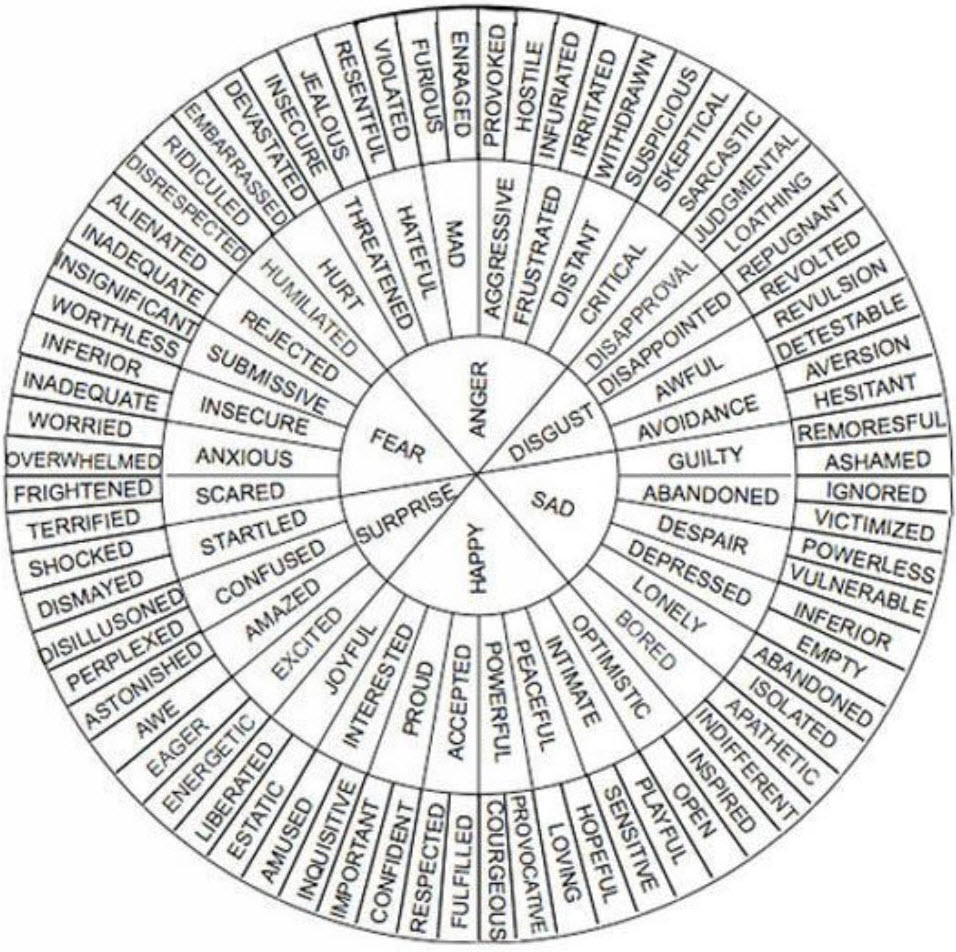
It is called the Wheel of Words, it’s exact origin is not clear, although I found it in an article about emotional copywriting as well as an article about vocabularly expansion of English.
Obviously there are other uses for this tool in coaching conversations as well as discussions, presentations, training and general writing,
Episode 96: YOW! 2014 Brisbane Vox Pop
 Clearing out the backlog, Craig and Tony roam the corridors at YOW! 2014 in Brisbane and talk to attendees and old friends and colleagues. Despite Tony’s fetish with pineapples and the fact it took 96 episodes to get a mention of ISO-9126 they talk to:
- Craig Aspinall on hosting the highly rated talk by Troy Hunt on “Hack Yourself First” and Peter Bell on “How to Undo Almost Anything with Git” and that listening to security talks is like watching horror movies, completely terrifying and entertaining at the same time!
- Jason Royals and Carlo Simbag on cheesecake and great talks by Troy Hunt, Jez Humble, Gojko Adzic and Gabrielle Benefield
- Andrew Newman on using Scala in the enterprise, keynotes from Martin Thompson and Todd Montgomery as well as Ed Kmett
- Sharon Robson on using Agile at Tatts Group, her favourite standard ISO-9126, Boehm’s Quality Tree, getting…
View original post 92 more words
Impact Map Cheat Sheet
I had to facilitate a couple of workshops in the last couple of days where impact mapping would potentially prove to be a good tool to drive the discussion (and for one of them it did). I have done a number of impact maps over the years but often in the heat of the moment I have a memory blank on what order the map goes in or how best to describe what each of the stages are. So today I knocked together a pocket cheat sheet for me to refer to if I needed it:
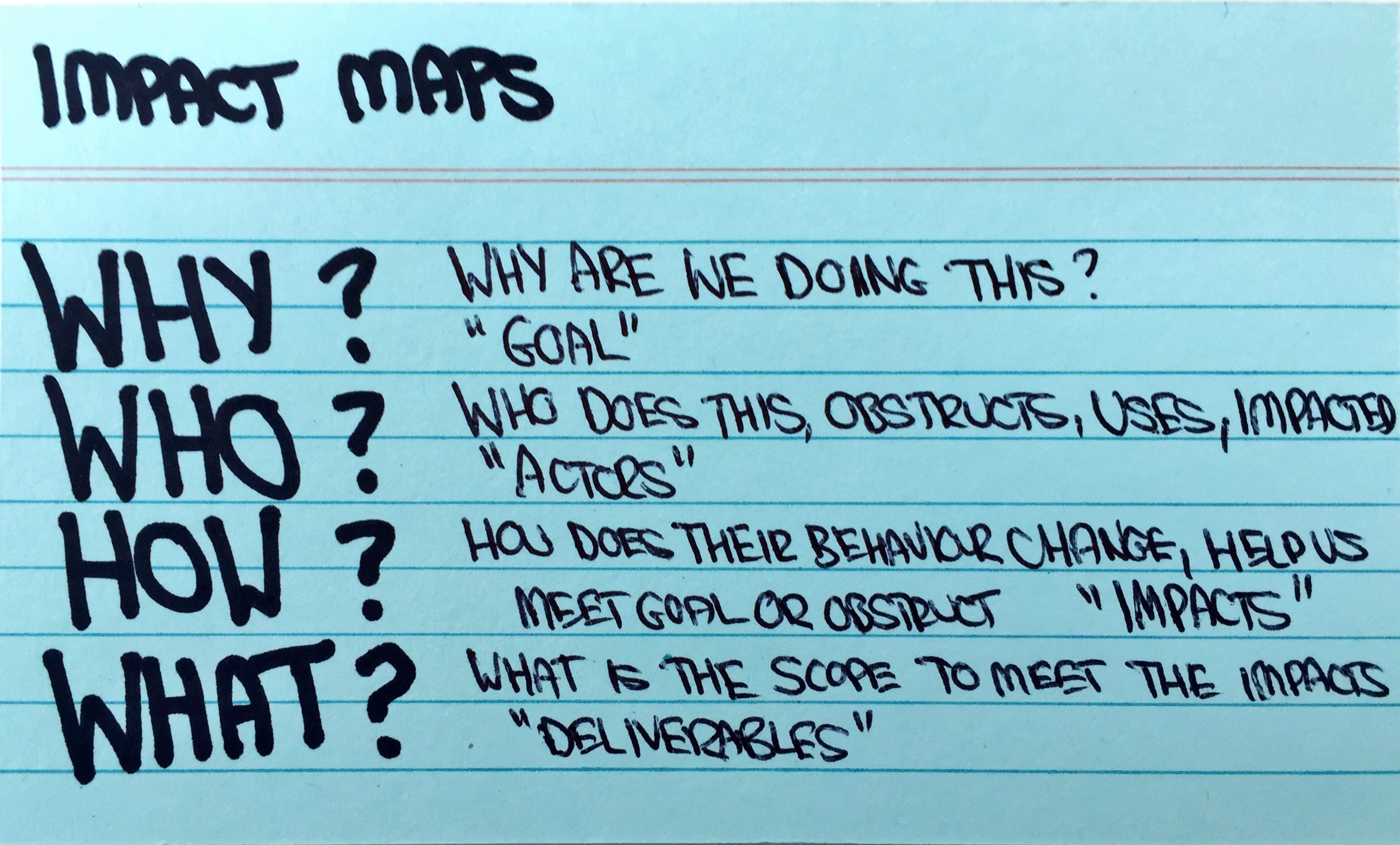
Depending on the workshop often depends whether I use the classic mind map style or just use a left to right grid using post-it notes.
Sanjiv Augustine on Scaling Agile, No-Management and Agile 2015 Executive Forum
Sanjiv Augustine talks about his new book “Scaling Agile: A Lean JumpStart”, reinventing organizations and the implementation of no-management at LitheSpeed and the Agile 2015 Executive Forum.
 Source: Sanjiv Augustine on Scaling Agile, No-Management and Agile 2015 Executive Forum
 Craig Smith
You must be logged in to post a comment.