
 Craig is in Dallas, Texas, USA at the Agile 2012 conference. Today was day 0 and the annual AA-FTT workshop.
In-depth notes can be found on Craig’s blog.
TheAgileRevolution-39 (8 minutes)
Craig is in Dallas, Texas, USA at the Agile 2012 conference. Today was day 0 and the annual AA-FTT workshop.
In-depth notes can be found on Craig’s blog.
TheAgileRevolution-39 (8 minutes)
 The Agile Alliance Functional Testing Tools (AA-FTT) workshop was held on the day before the Agile 2012 conference in Dallas, Texas. Run as an open space, the session was open to anyone interested in talking about the future of functional testing tools and beyond.
Source: Agile 2012 Session: Agile Alliance Functional Testing Tools Workshop

The Agile 2012 conference kicks off this week at the Gaylord Texan Hotel and Convention Center in Grapevine, Texas (just outside of Dallas). Over 1,500 people from around the world are expected to attend what is considered to be the premier international Agile conference, hosted by the Agile Alliance.
Source: Agile 2012 Conference Kicks Off in Dallas – Coverage on InfoQ
 This is a special mashup episode recorded in Auckland, New Zealand. Craig catches up with Mark Derricut from the Illegal Argument podcast and Craig Aspinall from the Coding By Numbers podcast. Not your usual Agile podcast, the discussion starts around the definition of Agile (“crash often, crash regulary”) and trying to define quality and ends up in a chat about wicked problems, devops and software development skillsets.
This episode has been released on the other channels as well (take a listen if you haven’t already)
TheAgileRevolution-38 (67 minutes)
 Craig and Renee take a revolutionary tour of Sydney and speak to Jeremie Benazra and Dominic Franco about the Agile work that they are doing in Australia’s big city including Kanban, cultural differences, safety and edgy Agile.
TheAgileRevolution-37 (26 minutes)
 Craig, Renee and Tony talk about Fed… no, Ship It! days, recent changes to Yammer and LinkedIn and the 10 agile bloggers you should know about. We also review Tony’s recent excursion to BA World and Renee’s journey to KLRAT and ponder just why Tony has such an obsession with pants…
Quotes:
View original post 73 more words
 Day 2 of Agile Australia 2012, and another busy day of MC’ing and attending sessions.
The first (hastily rescheduled) keynote session was from Roy Singham from ThoughtWorks.
 |
| From Agile Australia 2012 |
The second keynote was supposed to be Mark “Bomber” Thompson from the Essendon Football Club but he was an unexplained no show. After an impromptu thankyou speech from me and breaking the conference for an early break, James Hird arrived to substitute and did an impromptu talk. As a result of the scheduling changes, I unfortunately did not get to see much of either session.
 |
| From Agile Australia 2012 |
I sat in the back of this session delivered by Ed Cortis from Lonely Planet. His slides are available here.
 |
| From Agile Australia 2012 |
I was MC for this session delivered by Matthew Hodgson from Zen Ex Machina. He gets extra marks for working Doctor Who and bow tie references into the talk. His slides are available here.
 |
| From Agile Australia 2012 |
I was MC for this session for Kristan Vingrys from ThoughtWorks. I have known Kristan for a number of years, and I resonate very closely with his views on testing and testers. His slides are available here.
 |
| From Agile Australia 2012 |
I was MC for this session delivered by Julian Boot from Majitek. This was one of the highlight sessions that I attended at the conference and as I remarked when thanking Julian, it reaffirmed how much I don’t know about good design. His slides are available here.
 |
| From Agile Australia 2012 |
I was MC for this session led by Kelly Waters from ThoughtWorks and author of the All About Agile blog. I unfortunately did not get to see much of this presentation, the slides for which are available here.
 |
| From Agile Australia 2012 |
I was MC for this session delivered by Tony Young from Integrated Research. This session was designated as “Expert” but there is nothing in this that I could see that made it that level. His slides are available here.
 |
| From Agile Australia 2012 |
One of my colleagues who presented a talk on day 2 was Colin McCririck (who is the Executive Manager of a team I coached for some time) and he spoke on Leadership Secrets for Agile Adoption).
Rosie X recorded an interview with me during the conference which was a lot of fun.
Renee Troughton and I took some time out from talks to record a podcast interview with Ilan Goldstein for the Agile Revolution.
Renee also recorded a podcast with Kim Ballestrin on Cynefin.
We also recorded a wrapup podcast.
I also did some short interviews for InfoQ, which resulted in a wrap-up story.
Agile Australia 2012 was held a few weeks ago at the Hilton on the Park Melbourne in front of a record (and venue busting) 850 attendees. This year I had the privilege of being a plenary session host and speaker, present at two workshop sessions and be an MC at a number of different sessions.
Furthermore, I was a member of the advisory committee with the role of program overview along with the usual duties of reviewing and shepherding conference speakers. This year the review process was open to comments and voting from the community and overall I think we ended up with a good mix of proposals.
With all my duties I was quite busy this year, but here are my notes from day 1.
Dr. Fiona Wood, Plastic Surgeon and Director of the WA Burns Unit, was the keynote speaker and undoubtedly for many people was the highlight of the conference. The advisory committee (and particularly Martin Kearns) had been aiming to get somebody from the medical profession for a couple of years, and her talk was nothing short of inspiring.
 |
| From Agile Australia 2012 |
Following on from Dr. Fiona Wood was a tough act, but in front of 850 I took the stage with Nigel Dalton, David Joyce and Simon Bristow to deliver this session. The slides are available in a separate post.
 |
| From Agile Australia 2012 |
 |
| From Agile Australia 2012 |
Bram Surti and Rob White from BNZ delivered this session. Essentially I was interested to see if they did anything different to what I had already tried myself in this space. Sadly, I didn;t learn much new, but I was pleased to see they were using a lot of the same tools and approaches that I had used myself in this space. Their slides are available here.
 |
| From Agile Australia 2012 |
I was MC to this session by Sarah Taraporewalla from ThoughtWorks, her slides are available here.
 |
| From Agile Australia 2012 |
I was MC for this session delivered by Perryn Fowler from ThoughtWorks. I had high hopes for this talk as Kanban is still not well understood in the wder community. It covered a lot of good topics (and, as he stated at the top, the talk was the thoughts of Perryn), but it fell victim to running out of time for the meaty stuff and unfortunately was a little rushed at the end. Furthermore, his slides do not seem to be available either.
 |
| From Agile Australia 2012 |
I was MC for this session delivered by Sandra Dalli and Sarah McAllister from BankWest. I really enjoyed this session. They kicked off the session with a great video with music and time lapse pictures (unfortunately it does not seem to be available publicly). Most enjoyable was their honesty about their journey and this mistakes they made along the way (they started by spending three months in a cubicle writing a document about Agile!). It also appears that their slides are not available currently.
 |
| From Agile Australia 2012 |
I was MC for this session for Tom Sulston from ThoughtWorks. The highlight of this talk was the fail cake! His slides are available here.
 |
| From Agile Australia 2012 |
I was thrilled to be MC to Phil Abernathy (he was my MC last year and I have worked alongside him for a number of years). He had a great set of slides at the start of this talk to illustrate his experience. Given I knew the content of this talk quite well I did not take any notes, but I did like his analogy around the $100 strategy (for every $100 spent, where did it go – pull the strategic levers to figure out where you can change, these become your strategic programs). His slides are available here.
 |
| From Agile Australia 2012 |
At the beginning of the day, IBM sponsored a speakers breakfast, and they recorded an Agile song called “Wake Up To Jazz” (video and audio).
At the same time, Renee Troughton and I took the opportunity to record a conference kickoff podcast for the Agile Revolution.
Some of my colleagues presented talks on day 1 including Dipesh Pala (Easy Ways to Break Up) and Renee Troughton and Paul Watson (Panel: Agile Governance – The New Disinfectant).
The night wrapped up with a student event called Activate Agile. I sat in the back of a number of presentations, with the standout for me being being an overview from Andy Sheats about their journey at health.com.au.
 Renee, Craig and Ilan Goldstein talk at Agile Australia 2012 about Scrum Masters, conferences, writing a book and the state of Agile amongst other things.
Ilan is the Director at AxisAgile, and he is the author of the Scrum Shortcuts Without Cutting Corners blog. He is currently writing a new book with the working title “Scrum Shortcuts Without Cutting Corners” for Addison Wesley as part of the Mike Cohn Signature Series.
TheAgileRevolution-35 (33 minutes)
 Recently the Agile Academy decided to get out of running community meetups and hand them back to the community. At the same time, Adrian Smith and I had been talking about the lack of meetup groups in Brisbane. As a result, we took over the established group that existed and created the Brisbane Agile and Lean User Group.
We held our first meeting last week at the Villager Hotel who kindly sponsored the venue and some nibbles. We had about 30 attendees turn up to listen to a discussion about OpenMRS as well as having some group discussions on distributed Agile and selling Agile.
For our first meetup (under our new identity), we are going to run some lightning talks in an open space format. With a number of members having just attended Agile Australia and a long time since our last meetup, we are looking for members to share their stories.
For those that attended Agile Australia, there was a calll to action to support the OpenMRS project (http://openmrs.org/). With groups already kicked off in Melbourne and Sydney it would be great to canvas interest for a similar group in Brisbane.
If you are interested in giving a Lightning Talk please contact us and propose a topic. Alternatively, feel free to speak with us on the night as we setup the agenda.
We are also looking for suggestions on where and where to best host our meetup as well as looking for upcoming topics that the group is interested in hearing or speaking about.
After an overview of the new group and some discussion on potential upcoming topics, Michael Harrison led a discussion with Cathie Hagen on OpenMRS:

We then broke into two groups to talk about Distributed Agile:

Here is the output:

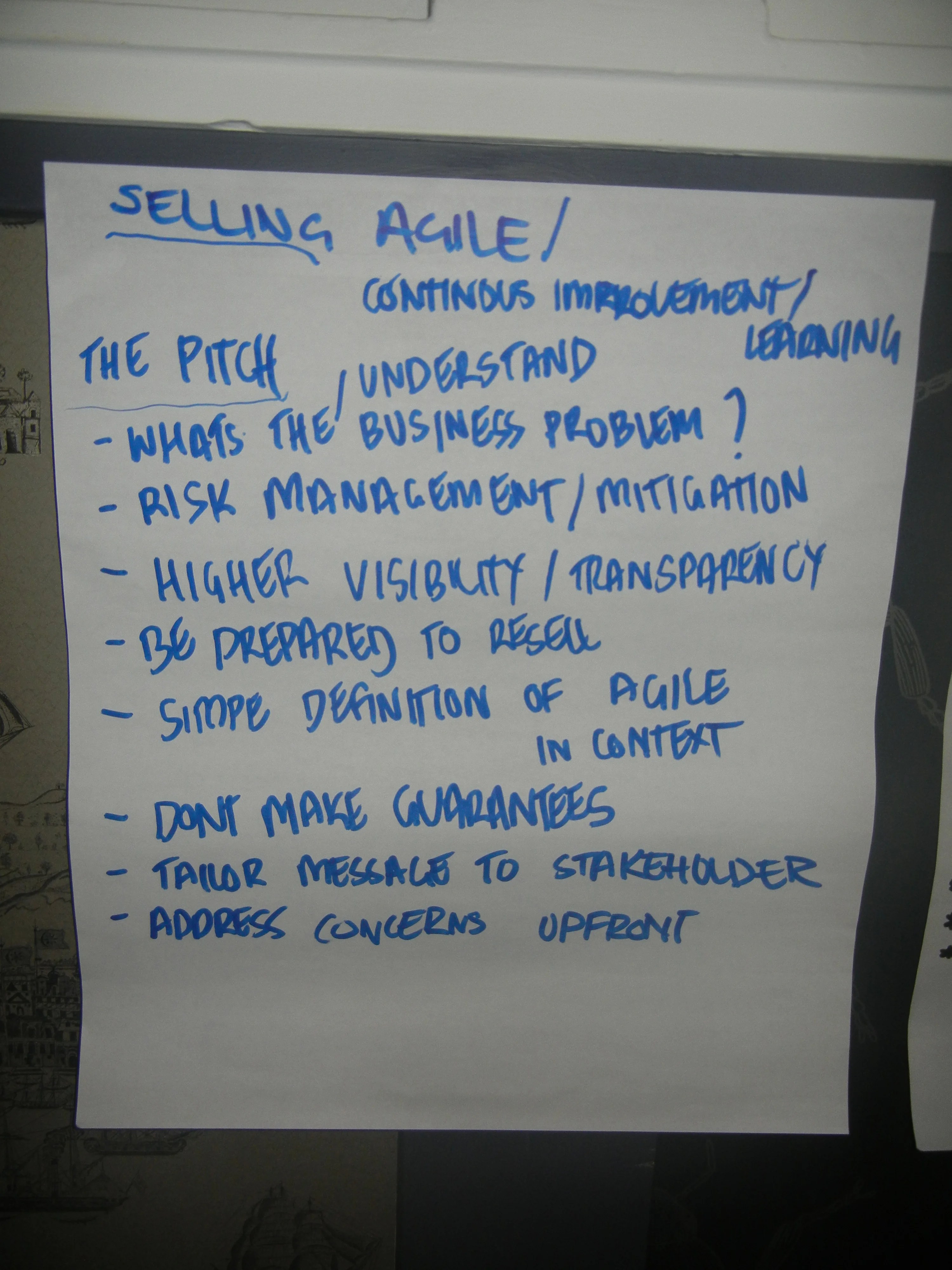
The other group talked about Selling Agile:

Here is the output:
 Craig Smith
You must be logged in to post a comment.